


More than 4,000 people were evacuated yesterday in areas of northern and eastern Taiwan as Typhoon Dujuan approached the nation, gathering strength as it bore down on the east coast.
The military, working with local governments, evacuated people from areas vulnerable to falling rocks, mudslides and flooding in 39 townships and districts in Yilan, Hualien, Taitung, Hsinchu and Nantou counties and Taipei and New Taipei City.
New Taipei City Mayor Eric Chu (朱立倫) said the vulnerable areas include Wulai District (烏來), which was hit hard by Typhoon Soudelor last month, with some residents unable to return home for weeks. Most shops and hotels in the hot springs town remain closed as roads and flood damage are yet to be fully repaired.
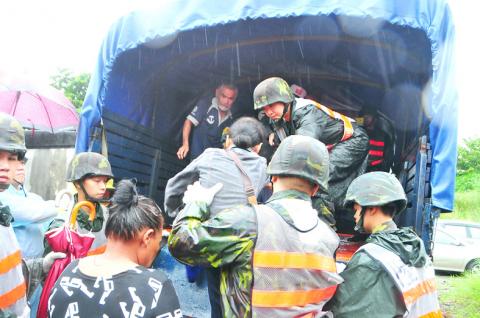
Photo: Hua Meng-ching, Taipei Times
“To be honest, we all feel very depressed. Any damage might further prolong the time needed for reconstruction,” said Chou Chih-kang, an Wulai neighborhood leader.
Television footage showed fast-moving flood waters swamping roads just outside Taipei and huge waves crashing against the northeast coastline.
Taipei 101 also reported that one of the glass doors to the underground portion of its mall was damaged by a strong gust of wind, but it had been repaired by the evening.
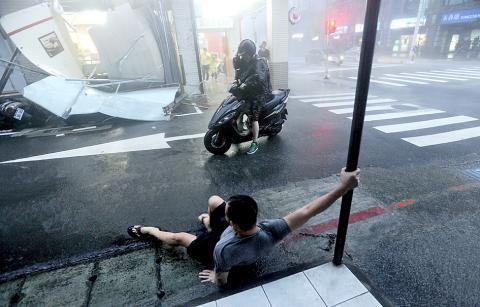
Photo: Lin Cheng-kung, Taipei Times
As of 7pm last night, the Central Emergency Operation Center said no injuries had been reported.
A total of 937,900 households nationwide lost power at some point during the day and as of 7:20pm, 532,800 households were still waiting for power to be restored, mostly in Yilan County and Taichung.
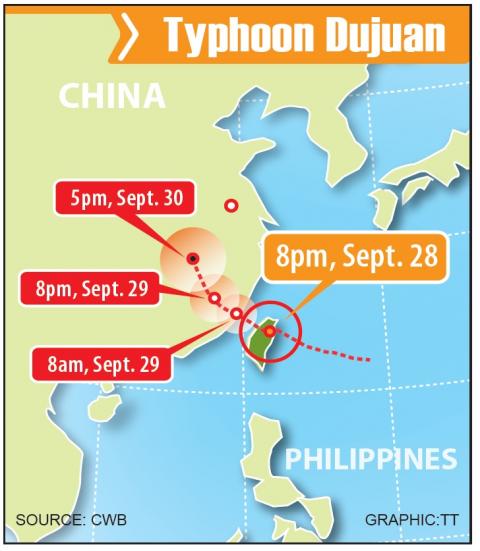
The Central Weather Bureau (CWB) said Dujuan made landfall at Suao Township (蘇澳) in Yilan County at 5:40pm. Suao brought gusts of wind reaching 243.7kph, the second-highest on record since a weather station was established in the township 34 years ago, the bureau said.
The strongest gusts ever experienced in Suao occurred during Typhoon Gladys in 1994, when wind speeds hit 246.9kph, the bureau said.
As of 9pm, the storm was centered 30km northeast of Taichung, moving at 20kph west-northwest, the bureau said.
With a radius of 220km, the storm’s strongest winds were estimated to be 184kph.
A super flood tide was due yesterday evening, and this, coupled with heavy tides brought by Dujuan, could inundate low-lying areas along the west coast of Taiwan proper, as well as riversides in the area.
Authorities said coastal areas could be particularly dangerous as tides are affected by the “supermoon” — a rare astrological event in which the moon appears brighter and larger — because it has reached its closest orbital point to Earth, resulting in its gravitational pull being stronger than usual.
According to the Ministry of National Defense, more than 24,000 personnel are on standby for disaster relief and evacuations, with 100 shelters set up.
At 8pm last night, Taipei, New Taipei City and Keelung had declared a half-typhoon day today, canceling work and classes this morning. However, at 10pm the three cities announced that the whole day would be a typhoon day.
Chuanghua, Nantou, Penghu, Yilan and Lienchiang counties and Taichung also declared a typhoon day for the full day. Taitung County and Tainan City are to operate as normal working days. Kaohsiung City, and Pingtung and Hualien Counties were yet to make announcements.
A Bon Jovi concert scheduled to take place last night at the Taipei World Trade Center Nangang Exhibition Hall was canceled because of the typhoon. The event promoter yesterday afternoon said that tickets for last night’s show could be exchanged or refunded at the exhibition hall starting at noon today. It also said that 90 percent of the tickets would be able to be exchanged.
The weather bureau said the typhoon would move away from Taiwan by noon today, but that rain and wind would only ease up after it made landfall in China.

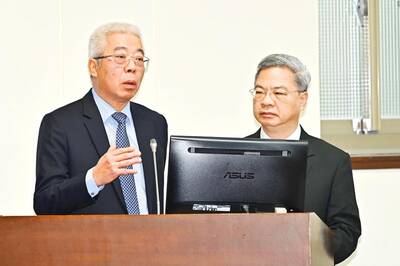
Taiwan has arranged for about 8 million barrels of crude oil, or about one-third of its monthly needs, to be shipped from the Red Sea this month to bypass the Strait of Hormuz and ease domestic supply pressures, CPC Corp, Taiwan (CPC, 台灣中油) said yesterday. The state-run oil company has worked with Middle Eastern suppliers to secure routes other than the Strait of Hormuz, through which about 20 percent of the world’s oil and liquefied natural gas typically passes, CPC chairman Fang Jeng-zen (方振仁) said at a meeting of the legislature’s Economics Committee in Taipei. Suppliers in Saudi Arabia have indicated they

South Korea has adjusted its electronic arrival card system to no longer list Taiwan as a part of China, a move that the Ministry of Foreign Affairs said would help facilitate exchanges between the two sides. South Korea previously listed “Taiwan” as “Taiwan (China)” in the drop-down menus of its online arrival card system, where people had to fill out where they came from and their next destination. The ministry had requested South Korea make a revision and said it would change South Korea’s name on Taiwan’s online immigration system from “Republic of Korea” to “Korea (South),” should the issue not be

Tainan, Taipei and New Taipei City recorded the highest fines nationwide for illegal accommodations in the first quarter of this year, with fines issued in the three cities each exceeding NT$7 million (US$220,639), Tourism Administration data showed. Among them, Taipei had the highest number of illegal short-term rental units, with 410. There were 3,280 legally registered hotels nationwide in the first quarter, down by 14 properties, or 0.43 percent, from a year earlier, likely indicating operators exiting the market, the agency said. However, the number of unregistered properties rose to 1,174, including 314 illegal hotels and 860 illegal short-term rental

AIR ALERT: China’s reservation of airspace over the Yellow Sea and East China Sea could be an attempt to test the US’ response ahead of a Trump-Xi meeting, the NSB head said China’s attempts to infiltrate Taiwan are systematic, planned and targeted, with activity shifting from recruiting mid-level military officers to rank-and-file enlisted personnel, National Security Bureau (NSB) Director-General Tsai Ming-yen (蔡明彥) said yesterday. The Chinese Communist Party’s (CCP) integrates national security, intelligence operations and “united front” efforts into a dense network to conduct intelligence gathering and espionage in Taiwan, Tsai said at a meeting of the legislature’s Foreign Affairs and National Defense Committee. It uses specific networks to screen targets through exchange activities and recruiting local collaborators to establish intelligence-gathering organizations, he said. China is also shifting who it targets to lower-ranking military personnel,


 RSS
RSS