


Scuffles broke out at the Taipei City Council yesterday when a Taipei city councilor made a disrespectful remark to Taipei Mayor Ko Wen-je (柯文哲).
Taipei city councilors of the Chinese Nationalist Party (KMT) yesterday continued their boycott against Ko over a roster published by EasyCard Corp of Taipei city councilors, city government officials and corporations who requested controversial EasyCards featuring a Japanese adult video actress.
EasyCard Corp is a semi-governmental firm in which the Taipei City Government is the largest shareholder, having a 40 percent stake.
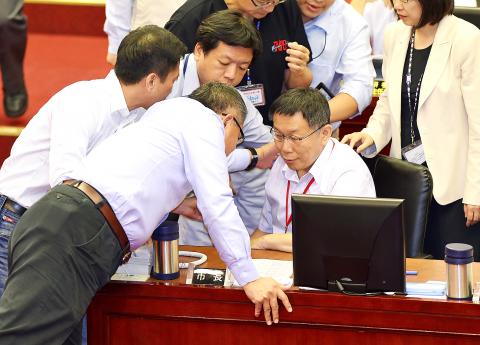
Photo: Chien Jung-fong, Taipei Times
During a question-and-answer session, KMT Taipei City Councilor William Hsu (徐宏庭) panned EasyCard’s handling of the roster and accused Ko of protecting the company formerly headed by his “protege” Tai Chi-chuan (戴季全).
“Sooner or later, [former Taipei Clean Government Committee member] Neil Peng (馮光遠) will say that you and Tai have a ‘special/sexual’ relationship’ (特殊性關係),” Hsu said.
Peng used the term to describe the relationship between President Ma Ying-jeou (馬英九) and his close aide King Pu-tsung (金溥聰), which prompted legal action by King.
King lost the libel suit.
Hsu’s remark prompted Democratic Progressive Party (DPP) Taipei City Councilor Tung Chung-yen (童仲彥) to slam his fist on the table and accuse him of abusing his councilors’ immunity, to which Hsu replied: “If you don’t like it, sue me.”
Tensions escalated as Tung later confronted Hsu face-to-face, prompting city councilors from both the KMT and DPP to separate them.
Ko, visibly angered, also pounded his desk upon hearing Hsu’s remark. The mayor at one point attempted to stand up in protest, but was stopped by Taipei Deputy Mayor Charles Lin (林欽榮).
Ko later told reporters that he had telephoned Taipei City Council Speaker Wu Pi-chu (吳碧珠) and apologized for his action.
“In fact, I still cannot stomach that kind of personal attack. I think that it is wrong. As to my losing my temper, I called council speaker Wu Pi-chu and apologized. I am an unconventional politician after all, so sometimes I show my feelings directly. It was unnecessary,” he said.
The decision to publish the roster came after Tung on Tuesday urged his colleagues to return the disputed cards they had received and stop being hypocrites — criticizing the cards while “pocketing” them.
The roster, which was due to be delivered to all Taipei city councilors’ offices at 11am yesterday, was two hours late, and revealed only requestors’ surnames, with their first names edited out.
It was also found to be ambiguous and rife with mistakes. For example, a city councilor surnamed Liao (廖) was said to have requested some cards, but no Taipei city councilor has that surname.
A city councilor surnamed Wu (吳) requested 20 sets of the controversial EasyCards, each containing two cards, but there are four city councilors surnamed Wu.
The number of cards given to corporations, 146 sets, were passed off as simply “company PR,” with no names given, the list showed.
The list also indicated that one of Ko’s advisers, surnamed Chang (張), took 10 sets of cards. Ko’s close aide Chang Yisan (張益瞻) confirmed that it was he who had asked for the cards.
A total of 1,608 sets were sold before EasyCard began accepting pre-orders via telephone on Sept. 1, contradicting a statement the company made that all 15,000 card sets would be sold by telephone.
No information on these private buyers was given yesterday, despite the council’s order.
KMT Taipei City Councilor Lee Hsin (李新) said the roster had caused his colleagues to speculate about their colleagues.
He said that while some city councilors might have requested the cards because they would need them when they ask officials questions, some apparently asked for the cards to give to voters in their constituencies.
He said city councilors should not go beyond their authority, and unless a decent roster is submitted, the KMT caucus would continue to delay Ko’s policy address.
Taipei Deputy Mayor Teng Chia-chi (鄧家基) said he had ordered EasyCard to improve the roster, and that a revised version would be published shortly.
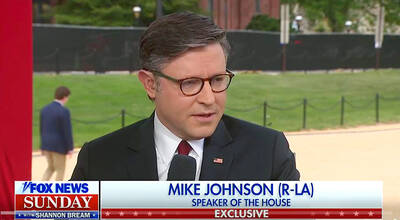
RESOLUTE BACKING: Two Republican senators are planning to introduce legislation that would impose immediate sanctions on China if it attempts to invade Taiwan US House of Representatives Speaker Mike Johnson on Sunday reaffirmed US congressional support for Taiwan, saying the US and “all freedom-loving people” have a stake in preventing China from seizing Taiwan by force. Johnson made the remarks in an interview with Fox News Sunday on US President Donald Trump’s summit with Chinese President Xi Jinping (習近平) last week. In an interview that aired on Friday on Fox News, just as Trump wrapped up a high-stakes visit to China, he said he has yet to green-light a new US$14 billion arms package to Taiwan and that it “depends on China.” “It’s a very good

DRONE CENTRAL: Taiwan aims to become Asia’s democratic hub for drones, with most exports focused on high-quality military-grade models, an official said Taiwan’s drone industry is expected to expand significantly by 2030, producing 100,000 units per month and exporting half of them, the Ministry of Economic Affairs said yesterday. Current drone production capacity is about 15,000 units per month, but the industry can quickly scale up as demand increases, Industrial Development Administration Director-General Chiou Chyou-huey (邱求慧) told a news conference in Taipei. Taiwan’s drone output grew 2.5-fold last year to NT$12.9 billion (US$408.3 million) under a government program to develop the uncrewed vehicle sector, he said. The Executive Yuan in October last year approved plans to invest NT$44.2 billion into domestic production of uncrewed aerial
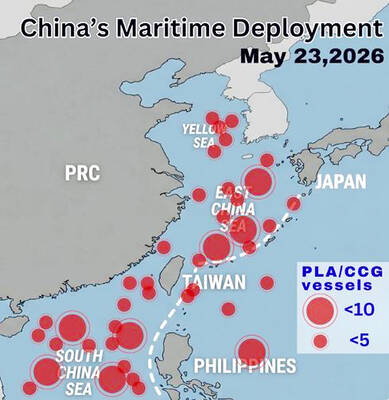
WARNING: China should stop engaging in actions that undermine regional peace and stability, as it would only build resentment among people across the Strait, the CGA said China has deployed more than 100 navy, coast guard and other vessels in waters from the Yellow Sea to the South China Sea and the western Pacific since US President Donald Trump and Chinese President Xi Jinping (習近平) met in Beijing, National Security Council Secretary-General Joseph Wu (吳釗燮) said yesterday. “In this part of the world, #China is the one & only PROBLEM wrecking the #StatusQuo & threatening regional peace & stability,” Wu wrote on X. In a separate post, he said Beijing was coercing Taiwan’s maritime domain, calling it illegal and provocative, after the Coast Guard Administration (CGA) expelled a
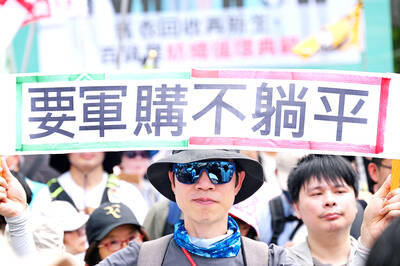
More than 8,000 people took part in a rally in Taipei yesterday to express support for more defense spending, after the opposition slashed the Cabinet’s proposed NT$1.25 trillion (US$39.6 billion) special defense budget and capped it at NT$780 billion. The demonstrators urged the Cabinet to propose another bill. Taiwan Economic Democracy Union convener Lai Chung-chiang (賴中強) said the main problem of the passed budget plan is the removal of funding for critical items, not just that the total amount is smaller. Critical budget items included purchasing or developing uncrewed vehicles, Strong Bow (強弓) missile systems, additional ammunition, artificial intelligence-powered combat systems and Taiwan-US


 RSS
RSS