


The Chinese Nationalist Party (KMT) government will prioritize passage of a cross-strait agreement on double taxation avoidance as well as bills on the budget, government restructuring and an all-volunteer military in the fall legislative session, Premier Mao Chi-kuo (毛治國) said yesterday.
Mao said the Cabinet would also push a special budget bill to finance a river basin management plan, an amendment to encourage small and medium-sized enterprises to raise wages for their employees and legislation promoting industrial innovation.
He listed the government’s priorities at a forum held by the KMT’s Policy Committee to discuss the legislature’s operations and coordination with the government before the new session begins today.
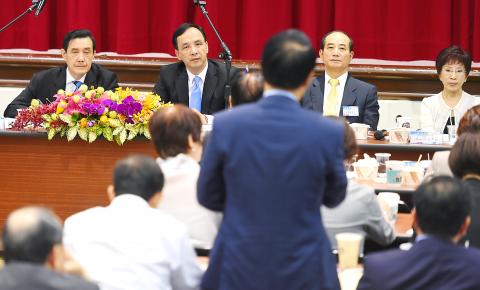
Photo: Chang Chia-ming, Taipei Times
President Ma Ying-jeou (馬英九), Legislative Speaker Wang Jin-pyng (王金平), KMT Chairman Eric Chu (朱立倫) and Deputy Legislative Speaker Hung Hsiu-chu (洪秀柱), who is the party’s presidential candidate, were all present at the forum.
Among the government’s top priorities is the ratification of an agreement between Taiwan and China that aims to protect Taiwanese businesses with operations in China from paying taxes on the same income on both sides of the Taiwan Strait.
The double taxation avoidance agreement was signed last month by Taiwan’s Straits Exchange Foundation Chairman Lin Join-sane (林中森) and China’s Association for Relations Across the Taiwan Straits Chairman Chen Deming (陳德銘) on behalf of their respective governments.
Ministry of Finance officials last month said that the pact would reduce the tax burden of Taiwanese companies and also offer an incentive for foreign companies to set up operations in Taiwan.
Meanwhile, KMT lawmakers at the forum called on party heavyweights to improve cooperation and solidarity before the January presidential and legislative elections, to avoid putting the party’s chances at risk.
KMT Legislator Lin Yu-fang (林郁方) said that despite the Democratic Progressive Party’s internal bickering, it at least presented a united front during elections.
On the other hand, polling revealed that no one believes the KMT has the same willingness to maintain solidarity, he said.
“Legislators are often the ones sacrificed, because our party’s heavyweights cannot work together,” Lin said, adding that he hoped the KMT’s principals would be able to talk things out.
The president said he fully supported the idea and would “do everything in my power, wherever I am needed.”
Chu said solidarity was important, adding that everyone at the forum was considered a “member of the upper echelon of the party.”
“We must work together in order for our 880,000 members to be united in purpose,” Chu said, adding that only then would the party get the support it needs.
Wang said coordinated efforts by the Cabinet, the legislature and the KMT to push the bills through would be very helpful to the party’s chances in the January polls.
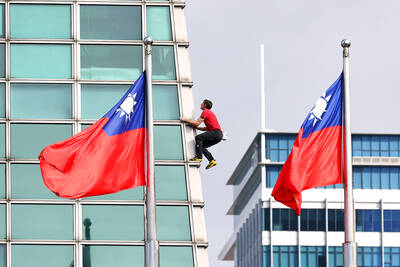
DAREDEVIL: Honnold said it had always been a dream of his to climb Taipei 101, while a Netflix producer said the skyscraper was ‘a real icon of this country’ US climber Alex Honnold yesterday took on Taiwan’s tallest building, becoming the first person to scale Taipei 101 without a rope, harness or safety net. Hundreds of spectators gathered at the base of the 101-story skyscraper to watch Honnold, 40, embark on his daredevil feat, which was also broadcast live on Netflix. Dressed in a red T-shirt and yellow custom-made climbing shoes, Honnold swiftly moved up the southeast face of the glass and steel building. At one point, he stepped onto a platform midway up to wave down at fans and onlookers who were taking photos. People watching from inside
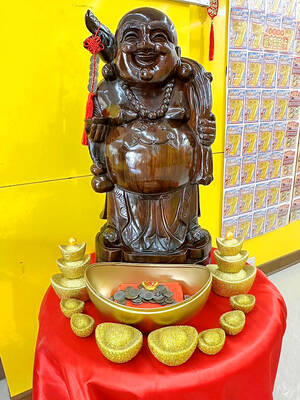
A Vietnamese migrant worker yesterday won NT$12 million (US$379,627) on a Lunar New Year scratch card in Kaohsiung as part of Taiwan Lottery Co’s (台灣彩券) “NT$12 Million Grand Fortune” (1200萬大吉利) game. The man was the first top-prize winner of the new game launched on Jan. 6 to mark the Lunar New Year. Three Vietnamese migrant workers visited a Taiwan Lottery shop on Xinyue Street in Kaohsiung’s Gangshan District (崗山), a store representative said. The player bought multiple tickets and, after winning nothing, held the final lottery ticket in one hand and rubbed the store’s statue of the Maitreya Buddha’s belly with the other,
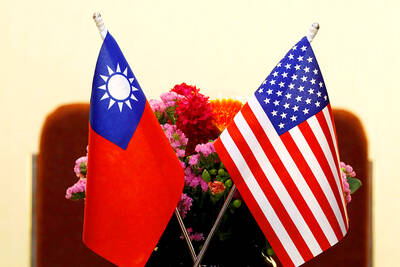
‘NATO-PLUS’: ‘Our strategic partners in the Indo-Pacific are facing increasing aggression by the Chinese Communist Party,’ US Representative Rob Wittman said The US House of Representatives on Monday released its version of the Consolidated Appropriations Act, which includes US$1.15 billion to support security cooperation with Taiwan. The omnibus act, covering US$1.2 trillion of spending, allocates US$1 billion for the Taiwan Security Cooperation Initiative, as well as US$150 million for the replacement of defense articles and reimbursement of defense services provided to Taiwan. The fund allocations were based on the US National Defense Authorization Act for fiscal 2026 that was passed by the US Congress last month and authorized up to US$1 billion to the US Defense Security Cooperation Agency in support of the
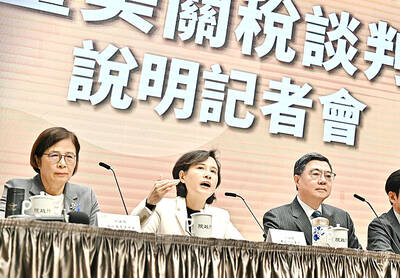
HIGH-TECH DEAL: Chipmakers that expand in the US would be able to import up to 2.5 times their new capacity with no extra tariffs during an approved construction period Taiwan aims to build a “democratic” high-tech supply chain with the US and form a strategic artificial intelligence (AI) partnership under the new tariffs deal it sealed with Washington last week, Taipei’s top negotiator in the talks said yesterday. US President Donald Trump has pushed Taiwan, a major producer of semiconductors which runs a large trade surplus with the US, to invest more in the US, specifically in chips that power AI. Under the terms of the long-negotiated deal, chipmakers such as Taiwan Semiconductor Manufacturing Co (TSMC, 台積電) that expand US production would incur a lower tariff on semiconductors or related manufacturing


 RSS
RSS