


China’s top official in Hong Kong has dispelled the notion of a separation of powers in the territory and says the chief executive has authority over the executive, judiciary and legislature branches.
In a speech titled “the correct understanding of Hong Kong’s political system,” Hong Kong Liaison Office Director Zhang Xiaoming (張曉明) said he picked a controversial issue to discuss in order to tackle the issue head-on.
“The dual responsibility of the chief executive to the central government and Hong Kong has given him a special legal position which is above the executive, legislative and judicial institutions,” Zhang said at an event commemorating the Basic Law, the constitution under which China governs the former British colony as a special administrative region.
“It should be clear that Hong Kong does not implement the political system of separation of powers,” Zhang said.
“It didn’t before the reunification, nor does it after the reunification,” Zhang added.
Zhang quoted former Chinese leader Deng Xiaoping (鄧小平) as saying in a 1987 speech that it would be inappropriate for Hong Kong to adopt a Western approach to its political system, such as the concept of separation of powers, according to a transcript of Zhang’s comments posted on the liaison office Web site.
Zhang’s speech prompted criticism from the territory’s pan-democratic figures.
Civic Party leader Alan Leong (梁家傑) said the comments elevate the leader’s status to that of an emperor; while Labour Party chairman Lee Cheuk-yan (李卓人) questioned the changing interpretation of the Basic Law, the South China Morning Post reported.
Zhang’s comments are not new, Hong Kong Chief Secretary for Administration Carrie Lam (林鄭月娥) said in a release from the Hong Kong government.
The chief executive is accountable both to the central government and to Hong Kong, Lam said.
Differences over political reform set off almost three months of protests last year. Hong Kong pro-democracy lawmakers rejected a China-backed election plan for the city in June, leaving in place the current system, where the chief executive is chosen by a 1,200-member committee of Hong Kong’s mostly Beijing-friendly political and economic elites, rather than by the city’s voters.
Additional reporting by Reuters

SILENCING CRITICS: In addition to blocking Taiwan, China aimed to prevent rights activists from speaking out against authoritarian states, a Cabinet department said The Ministry of Foreign Affairs (MOFA) yesterday condemned transnational repression by Beijing after RightsCon, a major digital human rights conference scheduled to be held in Zambia this week, was abruptly canceled due to Chinese pressure over Taiwanese participation. This year’s RightsCon, the world’s largest conference discussing issues “at the intersection of human rights and technology,” was scheduled to take place from tomorrow to Friday in Lusaka, and expected to draw 2,600 in-person attendees from 150 countries, along with 1,100 online participants. However, organizers were forced to cancel the event due to behind-the-scenes pressure from China, the ministry said, expressing its “strongest condemnation”
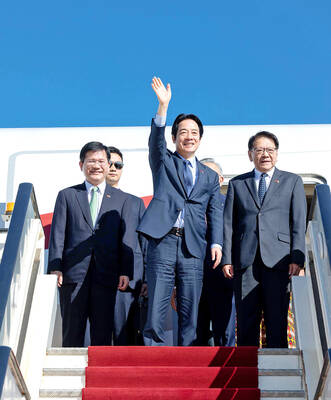
DELAYED BUT DETERMINED: The president’s visit highlights Taiwan’s right to international engagement amid regional pressure from China President Willaim Lai (賴清德) yesterday arrived in Eswatini, more than a week after his planned visit to Taiwan’s sole African ally was suspended because of revoked overflight permits. “The visit, originally scheduled for April 22, was postponed due to unforeseen external factors,” Lai wrote on social media. “After several days of careful arrangements by our diplomatic and national security teams, we successfully arrived today.” Lai said he looked forward to further deepening Taiwan-Eswatini relations through closer cooperation in the economy, agriculture, culture and education, as well as advancing the nation’s international partnerships. The president was initially scheduled to arrive in time to celebrate
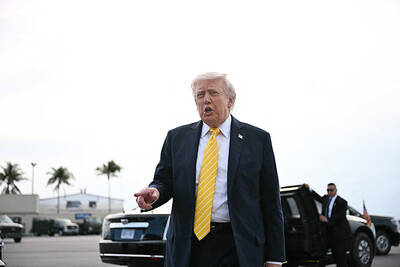
Iran’s Islamic Revolutionary Guard Corp (IRGC) yesterday said the US faced a choice between an “impossible” military operation or a “bad deal” with Tehran, after US President Donald Trump disparaged Iran’s latest peace proposal. Negotiations between the two countries have been deadlocked since a ceasefire came into effect on April 8, with only one round of direct peace talks held so far. Iran’s Tasnim and Fars news agencies reported that Tehran had submitted a 14-point proposal to mediator Pakistan, but Trump was quick to cast doubt on it. “I will soon be reviewing the plan that Iran has just sent to us, but
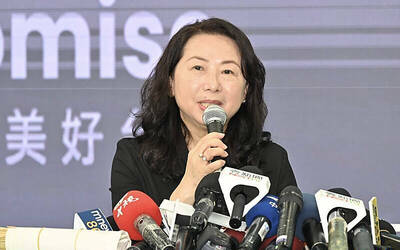
A group affiliated with indicted Chinese immigrant Xu Chunying (徐春鶯) is to be dissolved for monitoring Chinese immigrants in Taiwan, a source said yesterday. Xu, the secretary-general of the Cross-Strait Marriage and Family Service Alliance, was indicted on March 24 on charges of violating the Anti-Infiltration Act (反滲透法). The alliance “illegally monitored" Chinese immigrants living in Taiwan on behalf of the Chinese Communist Party (CCP) and the Ministry of the Interior is expected to dissolve the organization in the coming days under provisions of the Civil Associations Act (人民團體法), the source said. Xu, who married a Taiwanese in 1993 and became a Republic


 RSS
RSS