


Chinese Nationalist Party (KMT) presidential candidate Hung Hsiu-chu (洪秀柱) yesterday likened the struggle of her campaign to gain momentum to Republic of China (ROC) founding father Sun Yat-sen’s (孫逸仙) initial failures to overthrow the Qing Dynasty.
According to a poll conducted by Taiwan Indicators Survey Research (TISR) and released on Friday, Hung’s support has dropped to 12.7 percent, a decline from the 15 percent backing she received in a poll released by the Cross-strait Policy Association on Wednesday.
Of those surveyed, 37.3 percent in the Taiwan Indicators poll said they would vote for Democratic Progressive Party presidential candidate Tsai Ing-wen (蔡英文), while People First Party (PFP) presidential candidate James Soong (宋楚瑜) garnered 19.1 percent.
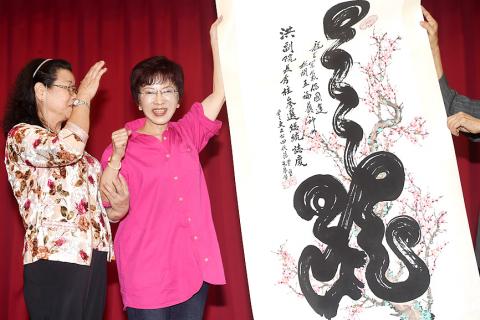
Photo: Liao Chen-huei, Taipei Times
Asked about rumors that some within the KMT’s own ranks oppose her candidacy and have asked her to withdraw if her numbers do not improve — with KMT Taipei City Councilor Lee Hsin (李新) proposing a head-to-head vote be conducted between Hung and Soong — Hung cited Sun as an example to demonstrate her resolve.
“Do you know how many times Sun launched insurrections against the Qing Dynasty before he finally succeeded? How could the ROC have been established if he had given up after just a single failure?” she said.
When asked about the possibility of a team-up between the KMT and the PFP, Hung said on Friday night it is “not possible” and reiterated yesterday that she is the candidate endorsed by the KMT’s national congress.
Hung also explained what she meant when she said in an interview on Friday night that she would like “more attention from [Legislative Speaker] Wang Jin-pyng (王金平) and [Vice President] Wu Den-yih (吳敦義),” denying she was suggesting the two are reluctant to help.
“It is just a call for party solidarity. People have the feeling that that the campaign is picking up momentum, but we just hope that the effort can speed up more,” she said.

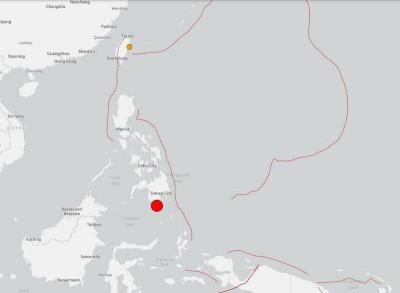
A magnitude 7.8 earthquake struck off the southern coast of Mindanao in the Philippines at 7:38am today, prompting the US Tsunami Warning System to issue an alert for neighboring countries, including Taiwan. The system issued a purple alert indicating a "tsunami threat." The potential threat zone includes Taiwan, the Philippines, Papua New Guinea, Yap and Palau. There were no immediate reports of major damage in the Philippines or Indonesia. The quake struck at a depth of 10km, said the German Research Centre for Geosciences, which had earlier pegged the earthquake at magnitude 8.2. Phivolcs, the Philippine agency, said the quake was magnitude 7 and

RESILIENCE: Taiwan plays a key role in semiconductors, energy, information infrastructure and advanced manufacturing, AIT Director Raymond Greene said Taiwan’s continued investment in deterrence and resilience remains vital, especially in uncrewed systems and other emerging technologies, American Institute in Taiwan (AIT) Director Raymond Greene said yesterday. Greene made the remarks at the annual National Strategic Summit on Supply Chain Resilience held by the Research Institute for Democracy, Society and Emerging Technology (DSET), a government-backed think tank. As Taiwan last year became the US’ fourth-largest trading partner and supply chain security is becoming more important, cooperation in emerging technologies continues to deepen between the two countries, he said. The US is committed to accelerating innovation, building key infrastructure, strengthening cooperation

The National Chungshan Institute of Science and Technology yesterday showcased its locally developed variants of the Vision 60 robotic patrol dog, which it plans to deploy on the nation’s outlying territories in the South China Sea. The variants were produced under the Joint Lab project — created by the institute and domestic companies — and assembled with domestically produced motors, lenses and artificial intelligence (AI) systems alongside licensed tech from the US, Missile and Rocket Systems Research Division deputy director Jen Kuo-kang (任國光) told the media event at a military base in Taipei’s Dazhi (大直) area. Taiwan has built up its strengths

RIGHT DIRECTION: Taiwan’s efforts to prevent forced labor include a proposal to ‘fully prohibit’ employers from withholding workers’ documents, an official said Taiwan is to establish a mechanism to restrict imports of goods linked to forced labor, the Executive Yuan said yesterday, after the US proposed imposing additional tariffs on Taiwanese goods over labor concerns. “The Ministry of Labor and the Ministry of Economic Affairs are to establish an interministerial review procedure,” Executive Yuan spokesperson Michelle Lee (李慧芝) said at a news briefing in Taipei. “The government is to use the Foreign Trade Act [貿易法] as the legal basis to restrict imports of goods produced with forced labor” and bring its supply chain governance more in line with international standards on human rights, resilience


 RSS
RSS