


Taipei EasyCard Corp (悠遊卡) yesterday evening scrambled to recall its “Angel” version of two cards intended for a set featuring Yui Hatano, an actress in the Japanese adult video industry, after netizens reported that the image had been used on one of Hatano’s productions.
The company said Hatano came to Taiwan for a photography shoot, but due to a lack of appropriate pictures, it used a photograph provided by a Japanese company, without knowing it had been used elsewhere.
All of the cards in the series are to be retrieved and a redesign done, the company said.

Photo courtesy of the EasyCard Corp
The planned limited-edition series has drawn mixed reviews.
According to sources within the company, the decision was made after employee suggestions met with the approval of EasyCard chairman Tai Chi-chuan (戴季全).
However, the move has drawn criticism from educators and parents, who said the images would be detrimental to children.
As there would be no age restrictions on the purchase of the cards and they would be available at all four major convenience store chains, an education organization called for the company to put an age limit on sales and restrict the cards to certain channels.
Humanistic Education Foundation deputy executive director Hsieh Shu-mei (謝淑美) said that despite the availability of “sensory stimulating” pictures on the Internet, using an image of an actress in the adult video industry on EasyCards would exceed the appropriate level of knowledge that should be made available to children.
The company should take into account its social responsibility and limit the channels and groups able to purchase such cards, Hsieh said.
University of Taipei Department of Early Childhood Education associate professor Lin Pei-jung (林佩蓉) said that putting an image of the actress on EasyCards could affect the mindset of children and make them think that the commercialization of women is normal.
According to local media, parents held differing views on the issue, with some saying the availability of EasyCards would make it a strange platform for such pictures and suggested a seal to cover the picture, while others said that the picture on the cards would be acceptable as it was not overtly revealing and it was simply a marketing strategy targeting a certain group.
Others said the company might be breaching its own rules that customized cards must not involve violent, sexual or any content that might disturb “public order and culture.”
The company yesterday said that there would not be any nudity on the cards and called on the public to view the products with a healthy mindset.
The cards would hold great value as a collector’s item and would go on sale on Tuesday next week, the company said, adding that there would be 15,000 sets, with each set containing two cards,.
All proceeds from the sales of the limited-edition cards would go to charity, it said.
Taipei City Mayor Ko Wen-je (柯文哲), who appointed Tai in March last year, appeared surprised when reporters raised the issue while he was attending a meeting of community officials.
Ko said he told Tai to increase EasyCard Corp’s business by 100 percent and left the details up to him, but he expressed doubt that the special cards would help, especially with women accounting for 65 to 75 percent of EasyCard users.
The touch-and-go IC ticket can be used for the Taipei MRT, bus services, designated car parks and some stores, and the company also issues special-edition cards featuring cartoon figures popular among collectors.
The Taipei City Government, Taipei Rapid Transit Corp, Taipei Fubon Commercial Bank and 12 bus companies in Taipei are major shareholders of EasyCard Corp, while the chairman is appointed by the city’s mayor.

The National Chungshan Institute of Science and Technology yesterday showcased its locally developed variants of the Vision 60 robotic patrol dog, which it plans to deploy on the nation’s outlying territories in the South China Sea. The variants were produced under the Joint Lab project — created by the institute and domestic companies — and assembled with domestically produced motors, lenses and artificial intelligence (AI) systems alongside licensed tech from the US, Missile and Rocket Systems Research Division deputy director Jen Kuo-kang (任國光) told the media event at a military base in Taipei’s Dazhi (大直) area. Taiwan has built up its strengths

RIGHT DIRECTION: Taiwan’s efforts to prevent forced labor include a proposal to ‘fully prohibit’ employers from withholding workers’ documents, an official said Taiwan is to establish a mechanism to restrict imports of goods linked to forced labor, the Executive Yuan said yesterday, after the US proposed imposing additional tariffs on Taiwanese goods over labor concerns. “The Ministry of Labor and the Ministry of Economic Affairs are to establish an interministerial review procedure,” Executive Yuan spokesperson Michelle Lee (李慧芝) said at a news briefing in Taipei. “The government is to use the Foreign Trade Act [貿易法] as the legal basis to restrict imports of goods produced with forced labor” and bring its supply chain governance more in line with international standards on human rights, resilience

NOT IMMEDIATE: Taiwan has a chance to appeal the proposed 10 percent tariff before it starts, while other countries face a 12.5 percent tariff from the trade office Taiwan is among 60 economies determined by the US to have failed to impose or enforce a ban on the importation of goods produced with forced labor, according to a notice released on Tuesday by the Office of the US Trade Representative (USTR), which proposed imposing an additional 10 percent or more tariff on them. The USTR in a statement said that following an investigation, it had determined under Section 301 of the Trade Act of 1974 that the failure of the 60 economies to impose and effectively enforce a prohibition on the importation of goods produced with forced labor is
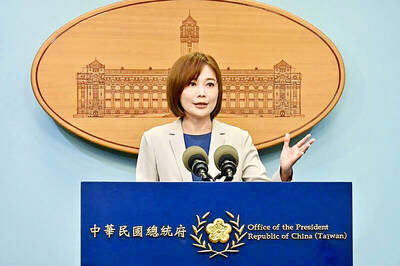
TIT-FOR-TAT: The US allegedly revoked the visa of a Chinese national working at Xinhua News Agency in the US in response to Beijing’s expulsion of Vivian Wang The Presidential Office yesterday condemned China for expelling a New York Times correspondent from Beijing following the newspaper’s interview with President William Lai (賴清德), saying the move highlighted Beijing’s suppression of press freedom and its threat to international news media. Taiwan has noted a series of recent incidents in which Beijing used similar tactics to “threaten and pressure international media outlets and journalists,” Presidential Office spokeswoman Karen Kuo (郭雅慧) said in a statement. “This concerns not only press freedom and freedom of expression, but also the safety of journalists, and Taiwan and relevant partners are paying close attention to the situation,” she


 RSS
RSS