


Asustek Computer Inc (華碩) yesterday confirmed that chief financial officer (CFO) David Chang (張偉明), who doubled as the firm’s spokesman, had died following a short illness at the age of 50.
He is survived by two children.
The PC maker said Chang, who had just returned from a business trip to China on Wednesday, passed away at his home on Thursday evening.
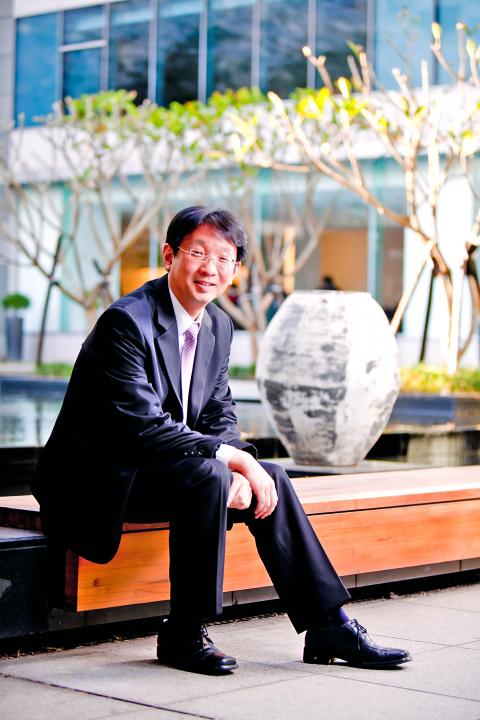
Photo provided by Asustek Computer Inc
The firm declined to elaborate on his cause of death, citing privacy concerns for Chang’s family.
“Chang had served at Asus[tek] for a long time and had participated in many of the firm’s major policy decisions... The company is grieving over the sudden tragedy. Asus is hoping to see its employees maintain good health and balance between work and family,” chairman Jonney Shih (施崇棠) said in an internal letter to Asustek employees yesterday morning.
Shih said Chang made great contributions to Asustek when the firm made its initial public offering in 1996 and when the company spun off its computer-related contract manufacturing unit, Pegatron Corp (和碩), in 2007.
Chang, who worked at the PC company for nearly 21 years, began work in the financial department in 1994 after it was established in 1989.
He had been serving as Shih’s executive assistant for 12 years and was promoted to chief financial officer and company spokesman in 2006. Chang was appointed by Shih to be the firm’s lead marketing officer in 2013.
Chang played a key role in driving Asustek’s smartphone business. He was often on international business trips over the past few years and accompanied Shih to many public events.
During a visit to the Consumer Electronics Show in Las Vegas in January last year, Chang almost fainted in his hotel room after attending a series of meetings and teleconferences with colleagues in Taiwan due to a lack of sleep, media reports said.
His unexpected passing sparked speculation that exhaustion due to overwork played a part in his death.
Asustek acting spokesman Nick Wu (吳長榮) yesterday denied a rumor Chang had died while working past midnight at the company’s headquarters.
The public should respect his family’s privacy, he said by telephone.
The company will spend months looking for a suitable successor, Lee said, adding that the board was to convene soon over the matter.
“The death will not affect the firm’s operations,” Lee said, adding that Asustek is still on schedule to hold smartphone product launches in India and Brazil next month.
Asustek shares rose 2.46 percent to NT$292 in Taipei trading yesterday.

‘NO SECURITY RISK’: The Railway Bureau reassured the public that the technicians’ activities were limited to technical guidance and did not involve sensitive systems The Railway Bureau yesterday said it had invited eight Chinese technicians to assist with an airport MRT construction project. The bureau issued the confirmation after an Internet user said Chinese nationals had entered the construction zone of Taiwan Taoyuan International Airport’s Terminal 3 project. They asked why “individuals from an enemy state” were allowed access to such a major national infrastructure project, which raised serious concerns over Taiwan’s industrial safety, sensitive systems and information security. The bureau’s Northern Region Engineering Branch Office said subcontractor Taiwan Handle Industrial Co (台灣手把工業) of the Taoyuan airport MRT’s “Contract No. CU05 Project A14 Station Civil, MEP &

The National Chungshan Institute of Science and Technology yesterday showcased its locally developed variants of the Vision 60 robotic patrol dog, which it plans to deploy on the nation’s outlying territories in the South China Sea. The variants were produced under the Joint Lab project — created by the institute and domestic companies — and assembled with domestically produced motors, lenses and artificial intelligence (AI) systems alongside licensed tech from the US, Missile and Rocket Systems Research Division deputy director Jen Kuo-kang (任國光) told the media event at a military base in Taipei’s Dazhi (大直) area. Taiwan has built up its strengths

RIGHT DIRECTION: Taiwan’s efforts to prevent forced labor include a proposal to ‘fully prohibit’ employers from withholding workers’ documents, an official said Taiwan is to establish a mechanism to restrict imports of goods linked to forced labor, the Executive Yuan said yesterday, after the US proposed imposing additional tariffs on Taiwanese goods over labor concerns. “The Ministry of Labor and the Ministry of Economic Affairs are to establish an interministerial review procedure,” Executive Yuan spokesperson Michelle Lee (李慧芝) said at a news briefing in Taipei. “The government is to use the Foreign Trade Act [貿易法] as the legal basis to restrict imports of goods produced with forced labor” and bring its supply chain governance more in line with international standards on human rights, resilience

NOT IMMEDIATE: Taiwan has a chance to appeal the proposed 10 percent tariff before it starts, while other countries face a 12.5 percent tariff from the trade office Taiwan is among 60 economies determined by the US to have failed to impose or enforce a ban on the importation of goods produced with forced labor, according to a notice released on Tuesday by the Office of the US Trade Representative (USTR), which proposed imposing an additional 10 percent or more tariff on them. The USTR in a statement said that following an investigation, it had determined under Section 301 of the Trade Act of 1974 that the failure of the 60 economies to impose and effectively enforce a prohibition on the importation of goods produced with forced labor is


 RSS
RSS