


The family of a 23-year-old medical student fatally injured in the Formosa Fun Coast (八仙海岸) inferno last month has decided to donate his organs after he was declared brain dead earlier yesterday, making the young man the fourth fatality in the disaster.
Far Eastern Memorial Hospital determined the man, named Su Chia-sheng (蘇家陞), to be brain dead at about 11am yesterday, after his condition took a sudden turn for the worse on Thursday.
Su, a junior-year dental student at Taipei Medical University (TMU), sustained second and third-degree burns to 73 percent of his body in the blast and ensuing fire on June 27, which injured 491 people and has killed four so far.

Photo provided by Su Chia-sheng’s family
The 23-year-old student was intubated and attached to a life-
sustaining extracorporeal membrane oxygenation (ECMO) machine on the day of the accident, after his heart stopped beating for 11 minutes while being rushed to Far Eastern hospital for emergency treatment.
He was removed from the ECMO equipment on July 1 after his conditions stabilized, only to lapse into unconsciousness the next day due to brain edema.
According to TMU, Su was to donate his heart, liver, pancreas, two kidneys, two corneas and a section of small intestines, which were expected to benefit eight critically ill patients.
“The reason my son chose medicine was because he wanted to dedicate himself to society. While he can no longer complete his education, he was still able to fulfill a doctor’s mission to save lives through another manner — by giving his organs to those in need,” Su’s father said.
Su’s mother said her son once told her after an anatomy lesson that he deeply revered his “cadaver teachers” and that he was willing to donate his body in support of medical education should he ever have the chance.
“Doctors considered my son’s body to be unfit for preservation due to the massive amount of burns he sustained. That was why we decided to donate his organs instead,” she said.
As of 12pm yesterday, a total of 415 victims of the blast remained hospitalized at 47 medical institutions nationwide, including 281 in intensive care units and 221 in critical condition, according to the Ministry of Health and Welfare’s latest victim monitoring data.
In related news, Taiwan Organ Registry and Sharing Center chairman Lee Po-chang (李伯璋) yesterday said that the center has seen 13 organ donors in the past two weeks, nearly 1.5 times the number normally recorded, including four who donated their skin.
“Catastrophic events always bring out the best and kindness in people, which is why we often see an increase in the number of organ donors following a tragic accident,” Lee said.
Lee said organ donations not only afford critically ill patients a second chance at life, but also allow the spouses or relatives within three degrees of kinship to be given priority on the nation’s transplant waiting list should they ever need one.
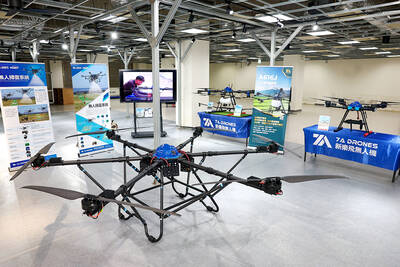
DRONE CENTRAL: Taiwan aims to become Asia’s democratic hub for drones, with most exports focused on high-quality military-grade models, an official said Taiwan’s drone industry is expected to expand significantly by 2030, producing 100,000 units per month and exporting half of them, the Ministry of Economic Affairs said yesterday. Current drone production capacity is about 15,000 units per month, but the industry can quickly scale up as demand increases, Industrial Development Administration Director-General Chiou Chyou-huey (邱求慧) told a news conference in Taipei. Taiwan’s drone output grew 2.5-fold last year to NT$12.9 billion (US$408.3 million) under a government program to develop the uncrewed vehicle sector, he said. The Executive Yuan in October last year approved plans to invest NT$44.2 billion into domestic production of uncrewed aerial
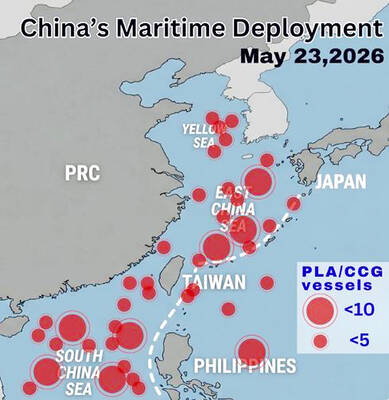
WARNING: China should stop engaging in actions that undermine regional peace and stability, as it would only build resentment among people across the Strait, the CGA said China has deployed more than 100 navy, coast guard and other vessels in waters from the Yellow Sea to the South China Sea and the western Pacific since US President Donald Trump and Chinese President Xi Jinping (習近平) met in Beijing, National Security Council Secretary-General Joseph Wu (吳釗燮) said yesterday. “In this part of the world, #China is the one & only PROBLEM wrecking the #StatusQuo & threatening regional peace & stability,” Wu wrote on X. In a separate post, he said Beijing was coercing Taiwan’s maritime domain, calling it illegal and provocative, after the Coast Guard Administration (CGA) expelled a
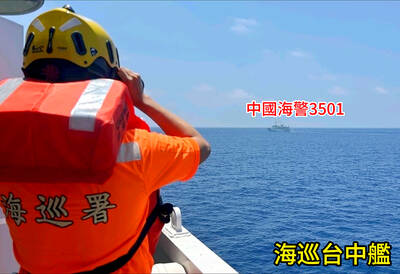
VERBOSE VESSELS: A CGA cutter and a China Coast Guard exchanged verbal barbs for more than a day in Taiwanese-controlled waters before the Chinese vessel left The Taiwanese and Chinese coast guards had a standoff near the strategically located Pratas Islands (Dongsha Islands, 東沙群島) in the north of the South China Sea, the Coast Guard Administration (CGA) said yesterday. The two sides engaged in intense radio exchanges over sovereignty claims during the 33-hour standoff. China Coast Guard vessel 3501 eventually left the restricted waters, 26.6 nautical miles (49.2km) west of the Pratas Islands, at 5pm yesterday, the CGA said. Lying approximately between southern Taiwan and Hong Kong, the Taiwan-controlled Pratas are seen by some security experts as vulnerable to Chinese attack due to their distance — more than
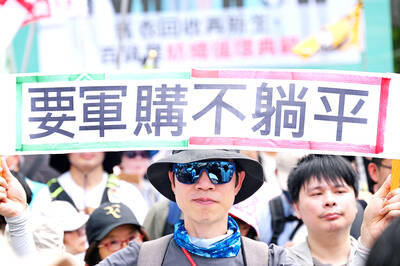
More than 8,000 people took part in a rally in Taipei yesterday to express support for more defense spending, after the opposition slashed the Cabinet’s proposed NT$1.25 trillion (US$39.6 billion) special defense budget and capped it at NT$780 billion. The demonstrators urged the Cabinet to propose another bill. Taiwan Economic Democracy Union convener Lai Chung-chiang (賴中強) said the main problem of the passed budget plan is the removal of funding for critical items, not just that the total amount is smaller. Critical budget items included purchasing or developing uncrewed vehicles, Strong Bow (強弓) missile systems, additional ammunition, artificial intelligence-powered combat systems and Taiwan-US


 RSS
RSS