


Human rights and social activist Lynn Miles, a well-known fighter for Taiwanese democracy, died early yesterday morning at a hospice in New Taipei City.
The 72-year-old American, also known by his Chinese name Mei Hsin-yi (梅心怡), had been suffering from mesothelioma, a cancer linked to asbestos that attacks the membrane lining of the lungs and abdomen, for several months, and spent the past few weeks at the Tzu Chi General Hospital in Xindian District (新店). He died at 1:30am.
Miles first came to Taiwan in 1962 to study Chinese. He became friends with people such as National Taiwan University professor Peng Ming-min (彭明敏) and writer Li Ao (李敖), and in 1967, he and a German friend, Klaus-Peter Metzke, opened The Barbarian (野人咖啡室) cafe in Ximending, where people could meet and exchange ideas.
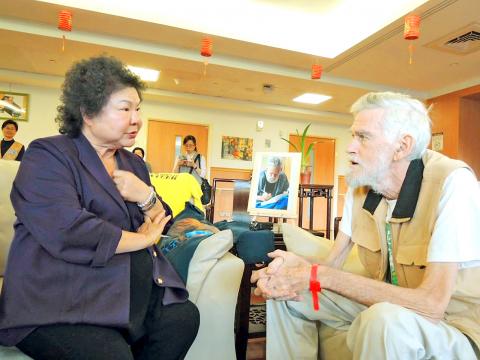
Photo: Liu Li-jen, Taipei Times
He helped Peng, who, along with two of his students, had been convicted for publishing a manifesto calling for the overthrow of the Chiang Kai-shek (蔣介石) regime, escape house arrest and flee the nation for exile in Sweden in 1970.
The Chiang government deported Miles the following year, after he tried to help Li and Peng’s two students after they were arrested. The government blacklisted him from returning to Taiwan until 1996.
Miles moved to Osaka, Japan, where he continued his pro-democracy efforts for Taiwan, establishing the International Committee for the Defense of Human Rights in Taiwan. The committee helped smuggle information about political prisoners out of Taiwan and Miles wrote reports on the political situation and the prisoners, and provided them to Amnesty International and other rights groups, reporters and churches.
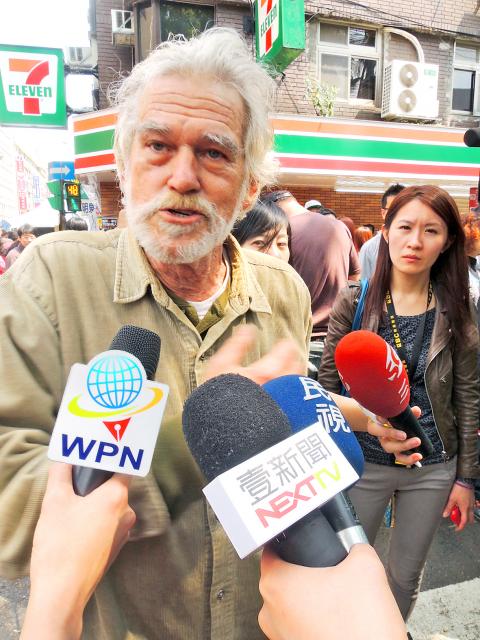
Photo: Hsieh Wen-hua, Taipei Times
He spent several years in the US before returning to Taiwan once the blacklist was lifted.
He received permanent residency in Taiwan in 2006 for his “special contributions to the nation” and in recent years taught at Fu Jen Catholic University.
The New Jersey native continued to be a familiar face at protests over rights issues and spoke out on a variety of issues, including efforts to end the death penalty in Taiwan, and organizing several Peacefests. He burned his US passport in front of the American Institute in Taiwan in Taipei on March 23, 2003, to protest the US-led war in Iraq.
He coauthored with Linda Gail Arrigo a book about the human rights movement in Taiwan, A Borrowed Voice: Taiwan Human Rights through International Networks, 1960-1980, which was published in 2008.
In February, Miles was among 119 people indicted by Taipei prosecutors for taking part in Sunflower movement-linked rallies in Taipei in the spring of last year against the government’s handling of a cross-strait service trade agreement.
As Miles’ health worsened in recent weeks, several prominent Democratic Progressive Party (DPP) members visited him at the hospital, including DPP Chairperson Tsai Ing-wen (蔡英文) and Kaohsiung Mayor Chen Chu (陳菊), while a Peacefest to celebrate his life was held on May 30.
Tsai, who is currently on a trip to the US, mourned Miles’ death.
“Leaning about his passing away is a very saddening thing,” Tsai said in a statement on her official Facebook page. “As an American, he has always been a good friend of Taiwan, who long assisted Taiwan in democratization, and sincerely hopes that the Taiwanese people could live in freedom and democracy.”
She called Miles a witness of a time.
“From undemocratic to democratic, it is because of many friends like him who took actions to support us that Taiwan is able to become democratized in the end,” Tsai said. “May he rest in peace, and may he be free of all pains.”
Additional reporting by Loa Iok-sin

A car bomb killed a senior Russian general in southern Moscow yesterday morning, the latest high-profile army figure to be blown up in a blast that came just hours after Russian and Ukrainian delegates held separate talks in Miami on a plan to end the war. Kyiv has not commented on the incident, but Russian investigators said they were probing whether the blast was “linked” to “Ukrainian special forces.” The attack was similar to other assassinations of generals and pro-war figures that have either been claimed, or are widely believed to have been orchestrated, by Ukraine. Russian Lieutenant General Fanil Sarvarov, 56, head

SAFETY FIRST: Double the number of police were deployed at the Taipei Marathon, while other cities released plans to bolster public event safety Authorities across Taiwan have stepped up security measures ahead of Christmas and New Year events, following a knife and smoke bomb attack in Taipei on Friday that left four people dead and 11 injured. In a bid to prevent potential copycat incidents, police deployments have been expanded for large gatherings, transport hubs, and other crowded public spaces, according to official statements from police and city authorities. Taipei Mayor Chiang Wan-an (蔣萬安) said the city has “comprehensively raised security readiness” in crowded areas, increased police deployments with armed officers, and intensified patrols during weekends and nighttime hours. For large-scale events, security checkpoints and explosives
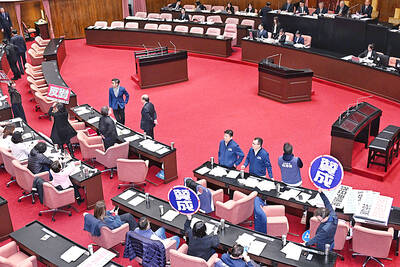
‘POLITICAL GAME’: DPP lawmakers said the motion would not meet the legislative threshold needed, and accused the KMT and the TPP of trivializing the Constitution The Legislative Yuan yesterday approved a motion to initiate impeachment proceedings against President William Lai (賴清德), saying he had undermined Taiwan’s constitutional order and democracy. The motion was approved 61-50 by lawmakers from the main opposition Chinese Nationalist Party (KMT) and the smaller Taiwan People’s Party (TPP), who together hold a legislative majority. Under the motion, a roll call vote for impeachment would be held on May 19 next year, after various hearings are held and Lai is given the chance to defend himself. The move came after Lai on Monday last week did not promulgate an amendment passed by the legislature that

PENTAGON ASSESSMENT: A US report said that even as China and Russia deepen their partnership, cooperation is hindered by a ‘mutual distrust’ of each other The Chinese People’s Liberation Army (PLA) as of October had doubled the number of ships and airplanes deployed around Taiwan compared with the previous two years, Vice Minister of National Defense Hsu Szu-chien (徐斯儉) said yesterday, a day after the opposition-controlled legislature voted against reviewing the government’s general budget for next year, including a NT$1.25 trillion (US$39.71 billion) special defense spending bill. The legislature’s vote against the Ministry of National Defense’s spending plans was regrettable, as the budget was designed to respond to the developing Chinese military threat, Hsu said on the sidelines of a legislative meeting on the general budget. Defense


 RSS
RSS