


Newly released satellite images show Vietnam has carried out significant land reclamation at two sites in the disputed South China Sea, though the scale and pace of the work is dwarfed by that of China, a US research institute said on Thursday.
The photographs from Washington’s Center for Strategic and International Studies (CSIS), show an expansion of the land area of Vietnamese-controlled Sandy Cay (Duncian Shajou, 敦謙沙洲) and West London Reef (West Yincing Reef, 尹慶群西礁) in the Spratly Islands (Nansha Islands, 南沙群島) and the addition of buildings.
Some or all of the islands are also claimed by Taiwan, China, Brunei, Malaysia and the Philippines.
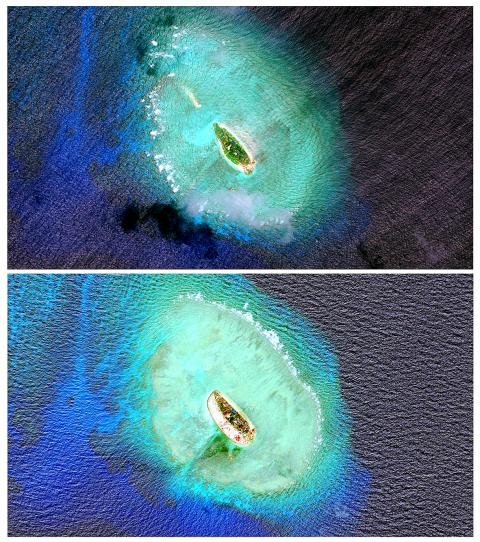
Photo: Reuters / CSIS Asia Maritime Transparency Initiative / DigitalGlobe / Handout
Mira Rapp-Hooper, director of the center’s Asia Maritime Transparency Initiative, said the work included military installations and appeared to have started before China began a flurry of reclamation projects last year.
The photographs, taken by satellite imagery firm DigitalGlobe, were taken between 2010 and April 30 this year.
“On one site, it has constructed a significant new area that was formerly under water and at another it has used land reclamation to add acreage to an existing island,” Rapp-Hooper said.
The Vietnamese government did not immediately respond to a request for comment, but routinely says it has sufficient legal and historical evidence to support its claims to the Spratlys.
Vietnam, the Philippines and other countries have been carrying out such reclamations for a long time, Chinese Ministry of Foreign Affairs spokeswoman Hua Chunying (華春瑩) said, on what she claimed were Chinese islands being illegally occupied.
“We are extremely concerned and resolutely opposed to these illegal activities. We demand that the relevant countries stop all their activities which infringe upon China’s sovereignty and rights,” she told a daily news briefing.
The speed of recent Chinese reclamation work has alarmed its neighbors and the US, which sees it as a potential threat to the “status quo” in a region through which US$5 trillion of sea-borne trade passes each year.
New Vietnamese military facilities at Sand Cay appeared to include defensive positions and gun emplacements, and new buildings visible on West London Reef could also have military applications, Rapp-Hooper said.
“Strictly speaking, these photos show that China is right, but we can safely say that the scope and scale of what China has undertaken is totally unprecedented, and dwarfs Vietnam’s activities many times over,” she said.
She said the images showed that Vietnam had reclaimed about 65,000m2 of land at West London Reef and 21,000m2 at Sandy Cay. This compared with 900,000m2 reclaimed by China at a single reef, Fiery Cross Reef (Yongshu Reef, 永暑礁).
Rapp-Hooper said satellite images showed that since about March last year, China had conducted reclamation work at seven sites in the Spratlys and was constructing a military-sized air strip on one artificial island.
She said Vietnam already had an airstrip on the Spratlys.
The Philippines has been the most vocal critic of China’s reclamation work, but was unlikely to be troubled by Vietnam’s activities partly because of growing security ties between Manila and Hanoi, experts said.

CREDIT-GRABBER: China said its coast guard rescued the crew of a fishing vessel that caught fire, who were actually rescued by a nearby Taiwanese boat and the CGA Maritime search and rescue operations do not have borders, and China should not use a shipwreck to infringe upon Taiwanese sovereignty, the Coast Guard Administration (CGA) said yesterday. The coast guard made the statement in response to the China Coast Guard (CCG) saying it saved a Taiwanese fishing boat. The Chuan Yu No. 6 (全漁6號), a fishing vessel registered in Keelung, on Thursday caught fire and sank in waters northeast of Diaoyutai Islands (釣魚台). The vessel left Keelung’s Badouzih Fishing Harbor (八斗子漁港) at 3:35pm on Sunday last week, with seven people on board — a 62-year-old Taiwanese captain surnamed Chang (張) and six

RISKY BUSINESS: The ‘incentives’ include initiatives that get suspended for no reason, creating uncertainty and resulting in considerable losses for Taiwanese, the MAC said China’s “incentives” failed to sway sentiment in Taiwan, as willingness to work in China hit a record low of 1.6 percent, a Ministry of Labor survey showed. The Directorate-General of Budget, Accounting and Statistics (DGBAS) also reported that the number of Taiwanese workers in China has nearly halved from a peak of 430,000 in 2012 to an estimated 231,000 in 2024. That marked a new low in the proportion of Taiwanese going abroad to work. The ministry’s annual survey on “Labor Life and Employment Status” includes questions respondents’ willingness to seek employment overseas. Willingness to work in China has steadily declined from

LEVERAGE: China did not ‘need to fire a shot’ to deny Taiwan airspace over Africa when it owns ‘half the continent’s debt,’ a US official said, calling it economic warfare The EU has raised concerns about overflight rights following the delay of President William Lai’s (賴清德) planned state visit to the Kingdom of Eswatini after three African nations denied overflight clearance for his charter at the last minute. Taiwanese allies Paraguay and Saint Kitts and Nevis, as well as several US lawmakers and the Inter-Parliamentary Alliance on China (IPAC) condemned China for allegedly pressuring the countries. Lai was scheduled to fly directly to Taiwan’s only African ally from yesterday to Sunday to celebrate the 40th anniversary of King Mswati III’s accession and his 58th birthday, but Seychelles, Mauritius and Madagascar suddenly revoked
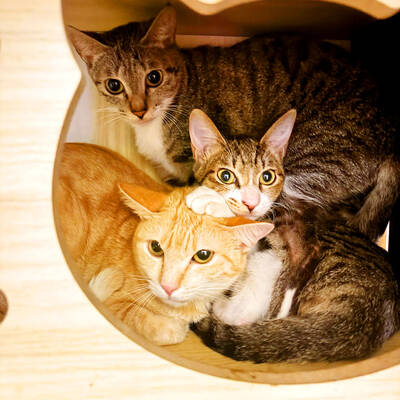
The number of pet cats in Taiwan surpassed that of pet dogs for the first time last year, reaching 1,742,033, a 32.8 percent increase from 2023, the Ministry of Agriculture said yesterday, citing a survey. By contrast, the number of pet dogs declined slightly by 1.2 percent over the same period to 1,462,528, the ministry said. Despite the shift, households with dogs still slightly outnumber those with cats by 1.2 percent. However, while the number of households with multiple dogs has remained relatively stable, households keeping more than two cats have increased, contributing to the overall rise in the feline population. The trend


 RSS
RSS