


US Secretary of State John Kerry on Monday told Japanese leaders that Washington’s treaty commitments to Japan’s security remain “iron-clad” and cover all territories under Tokyo’s administration, including islands in the East China Sea that Taiwan and China also claim.
Kerry renewed the security pledge related to the islets, known as the Diaoyutai Islands (釣魚台) in Taiwan and the Senkakus in Japan, at a New York news conference with Japan’s foreign and defense ministers to unveil updated US-Japan defense guidelines on the eve of Japanese Prime Minister Shinzo Abe’s official talks with US President Barack Obama.
“It’s an historic transition in the defense relationship between our two countries,” Kerry said.

Photo: AFP
The new guidelines for defense cooperation reflect Japan’s willingness to take on a more robust international role at a time of growing Chinese power and rising concerns about North Korea.
It follows a Japanese Cabinet resolution last year reinterpreting Japan’s pacifist post-World War II constitution to allow the exercise of the right to “collective self-defense.”
At the news conference, Kerry made it clear that Washington was ready to stick to its treaty obligations to come to Japan’s defense, an effort to reassure Tokyo in its maritime dispute with China.
In a pointed message to Beijing over its increasing assertiveness in the South China Sea as well, Kerry said the US rejects any suggestion that freedom of navigation and overflight “are privileges granted by big states to small ones subject to the whim and fancy of the big state.”
“Our treaty commitments to Japan’s security remains iron-clad and covers all territories under Japan’s administration, including the Senkaku Islands,” he said.
The guidelines allow for global cooperation militarily, ranging from defense against ballistic missiles, cyber and space attacks as well as maritime security.
They also eliminate geographic restrictions that had largely limited joint work to the defense of Japan and the surrounding area, a senior US official said.
“We will be able to do globally what we’ve been able to do in the defense of Japan and regionally,” the official said.
Chinese Ministry of Foreign Affairs spokesman Hong Lei (洪磊) said that the security arrangement between the US and Japan should not harm the interests of third parties such as China and ensure regional stability.
“As for the Diaoyu Islands, our position is clear and consistent — they are China’s inherent territory. No matter what anyone says or does, it cannot change the reality that they belong to China,” Hong said in Beijing.
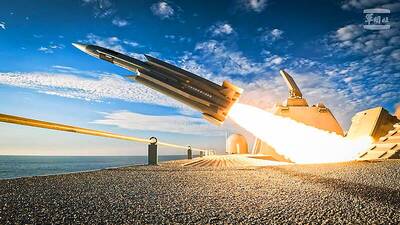
DETERRENCE: With 1,000 indigenous Hsiung Feng II and III missiles and 400 Harpoon missiles, the nation would boast the highest anti-ship missile density in the world With Taiwan wrapping up mass production of Hsiung Feng II and III missiles by December and an influx of Harpoon missiles from the US, Taiwan would have the highest density of anti-ship missiles in the world, a source said yesterday. Taiwan is to wrap up mass production of the indigenous anti-ship missiles by the end of year, as the Chungshan Institute of Science and Technology has been meeting production targets ahead of schedule, a defense official with knowledge of the matter said. Combined with the 400 Harpoon anti-ship missiles Taiwan expects to receive from the US by 2028, the nation would have
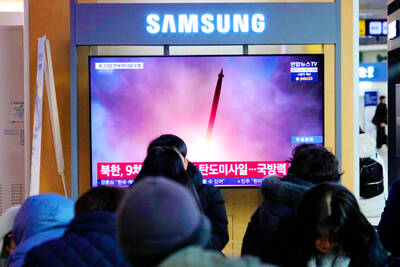
North Korea yesterday fired about 10 ballistic missiles to the sea toward Japan, the South Korean Joint Chiefs of Staff (JCS) said, days after Pyongyang warned of “terrible consequences” over ongoing South Korea-US military drills. Pyongyang recently dashed hopes of a diplomatic thaw with Seoul, Washington’s security ally, describing its latest peace efforts as a “clumsy, deceptive farce.” Seoul’s military detected “around 10 ballistic missiles launched from the Sunan area in North Korea toward the East Sea [Sea of Japan] at around 1:20pm,” JCS said in a statement, referring to South Korea’s name for the body of water. The missiles

‘UNWAVERING FRIENDSHIP’: A representative of a Japanese group that co-organized a memorial, said he hopes Japanese never forget Taiwan’s kindness President William Lai (賴清德) yesterday marked the 15th anniversary of the Tohoku earthquake and tsunami, urging continued cooperation between Taiwan and Japan on disaster prevention and humanitarian assistance. Lai wrote on social media that Taiwan and Japan have always helped each other in the aftermath of major disasters. The magnitude 9 earthquake struck northeastern Japan on March 11, 2011, triggering a massive tsunami that claimed more than 19,000 lives, according to data from Japanese authorities. Following the disaster, Taiwan donated more than US$240 million in aid, making it one of the largest contributors of financial assistance to Japan. In addition to cash donations and
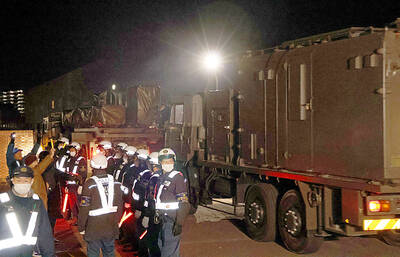
CLOSER TO CHINA: The upgraded Type-12 missile has a range of about 1,000km, compared with the original model’s range of 200km, and can reach mainland China Japan is preparing to deploy its first batch of domestically developed long-range missiles, with their launchers arriving at an army camp yesterday, as the country accelerates its offensive capability in response to rising challenges in the region. The upgraded Type-12 land-to-ship missiles are to be deployed at Camp Kengun in Japan’s southwestern prefecture of Kumamoto by the end of this month, completing the process of deployment, Japanese Chief Cabinet Secretary Minoru Kihara said without giving details. Army vehicles carrying the launchers and other equipment arrived past midnight in a highly secretive mission criticized by residents. Dozens of people stood outside of the


 RSS
RSS