


Dozens of students and activists last night took part in a silent procession around the Executive Yuan compound in Taipei, marking the one-year anniversary of the bloody police crackdown on the Executive Yuan protests on March 23 last year during the Sunflower movement.
Led by a coalition of youth activist groups, the participants paid respect to protesters who were injured in last year’s demonstrations, which ended violently after then-premier Jiang Yi-huah (江宜樺) ordered the police to clear the protesters by dawn on March 24.
Since April last year, about 50 injured protesters have filed lawsuits against Jiang, then-National Police Agency director Wang Cho-chiun (王卓鈞) and other police officials over charges related to police brutality — including charges of attempted murder.
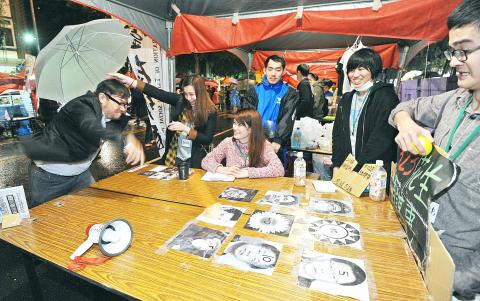
Photo: Liu Hsin-de, Taipei Times
Student activist Huang Yen-ju (黃燕如), a member of the Black Island National Youth Front, said that the exact number of protesters injured in the movement might remain unknown, as many protesters have been reluctant to file charges or apply for medical assistance out of fear of police prosecution.
Following the incident, the Taipei District Prosecutors’ office indicted 93 students on charges of unauthorized entry, citing Article 306 of the Criminal Code. The number was significantly higher than the 22 protesters indicted for the occupation of the Legislative Yuan’s main chamber.
The Executive Yuan protests occurred a week into the Sunflower movement protests last year, triggered by mounting dissatisfaction over a lack of an official response from the government toward demands for oversight of the proposed cross-strait service trade agreement.
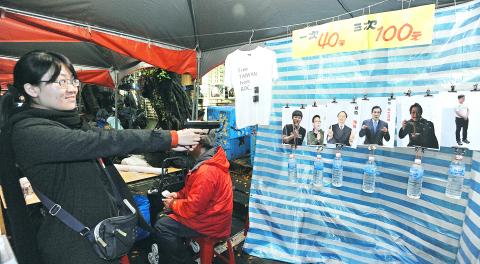
Photo: Liu Hsin-de, Taipei Times
While student-led protesters occupied the Legislative Yuan’s main chamber for 23 days — from March 18 to April 10 — the siege to occupy the nearby Executive Yuan compound ended in failure, as the police armed with batons, shields and water cannons swiftly overwhelmed protesters during the night.
The crackdown, which utilized a show of force unseen in Taiwan in more than two decades, has often been described as a turning point for the Sunflower movement, as public sympathy swelled in support for the injured protesters.
The incident revealed hidden fault lines among participants of the Sunflower movement, as leading activists based in the Legislative Yuan’s main chamber later distanced themselves from the decision to storm the Executive Yuan.
Last night’s event was held as part of a two-day event commemorating the Sunflower movement’s anniversary titled “Walking Back to the Place Without God.”
In heavy rainfall, the solemn procession paused momentarily when it reached Beiping E Road on the northern side of the Executive Yuan compound, as participants stopped to offer their blessings to the protesters who were injured.
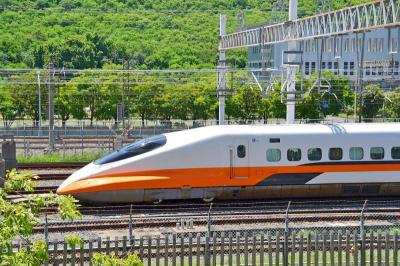
A signaling system malfunction disrupted high-speed rail (HSR) services beginning at 8am today, with trains temporarily reduced to three northbound and three southbound trains per hour as authorities conduct inspections. The malfunction occurred on a section of track in Miaoli County during pre-operation checks early this morning, forcing northbound and southbound trains to use a single track, the HSR operator said. The regular schedule has been replaced with three hourly trains offering only nonreserved seating in each direction, stopping at every station, it said, adding that business class cars would still have reserved seating. Departures from terminal stations are scheduled at the top

DRONE CENTRAL: Taiwan aims to become Asia’s democratic hub for drones, with most exports focused on high-quality military-grade models, an official said Taiwan’s drone industry is expected to expand significantly by 2030, producing 100,000 units per month and exporting half of them, the Ministry of Economic Affairs said yesterday. Current drone production capacity is about 15,000 units per month, but the industry can quickly scale up as demand increases, Industrial Development Administration Director-General Chiou Chyou-huey (邱求慧) told a news conference in Taipei. Taiwan’s drone output grew 2.5-fold last year to NT$12.9 billion (US$408.3 million) under a government program to develop the uncrewed vehicle sector, he said. The Executive Yuan in October last year approved plans to invest NT$44.2 billion into domestic production of uncrewed aerial
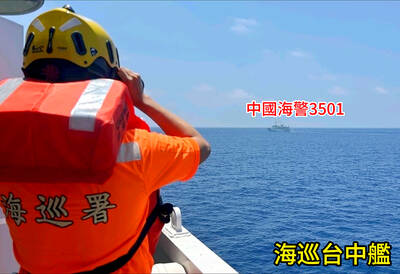
VERBOSE VESSELS: A CGA cutter and a China Coast Guard exchanged verbal barbs for more than a day in Taiwanese-controlled waters before the Chinese vessel left The Taiwanese and Chinese coast guards had a standoff near the strategically located Pratas Islands (Dongsha Islands, 東沙群島) in the north of the South China Sea, the Coast Guard Administration (CGA) said yesterday. The two sides engaged in intense radio exchanges over sovereignty claims during the 33-hour standoff. China Coast Guard vessel 3501 eventually left the restricted waters, 26.6 nautical miles (49.2km) west of the Pratas Islands, at 5pm yesterday, the CGA said. Lying approximately between southern Taiwan and Hong Kong, the Taiwan-controlled Pratas are seen by some security experts as vulnerable to Chinese attack due to their distance — more than
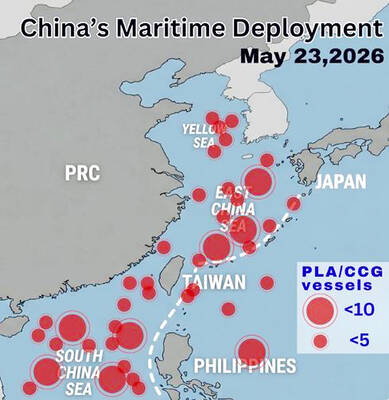
WARNING: China should stop engaging in actions that undermine regional peace and stability, as it would only build resentment among people across the Strait, the CGA said China has deployed more than 100 navy, coast guard and other vessels in waters from the Yellow Sea to the South China Sea and the western Pacific since US President Donald Trump and Chinese President Xi Jinping (習近平) met in Beijing, National Security Council Secretary-General Joseph Wu (吳釗燮) said yesterday. “In this part of the world, #China is the one & only PROBLEM wrecking the #StatusQuo & threatening regional peace & stability,” Wu wrote on X. In a separate post, he said Beijing was coercing Taiwan’s maritime domain, calling it illegal and provocative, after the Coast Guard Administration (CGA) expelled a


 RSS
RSS