


The Buddhist Compassion Relief Tzu Chi Foundation yesterday announced that it would retract its proposed development plan to set up a logistics center and workshops for disaster relief in a geologically sensitive protected area in Taipei’s Neihu District (內湖), while saying that it would make public all records about donations by its followers and how the money is spent.
Tzu Chi deputy chief executive Wang Tuan-cheng (王端正) told a news conference in Hualien that the foundation is “deeply unnerved” by the controversy sparked by the development plan and would retract its proposal to rezone a 4.4 hectare plot until society could reach a consensus on the issue.
Environmentalists say that the proposed site is located on a former pond which the foundation illegally reclaimed, increasing the chances of flooding in nearby farmland.
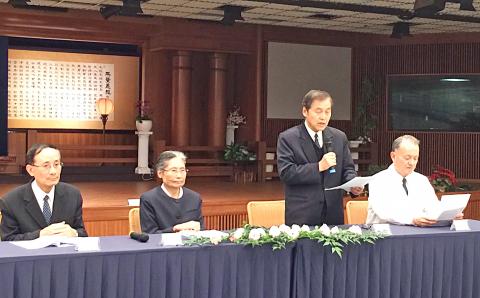
Photo: CNA
In addition, potential dip slopes are present in the area, which could lead to landslides, they say.
To promote environmental protection, Tzu Chi would cooperate with the Taipei City Government and seek advice on how to care for the protected area, Wang said.
Furthermore, Tzu Chi would restructure itself by inviting reputable individuals to serve as members of its board of directors to monitor and improve the foundation’s operations, he said.
Foundation deputy chief executive Lin Pi-yu (林碧玉) said Tzu Chi would make information about donations available online from Friday, while expenditure would be made public starting from Wednesday next week.
Lin made the announcement after media personalities Clara Chou (周玉蔻) and Jimmy Wang (汪潔民) last week accused Tzu Chi of pocketing donations, including a NT$1.5 billion (US$47.1 million) sum from its emergency reserve to purchase real estate.
Stock analyst Huang Shih-tsung (黃世聰) alleged that the foundation misappropriated funds it acquired for disaster relief to purchase bonds and stock.
Environmental activists criticized Tzu Chi’s announcement.
Treasure Our Land, Taiwan secretary-general Lin Tzu-lin (林子淩) said Tzu Chi is trying to buy time to gather the opinions of those who are in favor of the project and that it still intends to develop the protected area.
“What is the point in vowing to publish its accounts when there is so much confusion about its past dealings? Besides, it failed to respond to accusations it bought stock using donations,” Lin said.
In a press release, Taipei Deputy Mayor Charles Lin (林欽榮) expressed his thanks to Tzu Chi for proactively resolving years of controversy surrounding the development proposal.
He said the city government would send the withdrawal documents to the Taipei Urban Planning Commission as soon as they were received, expressing his hope that the land could become part of a gradual restoration of the ecology of Dahu (大湖).
Additional reporting by Abraham Gerber

A signaling system malfunction disrupted high-speed rail (HSR) services beginning at 8am today, with trains temporarily reduced to three northbound and three southbound trains per hour as authorities conduct inspections. The malfunction occurred on a section of track in Miaoli County during pre-operation checks early this morning, forcing northbound and southbound trains to use a single track, the HSR operator said. The regular schedule has been replaced with three hourly trains offering only nonreserved seating in each direction, stopping at every station, it said, adding that business class cars would still have reserved seating. Departures from terminal stations are scheduled at the top

DRONE CENTRAL: Taiwan aims to become Asia’s democratic hub for drones, with most exports focused on high-quality military-grade models, an official said Taiwan’s drone industry is expected to expand significantly by 2030, producing 100,000 units per month and exporting half of them, the Ministry of Economic Affairs said yesterday. Current drone production capacity is about 15,000 units per month, but the industry can quickly scale up as demand increases, Industrial Development Administration Director-General Chiou Chyou-huey (邱求慧) told a news conference in Taipei. Taiwan’s drone output grew 2.5-fold last year to NT$12.9 billion (US$408.3 million) under a government program to develop the uncrewed vehicle sector, he said. The Executive Yuan in October last year approved plans to invest NT$44.2 billion into domestic production of uncrewed aerial
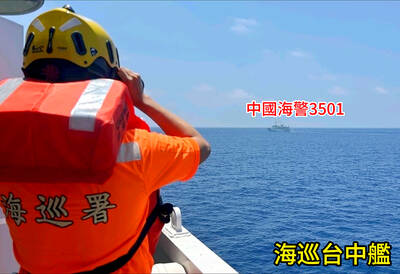
VERBOSE VESSELS: A CGA cutter and a China Coast Guard exchanged verbal barbs for more than a day in Taiwanese-controlled waters before the Chinese vessel left The Taiwanese and Chinese coast guards had a standoff near the strategically located Pratas Islands (Dongsha Islands, 東沙群島) in the north of the South China Sea, the Coast Guard Administration (CGA) said yesterday. The two sides engaged in intense radio exchanges over sovereignty claims during the 33-hour standoff. China Coast Guard vessel 3501 eventually left the restricted waters, 26.6 nautical miles (49.2km) west of the Pratas Islands, at 5pm yesterday, the CGA said. Lying approximately between southern Taiwan and Hong Kong, the Taiwan-controlled Pratas are seen by some security experts as vulnerable to Chinese attack due to their distance — more than
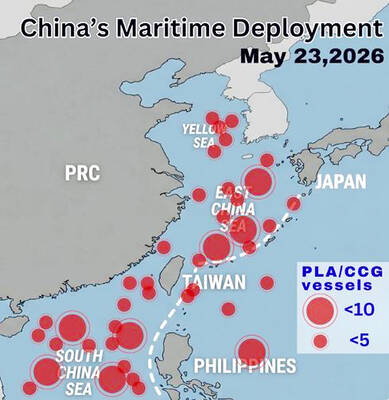
WARNING: China should stop engaging in actions that undermine regional peace and stability, as it would only build resentment among people across the Strait, the CGA said China has deployed more than 100 navy, coast guard and other vessels in waters from the Yellow Sea to the South China Sea and the western Pacific since US President Donald Trump and Chinese President Xi Jinping (習近平) met in Beijing, National Security Council Secretary-General Joseph Wu (吳釗燮) said yesterday. “In this part of the world, #China is the one & only PROBLEM wrecking the #StatusQuo & threatening regional peace & stability,” Wu wrote on X. In a separate post, he said Beijing was coercing Taiwan’s maritime domain, calling it illegal and provocative, after the Coast Guard Administration (CGA) expelled a


 RSS
RSS