


Taiwan Solidarity Union (TSU) legislators yesterday occupied the legislative speaker’s podium to protest against China’s unilateral establishment of an air route close to the median line of the Taiwan Strait and the government agreeing to China’s “trial flights” before the route is implemented.
The Mainland Affairs Council and the Civil Aeronautics Administration (CAA) on Monday night announced that Chinese air route M503, unilaterally announced by Beijing on Jan. 12 and just 7.8km from the median line at its nearest point, would be moved 6 nautical miles (11km) to the west and its implementation be delayed until China conducted test flights along the path.
Three feeder routes — W121, W122 and W123 — are to be temporarily frozen, they said.
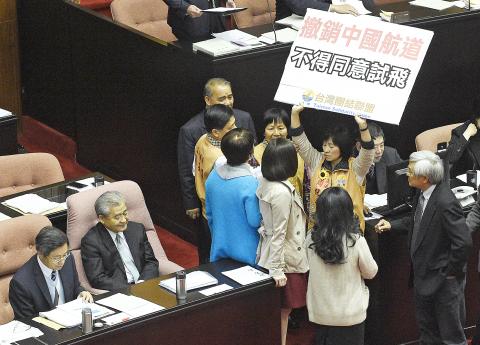
Photo: Chen Chih-chu, Taipei Times
“We are not satisfied with the conclusion, but on the basis of maintaining flight safety and national security, we are settling for [the unsatisfactory resolution],” Premier Mao Chi-kuo (毛治國) told the legislature yesterday morning.
When pressed by reporters to describe what he found unsatisfactory, Mao said that China moving the proposed route farther west would be a better outcome.
While a nation may establish new air routes in its flight information region, it is obligated to negotiate with neighboring nations, Mainland Affairs Council Minister Andrew Hsia (夏立言) said, citing regulations set by the International Civil Aviation Organization.
Hsia added that the implementation date for the M503 air route would be renegotiated after Beijing gathers information during its trial flights, saying that “trial flights” are not a “trial operation.”
TSU legislators occupied the podium before the question-and-answer session on the Cabinet’s policy report, shouting denunciations against Beijing’s establishment of the routes and Taipei’s approval of the trial flights.
The routes were “unilaterally set” and “put [Taiwan’s] flight safety at risk,” they said.
If Taiwan acquiesced after China arbitrarily established the routes without prior notice and negotiation, “there will be no end to it” in the future, TSU caucus whip Lai Cheng-chang (賴振昌) said.
Lai later questioned Mao’s “settling for” the unsatisfactory conclusion, asking the premier how he could be certain that Chinese aircraft would not fly eastward or that other routes would not be established east of M503 in the future.
“It is not possible that [China] would establish other air routes east of the M503,” Mao said.
Beijing has promised that the aircraft on the M503 route would move to the west if they must deviate from the course during emergencies, he said, adding that Beijing also assured Taipei that the routes are to be for civil aviation, and that “Chinese fighter jets would not be entering the region.”
“It is a plus to our national security,” he added.
The Democratic Progressive Party (DPP) said China’s revised M503 route was unacceptable.
Moving the M503 route farther west without canceling it still endangers national security, DPP spokesman Cheng Yun-peng (鄭運鵬) said on Monday night.
Beijing’s unilateral move to open new flight routes without first negotiating them with Taipei infringes on Taiwan’s flight security, national security and sovereignty, while violating the spirit of international civil aviation conventions, he said.
The DPP objected to Beijing’s move and called for the government to take action to safeguard the nation’s interests, he said.
All major cross-strait issues require considerable negotiation and understanding between the two sides of the Taiwan Strait to maintain peace and stability in the region, he said.
Meanwhile, Ministry of National Defense spokesman Major General David Lo (羅紹和) told a news conference in Taipei that the military has response measures in place and will closely monitor aircraft flying over the Taiwan Strait to ensure national safety.
Military air patrols will continue to protect Taiwan’s airspace, and those patrols and combat training in the area will not be affected by China’s planned flight routes, Lo said.
He said the military is capable of effectively monitoring all aircraft near the Strait and denied a report that cited an unnamed military official as saying that China’s new flight routes could overburden Taiwan’s air defenses.
Since direct flights between Taiwan and China were launched in 2008, the defense ministry has been able to monitor all 280,000 civilian aircraft, including 140,000 Chinese planes, crossing the Strait.
The ministry has rigorous monitoring measures and will continue its efforts to safeguard the nation, he said.
“The military is able and is confident of ensuring the safety of Taiwan’s air space,” Lo said.
Meanwhile, China’s Taiwan Affairs Office spokesperson Ma Xiaoguang (馬曉光) told a news conference at the Shanghai Area Control Center that Taiwan should not politicize the route issue.
The M503 route has no strategic value in military terms, Ma said.
To delay implementation of the M503 route is the most friendly gesture Beijing could make, Chinese Air Traffic Management Bureau Director Che Jin-jun (車進軍) said, adding that the route is a “peace line” between Taiwan and China.

‘NO SECURITY RISK’: The Railway Bureau reassured the public that the technicians’ activities were limited to technical guidance and did not involve sensitive systems The Railway Bureau yesterday said it had invited eight Chinese technicians to assist with an airport MRT construction project. The bureau issued the confirmation after an Internet user said Chinese nationals had entered the construction zone of Taiwan Taoyuan International Airport’s Terminal 3 project. They asked why “individuals from an enemy state” were allowed access to such a major national infrastructure project, which raised serious concerns over Taiwan’s industrial safety, sensitive systems and information security. The bureau’s Northern Region Engineering Branch Office said subcontractor Taiwan Handle Industrial Co (台灣手把工業) of the Taoyuan airport MRT’s “Contract No. CU05 Project A14 Station Civil, MEP &

The National Chungshan Institute of Science and Technology yesterday showcased its locally developed variants of the Vision 60 robotic patrol dog, which it plans to deploy on the nation’s outlying territories in the South China Sea. The variants were produced under the Joint Lab project — created by the institute and domestic companies — and assembled with domestically produced motors, lenses and artificial intelligence (AI) systems alongside licensed tech from the US, Missile and Rocket Systems Research Division deputy director Jen Kuo-kang (任國光) told the media event at a military base in Taipei’s Dazhi (大直) area. Taiwan has built up its strengths

RIGHT DIRECTION: Taiwan’s efforts to prevent forced labor include a proposal to ‘fully prohibit’ employers from withholding workers’ documents, an official said Taiwan is to establish a mechanism to restrict imports of goods linked to forced labor, the Executive Yuan said yesterday, after the US proposed imposing additional tariffs on Taiwanese goods over labor concerns. “The Ministry of Labor and the Ministry of Economic Affairs are to establish an interministerial review procedure,” Executive Yuan spokesperson Michelle Lee (李慧芝) said at a news briefing in Taipei. “The government is to use the Foreign Trade Act [貿易法] as the legal basis to restrict imports of goods produced with forced labor” and bring its supply chain governance more in line with international standards on human rights, resilience

NOT IMMEDIATE: Taiwan has a chance to appeal the proposed 10 percent tariff before it starts, while other countries face a 12.5 percent tariff from the trade office Taiwan is among 60 economies determined by the US to have failed to impose or enforce a ban on the importation of goods produced with forced labor, according to a notice released on Tuesday by the Office of the US Trade Representative (USTR), which proposed imposing an additional 10 percent or more tariff on them. The USTR in a statement said that following an investigation, it had determined under Section 301 of the Trade Act of 1974 that the failure of the 60 economies to impose and effectively enforce a prohibition on the importation of goods produced with forced labor is


 RSS
RSS