


China on Saturday said that it is willing to hold more discussions with Taiwan over its planned opening of four flight routes just west of the Taiwan Strait’s median line.
China’s Taiwan Affairs Office spokesperson Ma Xiaoguang (馬曉光) said Beijing would be willing to discuss “technical issues” related to the use of flight route M503 soon.
On Monday last week, Beijing unilaterally announced that it planned to open a new route, M503, that hugs the median line of the Taiwan Strait and three east-west routes — W121, W122 and W123 — that connect with it, sparking strong opposition in Taiwan.
On Friday last week, the Legislative Yuan issued a statement panning China’s unilateral decision to open new air routes, while calling on the Executive Yuan and the Ministry of Foreign Affairs to take strong action over the matter.
Taiwan has said that the new flight routes, which China intends to implement beginning on March 5, would create flight risks under abnormal situations such as bad weather conditions.
The Civil Aeronautics Administration (CAA) said the M503 route was too close to the Taipei Flight Information Region, a key air transportation hub in the West Pacific, while routes W121, W122 and W123 could affect flights between Taiwan and Kinmen and Matsu.
However, Ma reiterated in a statement that the opening of route M503 was a response to the increasing number of flights on the western side of the Taiwan Strait and an attempt at addressing flight congestion.
China has also prepared adequate safety measures for the use of M503 to ensure flight safety, Ma said, arguing that the M503 route would not affect the operations of flight routes in neighboring airspace.
Chinese civil aviation officials discussed the planned flight routes with their Taiwanese counterparts twice last month, Ma said, and officials on both sides of the Taiwan Strait are expected to hold more discussions on the matter soon.
Ma said China hopes Taiwan will fully understand the reasons behind the new flight route plan through further discussion.
The CAA said in response that no decision has been made on when to hold discussions.
Acting Minister of Transportation and Communications Chen Jian-yu (陳建宇) said he hoped the two sides will hold frequent discussions on the issue before the new flight routes are set to be implemented in March.
He also urged Beijing to shift the planned flight routes further west, closer to China’s coastline.
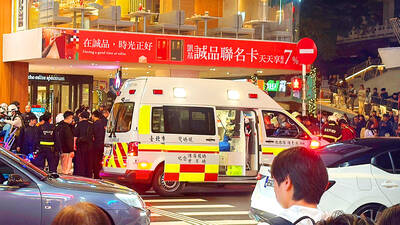
TRAGEDY STRIKES TAIPEI: The suspect died after falling off a building after he threw smoke grenades into Taipei Main Station and went on a killing spree in Zhongshan A 27-year-old suspect allegedly threw smoke grenades in Taipei Main Station and then proceeded to Zhongshan MRT Station in a random killing spree that resulted in the death of the suspect and two other civilians, and seven injured, including one in critical condition, as of press time last night. The suspect, identified as a man surnamed Chang Wen (張文), allegedly began the attack at Taipei Main Station, the Taipei Fire Department said, adding that it received a report at 5:24pm that smoke grenades had been thrown in the station. One man in his 50s was rushed to hospital after a cardiac arrest
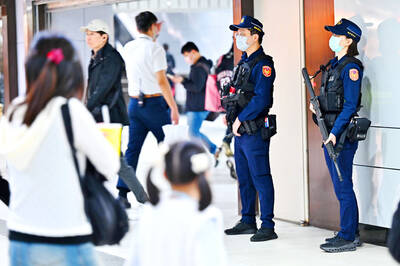
PUBLIC SAFETY: The premier said that security would be tightened in transport hubs, while President Lai commended the public for their bravery The government is to deploy more police, including rapid response units, in crowded public areas to ensure a swift response to any threats, President William Lai (賴清德) said yesterday after a knife attack killed three people and injured 11 in Taipei the previous day. Lai made the remarks following a briefing by the National Police Agency on the progress of the investigation, saying that the attack underscored the importance of cooperation in public security between the central and local governments. The attack unfolded in the early evening on Friday around Taipei Main Station’s M7 exit and later near the Taipei MRT’s Zhongshan
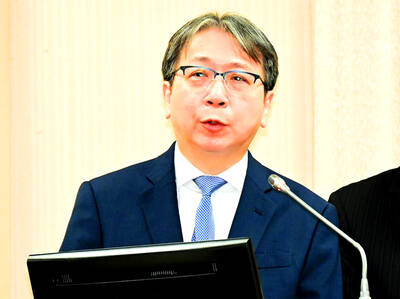
ON ALERT: Taiwan’s partners would issue warnings if China attempted to use Interpol to target Taiwanese, and the global body has mechanisms to prevent it, an official said China has stationed two to four people specializing in Taiwan affairs at its embassies in several democratic countries to monitor and harass Taiwanese, actions that the host nations would not tolerate, National Security Bureau (NSB) Director-General Tsai Ming-yen (蔡明彥) said yesterday. Tsai made the comments at a meeting of the legislature’s Foreign Affairs and National Defense Committee, which asked him and Minister of National Defense Wellington Koo (顧立雄) to report on potential conflicts in the Taiwan Strait and military preparedness. Democratic Progressive Party (DPP) Legislator Michelle Lin (林楚茵) expressed concern that Beijing has posted personnel from China’s Taiwan Affairs Office to its
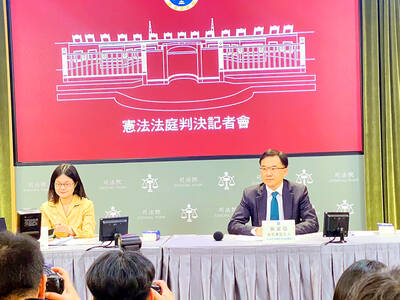
‘ILLEGAL RULING’: The KMT and the TPP slammed the Constitutional Court judgement, saying it contravened the law and was trying to clear the way for a ‘green dictatorship’ The Constitutional Court yesterday ruled that amendments to the Constitutional Court Procedure Act (憲法訴訟法) passed by the Legislative Yuan last year are unconstitutional, as they contravene due legislative process and separation of powers. The Legislative Yuan on Dec. 20 last year passed amendments stipulating that no fewer than 10 grand justices must take part in deliberations of the Constitutional Court, and at least nine grand justices must agree to declare a law unconstitutional. The Executive Yuan on Jan. 2 requested that lawmakers reconsider the bill, but the Legislative Yuan, under a combined majority of Chinese Nationalist Party (KMT) and Taiwan People’s Party


 RSS
RSS