


The legislature’s Social Welfare and Environmental Hygiene Committee yesterday approved a series of draft amendments to the Water Pollution Control Act (水汙染防治法), seeking to impose stiffer penalties on firms found to have illegally discharged wastewater or sewage.
If the draft amendments clear the legislative floor, firms that discharge wastewater, or arbitrarily dump or fail to properly handle sewage will be subject to a maximum fine of NT$20 million (US$658,000), a significant increase from NT$60,000.
Businesses could also face mandatory shutdowns and rescission of their discharge permits if they fail to make the necessary improvements within a statutory period.
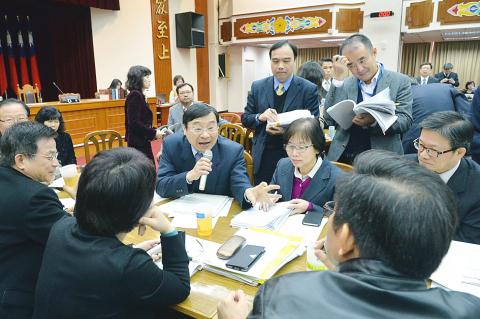
Photo: CNA
In addition, owners of firms that emit potentially hazardous wastewater without permission could be sentenced to as many as seven years in prison, which would be commutable to a NT$20 million fine if the transgression causes illness, with the maximum length of prison terms increasing to between 10 years and life should illicit conduct lead to disability or death.
The preliminary passage of the draft amendments was prompted primarily by the Kaohsiung District Court’s decision in October last year to issue a fine of just NT$3 million to Advanced Semiconductor Engineering Inc (AEC, 日月光半導體), the world’s largest IC packaging and testing services provider for dumping massive amounts of wastewater into the city’s Houjin River (後勁溪).
Other major changes proposed by the draft amendments include increasing the maximum fine from NT$120,000 to NT$600,000 for proprietors of establishments engaged in animal husbandry who are caught illegally discharging sewage; offering whistleblowers a certain percentage of any fines as a reward; and barring firms found violating the act from receiving government benefits for three years.
Attorney and environmentalist Thomas Chan (詹順貴) lauded the draft bill’s preliminary passage, saying that he was particularly pleased to see Chinese Nationalist Party (KMT) legislators finally willing to join the right side.
Citizen of the Earth, Taiwan director Tsai Hue-hsun (蔡卉荀) said she was glad to see environmentalists’ push for the amendments finally coming to fruition.
However, Tsai said she was disappointed by the Council of Agriculture’s insistence on not setting the maximum fine for animal husbandry firms caught breaking the rules at NT$1.2 million, which the council said was a bid to protect small businesses.
“If the council is willing to offer fallow subsidies to rice farmers, why not use government resources to help small pig farms improve their wastewater treatment systems?” Tsai said.
Meanwhile, the Finance Committee approved an amendment to adjust downward the ceiling of revolving interest rates that domestic credit card and cash-advance card issuers can charge cardholders from 20 to 15 percent.
According to the Civil Law (民法), the ceiling for annual interest rates is generally set at 20 percent for the private sector. In a bid to ease the burden on hundreds of thousands of cardholders, the Financial Supervisory Commission (FSC) last year issued an administrative order asking card issuers to keep their revolving interest rates at 16 percent or lower.
Some lawmakers, led by KMT Legislator Chen Ken-te (陳根德), had proposed setting the ceiling as low as 12 percent.
“Even at the commission’s request, I doubt if all the banks have followed the administrative order,” Chen said yesterday.
The commission and lawmakers reached a consensus on the issue, which led the committee to pass the preliminary review of a proposed amendment to the Banking Act (銀行法), adding a clause to cap revolving interest rates at 15 percent.
If the proposal is approved by the Legislative Yuan, the regulation could take effect in September at the earliest.
FSC Chairman William Tseng (曾銘宗) said that internal research showed that banks might be able to cover the cost of revolving credit with a revolving interest rate set at between 13 and 15 percent.
“Local banks should still receive sufficient payments under the move to cover their costs,” Tseng said.
Banking Bureau director-general Austin Chan (詹庭禎) said that if the amendment were to take effect later this year, it would benefit 800,000 to 900,000 cardholders.
However, the move could result in net losses of between NT$400 million and NT$500 million per year for the banking sector, Chan said, citing estimates made by the Bankers’ Association of the Republic of China (銀行公會).
The Finance Committee yesterday passed another amendment to the Banking Act, to extend the maximum limitation of a local bank’s reinvestment to 40 percent of its net asset worth.
The investment cap was previously set at 40 percent of a bank’s registered capital, which showed a gap of more than NT$1 trillion between the nation’s banking sector and the sector’s net asset worth.
The move might offer domestic banks more chances for mergers and acquisitions worth as much as NT$500 billion across the sector.
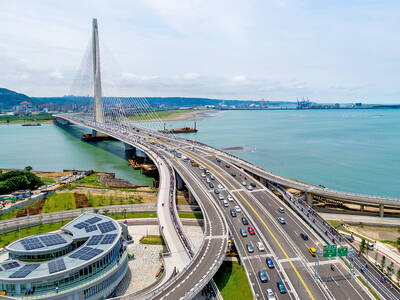
The Ministry of Transportation and Communications yesterday inaugurated the Danjiang Bridge across the Tamsui River in New Taipei City, saying that the structure would be an architectural icon and traffic artery for Taiwan. Feted as a major engineering achievement, the Danjiang Bridge is 920m long, 211m tall at the top of its pylon, and is the longest single-pylon asymmetric cable-stayed bridge in the world, the government’s Web site for the structure said. It was designed by late Iraqi-British architect Zaha Hadid. The structure, with a maximum deck of 70m, accommodates road and light rail traffic, and affords a 200m navigation channel for boats,
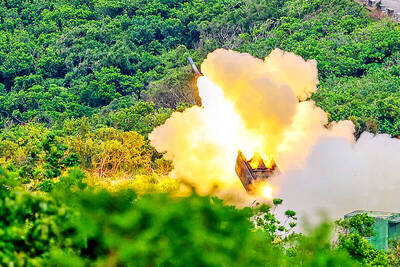
PRECISION STRIKES: The most significant reason to deploy HIMARS to outlying islands is to establish a ‘dead zone’ that the PLA would not dare enter, a source said A High Mobility Artillery Rocket System (HIMARS) would be deployed to Penghu County and Dongyin Island (東引) in Lienchiang County (Matsu) to force the Chinese military to retreat at least 100km from the coastline, a military source said yesterday. Taiwan has been procuring HIMARS and Army Tactical Missile Systems (ATACMS) from the US in batches. Once all batches have been delivered, Taiwan would possess 111 HIMARS units and 504 ATACMS, which have a range of 300km. Considering that “offense is the best defense,” the military plans to forward-deploy the systems to outlying islands such as Penghu and Dongyin so that
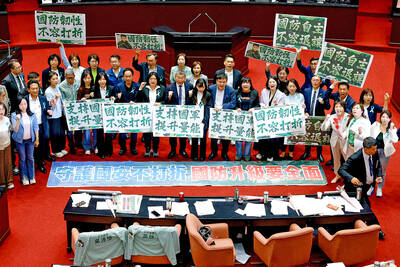
WHAT WAS ALL THAT FOR? Jaw Shaw-kong said that Cheng Li-wen had pushed for more drastic cuts and attacked him, just for the outcome to be nearly identical to his bill The legislature yesterday passed a supplementary budget bill to fund the purchase of separate packages of US military equipment, with the combined amount of spending capped at NT$780 billion (US$24.8 billion). The Chinese Nationalist Party (KMT) and Taiwan People’s Party (TPP) used their legislative majority to pass the bill, which runs until 2033 and has two main funding provisions. One was for NT$300 billion of arms sales already approved by the US for Taiwan on Dec. 17 last year, the other was for NT$480 billion for another arms package expected to be announced by Washington. The bill, which fell short of the NT$1.25
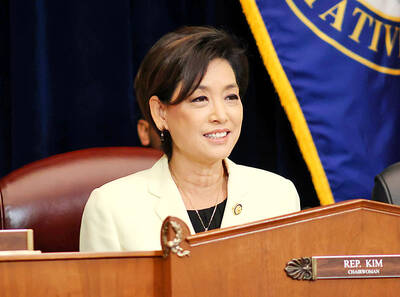
‘CLEAR MESSAGE’: The bill would set up an interagency ‘tiger team’ to review sanctions tools and other economic options to help deter any Chinese aggression toward Taiwan US Representative Young Kim has introduced a bill to deter Chinese aggression against Taiwan, calling for an interagency “tiger team” to preplan coordinated sanctions and economic measures in response to possible Chinese military or political action against Taiwan. “[Chinese President] Xi Jinping [習近平] has directed the People’s Liberation Army to be ready to invade Taiwan by 2027. China has a plan. America should have one too,” Kim said in a news release on Thursday last week. She introduced the “Deter PRC [People’s Republic of China] aggression against Taiwan act” to “ensure the US has a coordinated sanctions strategy ready should


 RSS
RSS