


A-ho, the male hippopotamus that sustained serious injuries when it fell from a moving truck as he was being transported to a zoo on Friday, was found dead yesterday morning in Greater Taichung.
Caretakers found the animal’s body at about 6:30am in a pond after noticing that it had not swum ashore to rest overnight.
The hippo had been placed in a pond at a farm in Taichung following Friday’s incident, but not before suffering a second fall on Saturday while being transported to receive treatment. A-ho fell from a height of 2m after a cable on a hoist holding the container he was in snapped.
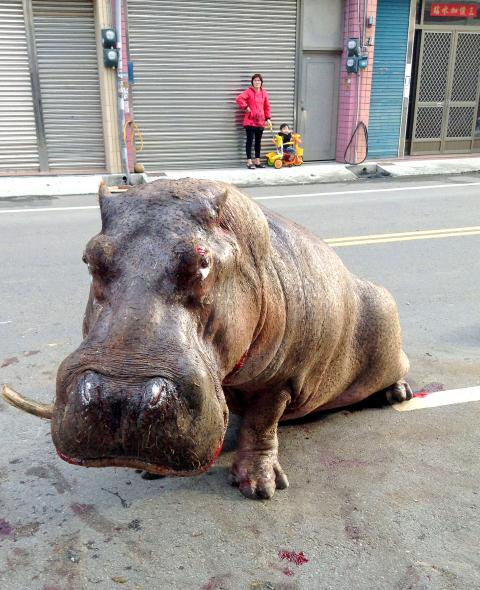
Photo: EPA
An autopsy report issued by Taipei Zoo yesterday afternoon found that the hippo had sustained a 30cm to 40cm laceration to the right of its septum and that its lungs had dropped into its abdominal cavity, while the surface of its liver showed signs of hemorrhaging.
Council of Agriculture Minister Chen Bao-ji (陳保基) said that the keeper at the Taichung-based Sky Zoo (天馬牧場) who was in charge of the mammal would face the maximum punishment of one year in jail over A-ho’s death.
Regardless of the technical reasons behind the accidents, it is clear that they were the result of Sky Zoo’s negligence, Chen said.
“Now that the hippopotamus is dead, its keeper will face the maximum punishment stipulated in the Animal Protection Act (動物保護法),” he added.
Article 30 of the act states that those who mistreat animals, leading to injuries or death, face a maximum prison term of one year, Chen said.
Meanwhile, the Environment and Animal Society of Taiwan (EAST) lashed out at Sky Zoo, saying that the facility could not provide any documents proving its ownership of the hippo, but had still displayed it as part of its menagerie.
EAST director Chen Yu-min (陳玉敏) called for Article 9, Clause 1 of the act to be amended to include punishments for facilities that inadequately transfer animals.
The group also highlighted a string of loopholes in the act, which it said does not contain any regulations on how animals are sourced, traded, sold, bred or exhibited.
Saying that A-ho’s case provided only a glimpse into the atrocious treatment animals routinely receive at zoos and facilities that put on animal performances and exhibitions, EAST requested that local governments launch a systematic probe into such establishments — including to inventory the animals they possess, and determine the creatures’ origins and health conditions — and asked the council to oversee the process.
EAST chief executive officer Wu Hung (朱增宏) criticized Taipei Zoo for adopting what it called an apathetic attitude after learning of A-ho’s accidents, even though it possesses the largest animal care and medical treatment resources in the nation.
Democratic Progressive Party Legislator Tien Chiu-chin (田秋堇) called on members of the legislature’s Economics Committee to pass a draft amendment to the act that would require all facilities housing animals to acquire a license before they are allowed to start operations.
Current regulations only require such facilities to register with local governments, and they only deal with performances and exhibitions involving protected species.

CREDIT-GRABBER: China said its coast guard rescued the crew of a fishing vessel that caught fire, who were actually rescued by a nearby Taiwanese boat and the CGA Maritime search and rescue operations do not have borders, and China should not use a shipwreck to infringe upon Taiwanese sovereignty, the Coast Guard Administration (CGA) said yesterday. The coast guard made the statement in response to the China Coast Guard (CCG) saying it saved a Taiwanese fishing boat. The Chuan Yu No. 6 (全漁6號), a fishing vessel registered in Keelung, on Thursday caught fire and sank in waters northeast of Diaoyutai Islands (釣魚台). The vessel left Keelung’s Badouzih Fishing Harbor (八斗子漁港) at 3:35pm on Sunday last week, with seven people on board — a 62-year-old Taiwanese captain surnamed Chang (張) and six

RISKY BUSINESS: The ‘incentives’ include initiatives that get suspended for no reason, creating uncertainty and resulting in considerable losses for Taiwanese, the MAC said China’s “incentives” failed to sway sentiment in Taiwan, as willingness to work in China hit a record low of 1.6 percent, a Ministry of Labor survey showed. The Directorate-General of Budget, Accounting and Statistics (DGBAS) also reported that the number of Taiwanese workers in China has nearly halved from a peak of 430,000 in 2012 to an estimated 231,000 in 2024. That marked a new low in the proportion of Taiwanese going abroad to work. The ministry’s annual survey on “Labor Life and Employment Status” includes questions respondents’ willingness to seek employment overseas. Willingness to work in China has steadily declined from

LEVERAGE: China did not ‘need to fire a shot’ to deny Taiwan airspace over Africa when it owns ‘half the continent’s debt,’ a US official said, calling it economic warfare The EU has raised concerns about overflight rights following the delay of President William Lai’s (賴清德) planned state visit to the Kingdom of Eswatini after three African nations denied overflight clearance for his charter at the last minute. Taiwanese allies Paraguay and Saint Kitts and Nevis, as well as several US lawmakers and the Inter-Parliamentary Alliance on China (IPAC) condemned China for allegedly pressuring the countries. Lai was scheduled to fly directly to Taiwan’s only African ally from yesterday to Sunday to celebrate the 40th anniversary of King Mswati III’s accession and his 58th birthday, but Seychelles, Mauritius and Madagascar suddenly revoked
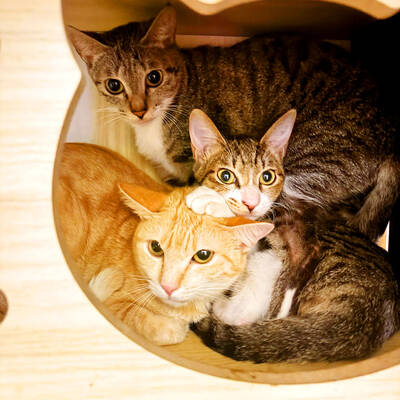
The number of pet cats in Taiwan surpassed that of pet dogs for the first time last year, reaching 1,742,033, a 32.8 percent increase from 2023, the Ministry of Agriculture said yesterday, citing a survey. By contrast, the number of pet dogs declined slightly by 1.2 percent over the same period to 1,462,528, the ministry said. Despite the shift, households with dogs still slightly outnumber those with cats by 1.2 percent. However, while the number of households with multiple dogs has remained relatively stable, households keeping more than two cats have increased, contributing to the overall rise in the feline population. The trend


 RSS
RSS