


Democratic Progressive Party (DPP) Legislator Wu Yi-chen (吳宜臻) yesterday said that she would not contest the legislative by-election in Miaoli in February next year and praised former Sunflower movement student leader Chen Wei-ting (陳為廷) for his decision to join the race, where non-Chinese Nationalist Party (KMT) candidates normally face a tough battle.
Following Chen’s announcement of his intention to run as an independent candidate in the by-election, the DPP’s office in Miaoli and Wu’s campaign team separately voiced objections to the DPP’s possible cooperation with the student activist.
Wu, who ran as DPP candidate for Miaoli County commissioner in the Nov. 29 election, but lost, apologized for the emotional response from her campaign team, which held a press conference on Monday saying that Chen is not Taipei mayor-elect Ko Wen-je (柯文哲) and calling the headquarters’ move to yield the candidacy to Chen “despicable.”
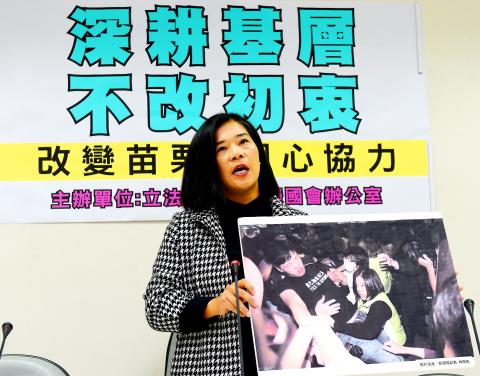
Photo: Chien Jung-fong, Taipei Times
Wu said the team only wanted local opinions to be heard and hoped the party center would see their efforts at the local level, adding that she would support anyone the DPP decides to.
At the press conference, Wu also showed a photograph from the Sunflower movement’s occupation of the Legislative Yuan’s main chamber in March and April, in which she, one of the DPP lawmakers who quickly assumed the role of guarding the chamber from the police, is seen pulling Chen away from the police.
“Chen is the pride of the Miaoli people; we are both fighting for Miaoli,” said Wu, adding that she did not regret having pulled Chen from the police simply because they were now in competition.
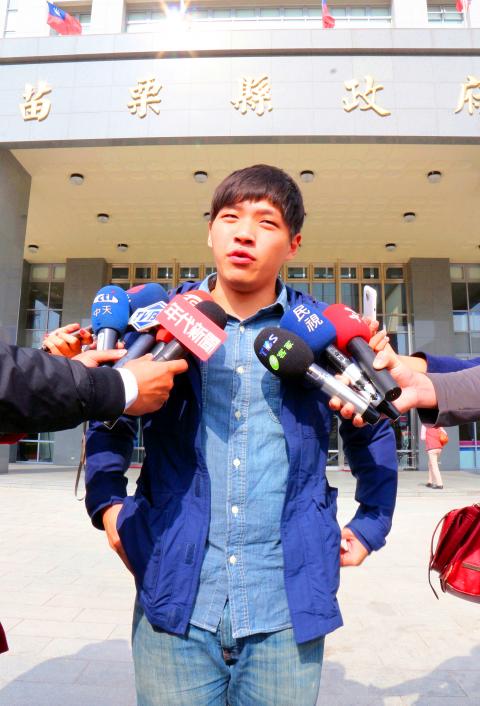
Photo: CNA
Separately, Su Jia-chyuan (蘇嘉全), the convener of the DPP’s election response measure committee, said he would visit Miaoli with committee members to gather local opinions on the candidates. The DPP’s candidate is to be decided on Wednesday next week, either by the party on its own, or in cooperation with civic groups.
Meanwhile, in Miaoli, Chen announced that his campaign team is in place in the county and would start consulting local elders this week and holding campaign events next week.
The team also plans to visit Taipei and Greater Kaohsiung to invite young people who have left Miaoli for work or study to return home to volunteer and vote for change, he said.
Chen said he would welcome Miaoli County Commissioner Liu Cheng-hung (劉政鴻) of the KMT to compete in the by-election, calling on the KMT to speed up its candidate-fielding process so its selection can come under the electorate’s scrutiny.
Chen once hurled a shoe at Liu in protest over Liu’s government’s seizure and demolition of residents’ houses for a city development project, which Chen said was really a cover for the local government’s land speculation.
Chen was later charged and fined for throwing the shoe.
Chen called the legislative by-election “a make-up exam for the KMT after its defeat,” saying that the KMT’s candidate could be a reflection of the extent of so-called party reform that has been advocated by New Taipei City Mayor Eric Chu (朱立倫), who is seeking the KMT chairmanship.
Chen thanked Wu for her withdrawal and said he would run as an independent instead of becoming a DPP member.
He said that was not out of political calculation, but a decision made out of his opposition to the KMT, along with his doubts about the DPP’s own reforms.

‘NO SECURITY RISK’: The Railway Bureau reassured the public that the technicians’ activities were limited to technical guidance and did not involve sensitive systems The Railway Bureau yesterday said it had invited eight Chinese technicians to assist with an airport MRT construction project. The bureau issued the confirmation after an Internet user said Chinese nationals had entered the construction zone of Taiwan Taoyuan International Airport’s Terminal 3 project. They asked why “individuals from an enemy state” were allowed access to such a major national infrastructure project, which raised serious concerns over Taiwan’s industrial safety, sensitive systems and information security. The bureau’s Northern Region Engineering Branch Office said subcontractor Taiwan Handle Industrial Co (台灣手把工業) of the Taoyuan airport MRT’s “Contract No. CU05 Project A14 Station Civil, MEP &

A US uncrewed surface vessel (USV) encountered multiple Chinese warships during an autonomous transit of the Taiwan Strait, US defense company Seasats said in a statement on Wednesday. Seasats announced that a Lightfish USV had completed the first autonomous transit of the Taiwan Strait. Over five days, the USV traversed the entire length of the Strait while constantly monitoring surface vessel traffic, the company said. The Lightfish encountered multiple Chinese warships, one of which was a Chinese People’s Liberation Army Navy (PLAN) Type 056 corvette, it said. The Chinese vessels were operating “well within Taiwan’s exclusive economic zone without transmitting their identity via the

Taiwan is still in the process of assessing the possibility of recruiting workers from Eswatini, the Ministry of Foreign Affairs said yesterday, adding that its goal is to help Eswatini upgrade its vocational training centers. If there are plans to recruit workers from Eswatini, safeguarding national security, protecting public health and ensuring the employment rights of Taiwanese would be prerequisites, Department of West Asian and African Affairs Director-General Yen Chia-liang (顏嘉良) told a news conference. Key considerations would also include filling labor shortages in specific industries, and fostering bilateral professional and technical exchanges, he said. Yen was asked about the progress of labor
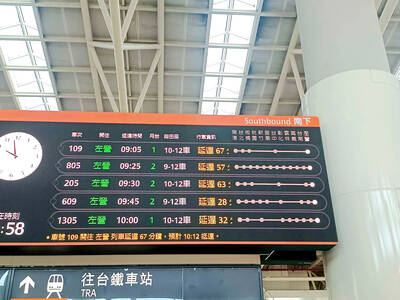
The nation’s usually punctual high-speed rail system yesterday was hit by major disruptions after all scheduled services were canceled and replaced with three hourly trains offering only non-reserved seating, affecting more than 200,000 passengers. Preliminary findings indicate the disruption was caused by a faulty power module in a track switch control cabinet, Taiwan High-Speed Rail Corp (THSRC) said, adding that as a full system inspection could only be conducted after operations end for the day, a decision on whether normal service would resume today would be announced before the first train departs. During a routine inspection early yesterday, a switch signal abnormality


 RSS
RSS