


Hopes for a major Cabinet reshuffle were dashed yesterday as the newly appointed premier announced a team filled with many old, familiar faces.
Legislators panned the “micro-changes” in the Executive Yuan as the work of a government that has grown numb to public calls for reform.
While President Ma Ying-jeou (馬英九) promised major reforms after the Chinese Nationalist Party’s (KMT) massive defeat at the nine-in-elections last Saturday, the new appointments have turned out to be mainly major promotions instead of changes of personnel.
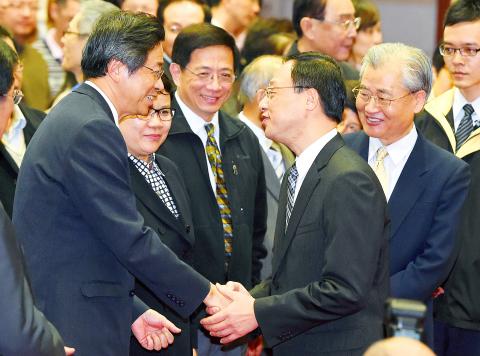
Photo: Liao Chen-huei, Taipei Times
Incoming premier Mao Chi-kuo (毛治國), who was appointed on Wednesday, served as vice premier under outgoing Premier Jiang Yi-huah (江宜樺). Mao’s new Cabinet includes: Minister of Science and Technology Simon Chang (張善政), who has been named the new vice premier; Minister Without Portfolio John Deng (鄧振中), who is to succeed Minister of Economic Affairs Woody Duh (杜紫軍); and Coast Guard Administration Deputy Minister Wang Chung-yi (王崇儀), who is to take over as head of the agency.
Other ministry heads are to remain in their posts, including Minister of Transportation and Communications Yeh Kuang-shih (葉匡時), who has been the target of unrelenting protests by former toll collectors and their supporters, and Minister of Justice Luo Ying-shay (羅瑩雪), who has been the target of criticism by various civic groups advocating legal reforms, abolition of the death penalty and marriage equality.
The vacancies left by the promotion of Chang and the resignation of Minister of Culture Lung Ying-tai (龍應台) are to be temporarily filled by their respective deputy ministers.
Environmental Protection Administration Deputy Minister Yeh Hsin-cheng (葉欣誠) has been named a minister without portfolio, as two former ministers without portfolio — Yang Chiu-hsing (楊秋興) and Chien Tai-lang (簡太郎) — had resigned to run as the KMT’s candidates for Greater Kaohsiung mayor and Pingtung County commissioner. Both lost in the polls. The other vacancy awaits future designation.
Duh, the outgoing minister of economic affairs, is stepping into the vacancy left by Deng. The two are, in effect, just swapping positions.
The much-touted en masse resignation of the Cabinet ended with only three members actually leaving: Jiang, Lung and outgoing Coast Guard Administration Minister Wang Ginn-wang (王進旺).
KMT Legislator Liao Kuo-tung (廖國棟) said people have become “numb” to the so-called new moves that the government is making in the wake of the party’s electoral defeat.
Democratic Progressive Party (DPP) Legislator Tsai Chi-chang (蔡其昌) said the minor changes made to the Cabinet showed that the KMT, despite its electoral rout, “has failed to respond to people’s calls for reforms.”
“President Ma Ying-jeou has not learned his lesson at all; he is completely at a loss on how to interpret the election results,” Tsai said.
DPP Legislator Tsai Huang-liang (蔡煌瑯) called the “old-wine-in-old-bottle” Cabinet “a caretaker Cabinet that is not blessed” and is “destined to fail.”
The new Cabinet is scheduled to take office on Monday.
Meanwhile, the legislature yesterday decided that Mao and his new Cabinet would make their policy address and reports on the central government’s general budget proposal to the legislature next Friday and on Dec. 15.
The three party caucuses will have 23 lawmakers participate in the question-and-answer session, 10 each for the KMT and the DPP and three for the Taiwan Solidarity Union.
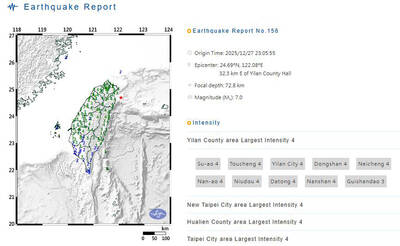
A magnitude 7.0 earthquake struck off Yilan at 11:05pm yesterday, the Central Weather Administration (CWA) said. The epicenter was located at sea, about 32.3km east of Yilan County Hall, at a depth of 72.8km, CWA data showed There were no immediate reports of damage. The intensity of the quake, which gauges the actual effect of a seismic event, measured 4 in Yilan County area on Taiwan’s seven-tier intensity scale, the data showed. It measured 4 in other parts of eastern, northern and central Taiwan as well as Tainan, and 3 in Kaohsiung and Pingtung County, and 2 in Lienchiang and Penghu counties and 1

FOREIGN INTERFERENCE: Beijing would likely intensify public opinion warfare in next year’s local elections to prevent Lai from getting re-elected, the ‘Yomiuri Shimbun’ said Internal documents from a Chinese artificial intelligence (AI) company indicated that China has been using the technology to intervene in foreign elections, including propaganda targeting Taiwan’s local elections next year and presidential elections in 2028, a Japanese newspaper reported yesterday. The Institute of National Security of Vanderbilt University obtained nearly 400 pages of documents from GoLaxy, a company with ties to the Chinese government, and found evidence that it had apparently deployed sophisticated, AI-driven propaganda campaigns in Hong Kong and Taiwan to shape public opinion, the Yomiuri Shimbun reported. GoLaxy provides insights, situation analysis and public opinion-shaping technology by conducting network surveillance
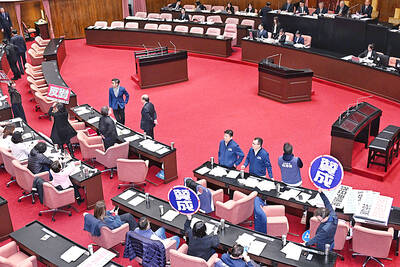
‘POLITICAL GAME’: DPP lawmakers said the motion would not meet the legislative threshold needed, and accused the KMT and the TPP of trivializing the Constitution The Legislative Yuan yesterday approved a motion to initiate impeachment proceedings against President William Lai (賴清德), saying he had undermined Taiwan’s constitutional order and democracy. The motion was approved 61-50 by lawmakers from the main opposition Chinese Nationalist Party (KMT) and the smaller Taiwan People’s Party (TPP), who together hold a legislative majority. Under the motion, a roll call vote for impeachment would be held on May 19 next year, after various hearings are held and Lai is given the chance to defend himself. The move came after Lai on Monday last week did not promulgate an amendment passed by the legislature that
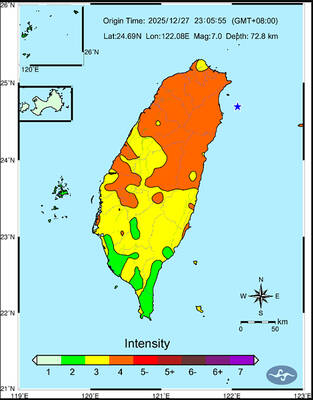
AFTERMATH: The Taipei City Government said it received 39 minor incident reports including gas leaks, water leaks and outages, and a damaged traffic signal A magnitude 7.0 earthquake struck off Taiwan’s northeastern coast late on Saturday, producing only two major aftershocks as of yesterday noon, the Central Weather Administration (CWA) said. The limited aftershocks contrast with last year’s major earthquake in Hualien County, as Saturday’s earthquake occurred at a greater depth in a subduction zone. Saturday’s earthquake struck at 11:05pm, with its hypocenter about 32.3km east of Yilan County Hall, at a depth of 72.8km. Shaking was felt in 17 administrative regions north of Tainan and in eastern Taiwan, reaching intensity level 4 on Taiwan’s seven-tier seismic scale, the CWA said. In Hualien, the


 RSS
RSS