


A group of students and citizens who participated in the occupation of the plaza of the Executive Yuan and were forcibly ejected by police on March 24 during the Sunflower movement yesterday called on outgoing Premier Jiang Yi-huah (江宜樺) to take responsibility for his part in the violence inflicted upon the protesters before attempting to return to academia.
Jiang, a former political science professor at National Taiwan University, resigned as premier to assume “political responsibility” for the Chinese Nationalist Party’s (KMT) drubbing in Saturday’s nine-in-one elections, but various controversies that occurred during his term have not been straightened out, especially the police’s violent action on March 24, the group said.
They asked that Jiang make public the decisionmaking process that led to the order demanding the forced eviction of protesters.
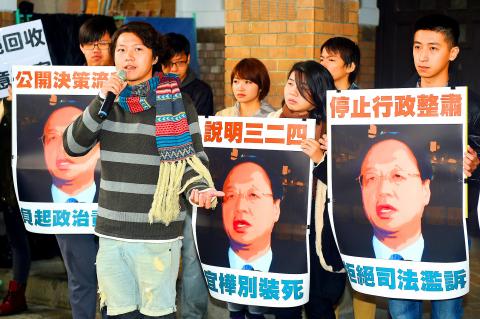
Photo: Liao Chen-huei, Taipei Times
One of the protesters, surnamed Chiu (邱), told a press conference that he was a witness to and victim of police violence that night.
He said that while the attack might be partly attributed to tensions that had built up between the police and protesters since the Sunflower movement started on March 18, he found it “hard to believe that the commander on the scene would have dared to order the officers to attack the protesters [on his own accord].”
“So the crux lies in the question of which government agency — the Executive Yuan or the National Police Agency — issued the order,” Chiu said, adding that Jiang could not leave his post believing that his conscience is clear without facing the issue.
The group called on all schools in the nation to refuse Jiang any teaching posts after he leaves the Cabinet, “since he is a negative example and has no value to either students or education per se.”
The government not only used unnecessary force and accused the protesters, but it has also continued to “abuse police power and judicial resources to harass people who on March 24 stood up against the government’s black-box [opaque]” handling of agreements with China.
Many of the protesters who filed private prosecutions against the Executive Yuan and the National Police Agency have found themselves defendants after the charges were made in court.
“Even the witnesses who came forward originally to substantiate our charges have been summoned by the police [as defendants],” said Judicial Reform Foundation deputy executive director Chen Yu-fan (陳雨凡), who has been assisting people in making the claims of abuse.
“Documents about private prosecutions provided to the court should not have ended up in the hands of prosecutors,” Chen said.
“We don’t have sufficient evidence to accuse the government of abusing the system and using what we have provided to the court to against us, but what has happened has made us entertain the possibility,” she added.
The group urged incoming premier Mao Chi-kuo (毛治國) to stop employing executive power to abuse the judicial system.
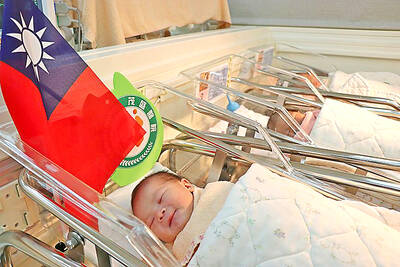
AGING: As of last month, people aged 65 or older accounted for 20.06 percent of the total population and the number of couples who got married fell by 18,685 from 2024 Taiwan has surpassed South Korea as the country least willing to have children, with an annual crude birthrate of 4.62 per 1,000 people, Ministry of the Interior data showed yesterday. The nation was previously ranked the second-lowest country in terms of total fertility rate, or the average number of children a woman has in her lifetime. However, South Korea’s fertility rate began to recover from 2023, with total fertility rate rising from 0.72 and estimated to reach 0.82 to 0.85 by last year, and the crude birthrate projected at 6.7 per 1,000 people. Japan’s crude birthrate was projected to fall below six,
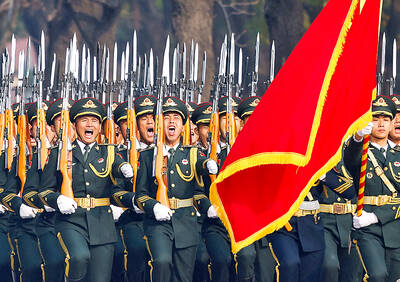
Conflict with Taiwan could leave China with “massive economic disruption, catastrophic military losses, significant social unrest, and devastating sanctions,” a US think tank said in a report released on Monday. The German Marshall Fund released a report titled If China Attacks Taiwan: The Consequences for China of “Minor Conflict” and “Major War” Scenarios. The report details the “massive” economic, military, social and international costs to China in the event of a minor conflict or major war with Taiwan, estimating that the Chinese People’s Liberation Army (PLA) could sustain losses of more than half of its active-duty ground forces, including 100,000 troops. Understanding Chinese
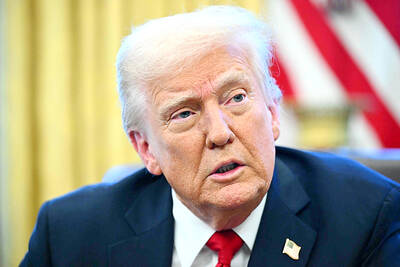
US President Donald Trump in an interview with the New York Times published on Thursday said that “it’s up to” Chinese President Xi Jinping (習近平) what China does on Taiwan, but that he would be “very unhappy” with a change in the “status quo.” “He [Xi] considers it to be a part of China, and that’s up to him what he’s going to be doing, but I’ve expressed to him that I would be very unhappy if he did that, and I don’t think he’ll do that. I hope he doesn’t do that,” Trump said. Trump made the comments in the context
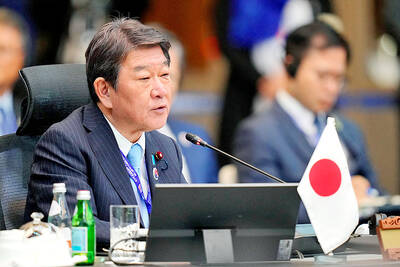
SELF-DEFENSE: Tokyo has accelerated its spending goal and its defense minister said the nation needs to discuss whether it should develop nuclear-powered submarines China is ramping up objections to what it sees as Japan’s desire to acquire nuclear weapons, despite Tokyo’s longstanding renunciation of such arms, deepening another fissure in the two neighbors’ increasingly tense ties. In what appears to be a concerted effort, China’s foreign and defense ministries issued statements on Thursday condemning alleged remilitarism efforts by Tokyo. The remarks came as two of the country’s top think tanks jointly issued a 29-page report framing actions by “right-wing forces” in Japan as posing a “serious threat” to world peace. While that report did not define “right-wing forces,” the Chinese Ministry of Foreign Affairs was


 RSS
RSS