


The Chinese Nationalist Party (KMT) yesterday appealed for unity as it sought to boost the election chances of Taipei mayoral candidate Sean Lien (連勝文) at an election eve rally, with dozens of speakers saying that the party, the city and the nation cannot afford to lose the election.
Held on Ketalagan Boulevard in front of the Presidential Office Building, the theme of the evening rally was “Taipei Sheng, Taiwan Win” (台北勝,台灣贏) — linking the election result of the capital city to the fate of the nation.
The slogan plays on the sheng character in Lien’s name “Sheng-wen” (勝文). Sheng means “victory” in Mandarin.
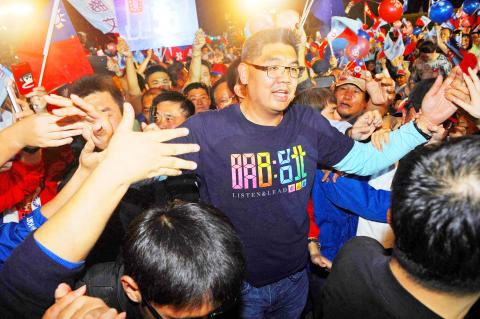
Photo: Chang Chia-ming, Taipei Times
New Party Secretary-General Lee Sheng-feng (李勝峰) was first to speak, highlighting the importance of the election to the future of the Republic of China (ROC), saying that a vote for Lien would be to defend the capital of the ROC.
Although Taipei has long been a stronghold of the KMT — voting patterns in past elections revealed a shift in blue-green support from 55-45 to 60-40 — Lien has consistently trailed his main rival, independent candidate Ko Wen-je (柯文哲), in opinion polls before Nov. 18.
To drum up enthusiasm among pan-blue supporters, President Ma Ying-jeou (馬英九) said that Taipei cannot afford to lose the election.
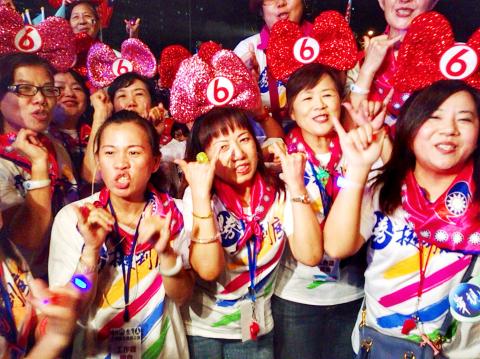
Photo: CNA
Taipei has developed into a “world-class capital” after 16 years of the KMT’s governance, starting when he was elected as Taipei mayor in 1998, Ma said.
Lien meets all the qualifications to become mayor of the capital because — as opposed to Ko — Lien has respect for women, is a professional with international vision and economic expertise, and he recognizes the so-called “1992 consensus,” which is essential to cross-strait relations, Ma added.
First lady Chow Mei-ching (周美青) urged everyone to cast their ballots.
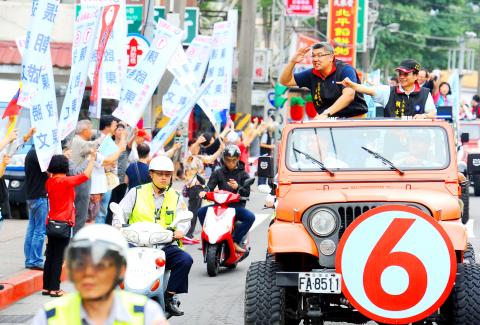
Photo: Chang Chia-ming, Taipei Times
“The election result has not only to do with you, but also Taiwan, your children and the future of the ROC. Cast your vote and vote for your future,” she said.
Lien appealed to young people in his speech.
“The problem Taiwan is facing is neither one of class nor generation. It’s the economy. I have the ability to improve the economy,” Lien said.
Other speakers included former KMT chairman Wu Poh-hsiung (吳伯雄) — who had not made a public appearance since suffering a stroke in September that kept him from stumping for his son, John (吳志揚), who is running for re-election as Taoyuan commissioner — and KMT Legislator Ting Shou-chung (丁守中), who lost to Lien in the April party primary.
Lien’s father, former vice president Lien Chan (連戰), said that the Taipei race was a battle crucial to the future of not only Taipei and Taiwan, but also the ROC.
“Only when we win the election can we continue to move forward as a free and democratic territory, defend the values of fairness and justice, and expect limitless prospects for cross-strait relations,” Lien Chan said.
People First Party (PFP) Chairman James Soong (宋楚瑜) had said that the party would not take sides in the election, but the KMT had Yeh Sung-nien (葉松年), head of the Friends of James Soong Association, stump for Sean Lien at the rally.
The KMT estimated the turnout at about 80,000 people.
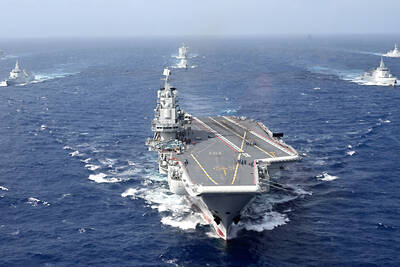
PROVOCATIVE: Chinese Deputy Ambassador to the UN Sun Lei accused Japan of sending military vessels to deliberately provoke tensions in the Taiwan Strait China denounced remarks by Japan and the EU about the South China Sea at a UN Security Council meeting on Monday, and accused Tokyo of provocative behavior in the Taiwan Strait and planning military expansion. Ayano Kunimitsu, a Japanese vice foreign minister, told the Council meeting on maritime security that Tokyo was seriously concerned about the situation in the East China and South China seas, and reiterated Japan’s opposition to any attempt to change the “status quo” by force, and obstruction of freedom of navigation and overflight. Stavros Lambrinidis, head of the EU delegation to the UN, also highlighted South China Sea

SILENCING CRITICS: In addition to blocking Taiwan, China aimed to prevent rights activists from speaking out against authoritarian states, a Cabinet department said The Ministry of Foreign Affairs (MOFA) yesterday condemned transnational repression by Beijing after RightsCon, a major digital human rights conference scheduled to be held in Zambia this week, was abruptly canceled due to Chinese pressure over Taiwanese participation. This year’s RightsCon, the world’s largest conference discussing issues “at the intersection of human rights and technology,” was scheduled to take place from tomorrow to Friday in Lusaka, and expected to draw 2,600 in-person attendees from 150 countries, along with 1,100 online participants. However, organizers were forced to cancel the event due to behind-the-scenes pressure from China, the ministry said, expressing its “strongest condemnation”
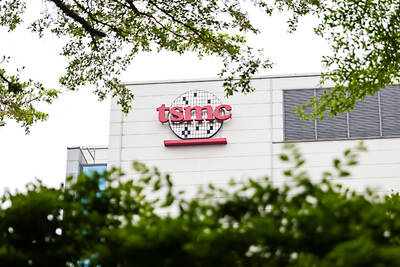
Taiwan Semiconductor Manufacturing Co (TSMC, 台積電), the world’s largest contract chipmaker, said it expects its 2-nanometer (2nm) chip capacity to grow at a compound annual rate of 70 percent from this year to 2028. The projection comes as five fabs begin volume production of 2-nanometer chips this year — two in Hsinchu and three in Kaohsiung — TSMC senior vice president and deputy cochief operating officer Cliff Hou (侯永清) said at the company’s annual technology symposium in Silicon Valley, California, last week. Output in the first year of 2-nanometer production, which began in the fourth quarter of last year, is expected to
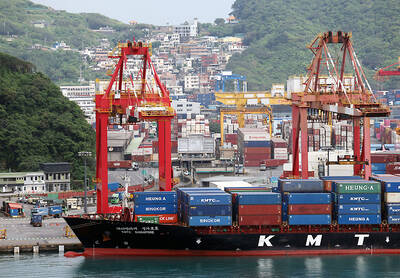
Taiwan’s economy grew far faster than expected in the first quarter, as booming demand for artificial intelligence (AI) applications drove a surge in exports, spilling over into investment and consumption, the Directorate-General of Budget, Accounting and Statistics (DGBAS) said yesterday. GDP growth was 13.69 percent year-on-year during the January-to-March period, beating the DGBAS’ February forecast by 2.23 percentage points and marking the most robust growth in nearly four decades, DGBAS senior official Chiang Hsin-yi (江心怡) told a news conference in Taipei. The result was powered by exports, which remain the backbone of Taiwan’s economy, Chiang said. Outbound shipments jumped 51.12 percent year-on-year to


 RSS
RSS