


Hundreds of Hong Kong police yesterday cleared a pro-democracy protest camp, arresting Joshua Wong (黃之鋒) and another student leader, and reopening a main road blocked for almost two months.
Pushing back protesters, police with the help of workmen removed tents and other obstacles blocking the six-lane Nathan Road in Mong Kok district.
It is seen as the most significant move so far in efforts to clear away protest camps at three separate locations in the territory, as public sympathy with the demonstrators wanes.
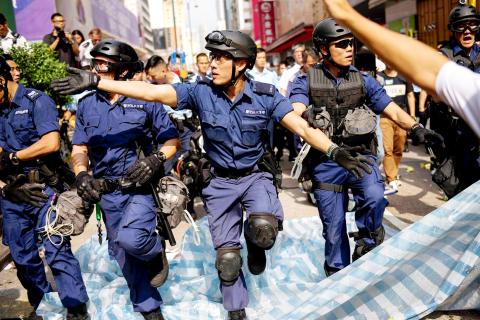
Photo: AFP
Scuffles broke out earlier in the day as police wearing helmets and brandishing batons moved in to protect the workmen from the crowds that surged forward to try to stop them tearing down road barricades.
The operation went ahead a day after nearly 150 demonstrators were arrested as authorities cleared a smaller section of the Mong Kok protest camp.
Hundreds of police quickly pushed protesters back, and removed wooden and metal barricades, tents and other obstructions along a 500m stretch of Nathan Road.
About two hours after the operation started, only a handful of protesters remained at the edge of the site.
The movement’s student leaders Wong and Lester Shum (岑敖暉) were arrested at the scene, according to protest group Scholarism and the Hong Kong Federation of Students.
A well-known protester and member of the League of Social Democrats, Raphael Wong (黃浩銘), who was arrested along with the pair, said on his Facebook page that they were being held at a police station.
“I am at the Kwai Chung police station, next to me is Joshua and Lester, we have been charged with contempt of court and obstructing public officers,” Wong wrote. “It is possible we won’t get bail tonight and will be at a magistrates’ court tomorrow.”
Police were unable to immediately give a reason why the three had been arrested when contacted.
Tensions were running high yesterday after scuffles the previous day when police used pepper spray on protesters at the site.
Mong Kok was the scene of some of the most violent clashes since the sit-ins began in the territory on Sept. 28.
Demonstrators are demanding fully free elections for the leadership of the semi-autonomous southern Chinese territory in 2017, but China has refused to budge on its arrangements for the poll.
Police said they arrested at total of 148 people, including a 14-year-old boy, in the two-day Mong Kok operation and that 22 police officers were injured.
Separately, seven police officers who were suspended after a video emerged of them beating and kicking a handcuffed man have been arrested.
“Police have arrested seven police officers suspected of assault causing bodily harm,” police said in a statement late yesterday, adding that investigations were ongoing.
The video that emerged last month showed plainclothes officers hauling a handcuffed and unarmed demonstrator to a dark corner of a protest-hit public park.
One officer stands over the man and punches him, as three others are seen repeatedly kicking him.

‘NO SECURITY RISK’: The Railway Bureau reassured the public that the technicians’ activities were limited to technical guidance and did not involve sensitive systems The Railway Bureau yesterday said it had invited eight Chinese technicians to assist with an airport MRT construction project. The bureau issued the confirmation after an Internet user said Chinese nationals had entered the construction zone of Taiwan Taoyuan International Airport’s Terminal 3 project. They asked why “individuals from an enemy state” were allowed access to such a major national infrastructure project, which raised serious concerns over Taiwan’s industrial safety, sensitive systems and information security. The bureau’s Northern Region Engineering Branch Office said subcontractor Taiwan Handle Industrial Co (台灣手把工業) of the Taoyuan airport MRT’s “Contract No. CU05 Project A14 Station Civil, MEP &

The National Chungshan Institute of Science and Technology yesterday showcased its locally developed variants of the Vision 60 robotic patrol dog, which it plans to deploy on the nation’s outlying territories in the South China Sea. The variants were produced under the Joint Lab project — created by the institute and domestic companies — and assembled with domestically produced motors, lenses and artificial intelligence (AI) systems alongside licensed tech from the US, Missile and Rocket Systems Research Division deputy director Jen Kuo-kang (任國光) told the media event at a military base in Taipei’s Dazhi (大直) area. Taiwan has built up its strengths

NOT IMMEDIATE: Taiwan has a chance to appeal the proposed 10 percent tariff before it starts, while other countries face a 12.5 percent tariff from the trade office Taiwan is among 60 economies determined by the US to have failed to impose or enforce a ban on the importation of goods produced with forced labor, according to a notice released on Tuesday by the Office of the US Trade Representative (USTR), which proposed imposing an additional 10 percent or more tariff on them. The USTR in a statement said that following an investigation, it had determined under Section 301 of the Trade Act of 1974 that the failure of the 60 economies to impose and effectively enforce a prohibition on the importation of goods produced with forced labor is

RIGHT DIRECTION: Taiwan’s efforts to prevent forced labor include a proposal to ‘fully prohibit’ employers from withholding workers’ documents, an official said Taiwan is to establish a mechanism to restrict imports of goods linked to forced labor, the Executive Yuan said yesterday, after the US proposed imposing additional tariffs on Taiwanese goods over labor concerns. “The Ministry of Labor and the Ministry of Economic Affairs are to establish an interministerial review procedure,” Executive Yuan spokesperson Michelle Lee (李慧芝) said at a news briefing in Taipei. “The government is to use the Foreign Trade Act [貿易法] as the legal basis to restrict imports of goods produced with forced labor” and bring its supply chain governance more in line with international standards on human rights, resilience


 RSS
RSS