


The two main rivals for Taipei mayor faced off in a televised debate last night, crossing swords on issues ranging from labor, gender equality and national identity to ethics, nuclear energy and the challenges facing young people.
Independent contender Ko Wen-je (柯文哲) touted himself as a candidate who can “reset” Taiwanese politics by breaking the partisan confrontation between the blue and green camps, and by realizing the ideals of fairness and justice.
The election’s outcome would determine whether people would be able to revive the belief that “success treads upon the heels of efforts” or whether the future would be dominated by a monopolistic “Taipei financial holding company” as Lien has proposed, Ko said.
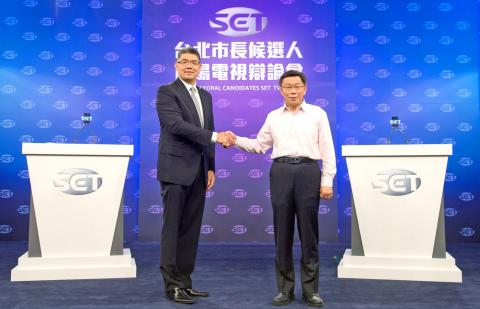
Photo courtesy of SET-TV
Sean Lien (連勝文) of the Chinese Nationalist Party (KMT) told voters that choosing between Ko and him was a choice between giving the city a chance to achieve “a great leap forward in development” or to face “a massive disaster.”
It is also a choice between giving him a chance to resolve problems facing the city or giving Ko a chance to treat the city as a “laboratory of new medicines,” Lien said, referring to Ko’s profession as a physician.
Their “vision” for the city is the biggest difference that sets them apart, Lien said.
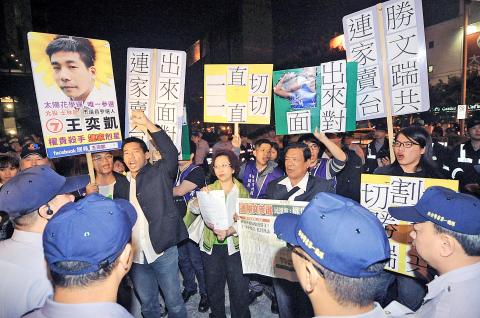
Photo: Liao Chen-huei, Taipei Times
The two-hour-long debate hosted by SET-TV (三立電視) from 8pm to 10pm yesterday was the first and so far the only debate event both camps have agreed to.
It started with scripted openings for Ko and Lien, followed by questions from six civic groups — the Taiwan Labor Front, Taiwan Competitiveness Forum, Taipei City Youth Development Association, Taiwan Coalition Against Violence, Homemakers United Foundation and the Organization of Urban Reforms — and questions from the candidates to their rivals, followed by a summation.
During the question-and-answer session with civic groups, Ko reiterated that he would not join any political party and, if elected, would ask senior city government officials not to participate in political activities.
Responding to criticism that he has shifted his position from being an advocate of Taiwanese independence to acceptance of the Republic of China (ROC) only after he decided to run for Taipei mayor, Ko said that people who favor the ROC over Taiwan should have the courage to mention the ROC when they are in China.
Lien vowed that he would demand that all city government officials strictly abide by rules on ethics when dealing with businesses if he wins the election.
All city government employees will not be allowed to entertain businesses involved in public tenders for city contracts, Lien said.
He added that he has never had ethics issues when he served as chairman of Taipei EasyCard Corp (悠遊卡公司).
On energy issues, Ko and Lien said they oppose extending the service life of the two nuclear power plants in New Taipei City. Ko added that he wished to see an early decommissioning of the plants and pledged to develop alternative energy sources.
During the cross-questioning session, Lien said that Ko, despite being an independent candidate, is closely affiliated with the “deep green” camp because Ko has said that if he is elected, it would be the best chance to release former president Chen Shui-bian (陳水扁), who is now severely ill in prison.
Ko said that both Lien and Chen were his patients.
“As a doctor, is there anything wrong when I said that Chen was diagnosed with severe psychological trauma?” Ko said.
“It’s a political issue. The issue should be open to discussion. Even Taipei Mayor Hau Lung-bin (郝龍斌) suggested medical parole for Chen,” Ko said.
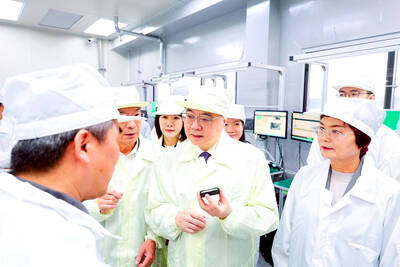
KEY INDUSTRY: The vice premier discussed a plan to create a non-red drone supply chain by next year, which has been allocated a budget of more than NT$7.2 billion The government has budgeted NT$44.2 billion (US$1.38 billion) to cultivate Taiwan’s uncrewed aerial vehicle (UAV) industry over the next five years, which would make the nation a major player in the industry’s democratic supply chain in the Asia-Pacific region, Premier Cho Jung-tai (卓榮泰) said yesterday. Cho made the remarks during a visit to the facilities of Cub Elecparts Inc (為升電裝). Democratic Progressive Party (DPP) Legislator Chen Su-yueh (陳素月) and Chinese Nationalist Party (KMT) Legislator Hsieh Yi-fong (謝依鳳) also participated in the trip. Cub Elecparts has transitioned from the automotive industry to the defense industry, which is the top priority among the nation’s
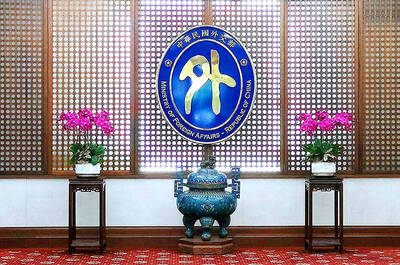
SOUTH KOREA DISPUTE: If Seoul continues to ignore its request, Taiwan would change South Korea’s designation on its arrival cards, the foreign ministry said If South Korea does not reply appropriately to a request to correct Taiwan’s name on its e-Arrival card system before March 31, the government would take corresponding measures to change how South Korea is labeled on the online Taiwan Arrival Card system, the Ministry of Foreign Affairs said yesterday. South Korea’s e-Arrival card system lists Taiwan as “China (Taiwan)” in the “point of departure” and “next destination” fields. Taipei has asked Seoul to change the wording. Since March 1, South Koreans who hold government-issued Alien Resident Certificates (ARC) have been identified as from “South Korea” rather than the “Republic of Korea,” the
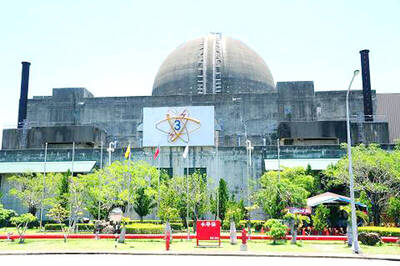
SUFFICIENT: The president said Taiwan has enough oil for next month, with reserves covering more than 100 days and natural gas enough for 12 to 14 days A restart plan for the Guosheng Nuclear Power Plant in New Taipei City’s Wanli District (萬里) and the Ma-anshan Nuclear Power Plant in Pingtung County’s Hengchun Township (恆春) would be submitted to the Nuclear Safety Commission by the end of the month, President William Lai (賴清德) said yesterday, reversing the government’s policy to abolish nuclear energy. On May 17 last year, Taiwan shut down its last nuclear reactor and became the first non-nuclear nation in East Asia, fulfilling the Democratic Progressive Party (DPP) government’s pledge of a “nuclear-free homeland.” Even without nuclear power, Taiwan can maintain a stable electricity supply until 2032,
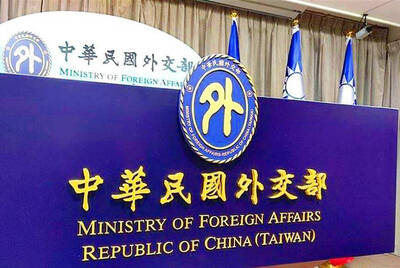
DEROGATORY: WTO host Cameroon’s designation of Taiwan as a ‘province of China’ seriously undermines the nation’s status and rights as a WTO member, MOFA said The Ministry of Foreign Affairs (MOFA) yesterday condemned Cameroon for listing Taiwan as “Taiwan, Province of China” in visa documents for an upcoming WTO ministerial conference, a move that led to Taiwan’s withdrawal from the event. The designation “seriously undermined” Taiwan’s status and rights as a WTO member, the ministry said in a statement. It is the first time since 2001 that Taiwan has declined to attend a WTO Ministerial Conference. The conference is scheduled to take place from Thursday to Sunday next week in Yaounde, the capital of Cameroon. Taiwan had planned to send a delegation led by Minister Without Portfolio


 RSS
RSS