


The Taiwan High Prosecutors’ Office said yesterday that 17 people have been indicted in the latest cooking oil scandal, including Ting Hsin International Group (頂新集團) executive Wei Ying-chun (魏應充), for whom prosecutors have asked for a 30-year prison term.
The Changhua District Prosecutors’ Office indicted Wei on 60 counts of fraud and 79 counts of serious fraud and is seeking the maximum 30-year prison term.
Changhua County Deputy Chief Prosecutor Huang Chih-yung (黃智勇) said the investigation indicated that Wei knew his company was processing animal feed-grade material to make expensive cooking oils, although Wei still refused to admit his role in one of the nation’s worst food safety scandals on record.
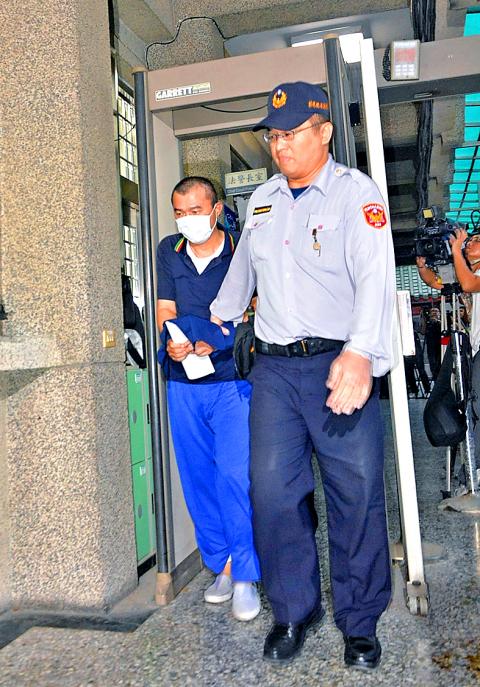
Photo: CNA
The Taiwan High Prosecutors’ Office said in a statement that investigators have so far uncovered illegal profits of NT$3.83 billion (US$125.9 million) associated with the cooking oil scandal.
The coordinated judicial proceeding yesterday involved five of the nation’s district prosecutors’ offices from Taipei, Changhua County, Chiayi County, Greater Tainan and Greater Kaohsiung.
Also indicted were former Ting Hsin Oil and Fat Industrial Co (頂新製油實業) president Chang Mei-feng (常梅峰); the company’s incumbent acting chairman Chen Mao-chia (陳茂嘉); Yang Chen-yi (楊振益), who owns the Vietnamese trading company Dai Hanh Phuc Co that is accused of selling animal feed-grade materials to the edible oil maker; among others.
Chang and the others indicted are facing prison terms of between 18 and 25 years.
Of the 17 indicted, 13 suspects had already been detained. Despite requests for bail by defense lawyers after the indictment, prosecutors applied to continue their detention, citing the likelihood of collusion, destruction of evidence and the possibility that some would flee the country.
In related developments, the Taipei District Court yesterday accepted a lawsuit submitted by Chiang Shou-shan (江守山), who is suing the executives and owners of Ting Hsin International Group and its subsidiary Cheng I Food Co (正義公司) for NT$1 billion in damages.
Chiang, a resident nephrologist at Taipei’s Shin Kong Memorial hospital who also runs a health food company, said he had suffered a loss of business and a damaged reputation because the company’s pork products had been using Cheng I Food’s tainted lard oil.
Along with the lawsuit, Chiang applied with the court for a warrant against Ting Hsin International for damages, because he was outraged that up to this time the Wei brothers had paid no concern to the companies and consumers who were victims of the adulterated oil products.
According to the indictment, Ting Hsin Oil and Fat purchased from Vietnam substandard fats and oils intended for the manufacture of animal feed to save costs.
The deal was arranged by Chang, and the fats and oils were fraudulently declared for human consumption during the customs clearance procedure. Ting Hsin used the substandard materials to produce thousands of tonnes of cooking oils and sold the oils to downstream food makers all over the nation, according to investigators.
Changhua prosecutors also found evidence that Ting Hsin International had eluded paying NT$733 million in taxes between 2006 and 2012.
Additional reporting by CNA
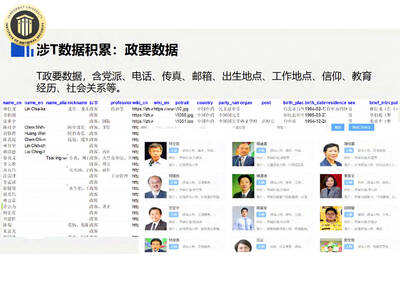
NETWORK-MAPPING PROJECT: The database contains 170 detailed files of Taiwanese politicians and about 23 million records of household registration data in Taiwan China has developed a network-mapping project targeting political figures and parties in Taiwan to monitor public opinion during elections and to craft tailored influence campaigns aimed at dividing Taiwanese society, according to documents leaked by Chinese technology firm GoLaxy (中科天璣). The documents, collected by Taipei-based Doublethink Lab, showed a database was specifically created to gather detailed information on Taiwanese political figures, including their political affiliations, job histories, birthplaces, residences, education, religion and a brief biography about them. Several notable Taiwanese politicians are in the database, including President William Lai (賴清德), former president Tsai Ing-wen (蔡英文), Minister of Foreign Affairs Lin Chia-lung (林佳龍),
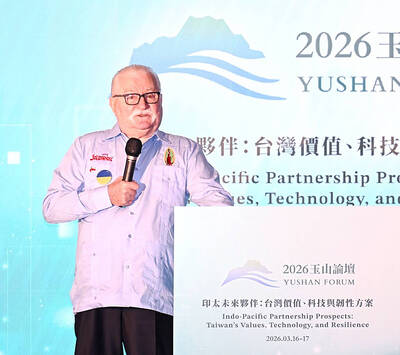
RECOGNITION: Former Fijian prime minister Mahendra Chaudhry said that Taiwan’s New Southbound Policy serves as a stabilizing force in the Indo-Pacific region Taiwan can lead the unification of the Chinese people, Nobel Peace Prize laureate and former Polish president Lech Walesa said in Taipei yesterday, adding that as the world order is changing, peaceful discussion would find good solutions, and that the use of force and coercion would always fail. Walesa made the remarks during his keynote address at a luncheon of the Yushan Forum in Taipei, titled “Indo-Pacific Partnership Prospects: Taiwan’s Values, Technology and Resilience,” organized by the Taiwan-Asia Exchange Foundation with the Ministry of Foreign Affairs. Walesa said that he had been at the forefront of a big peaceful revolution and “if
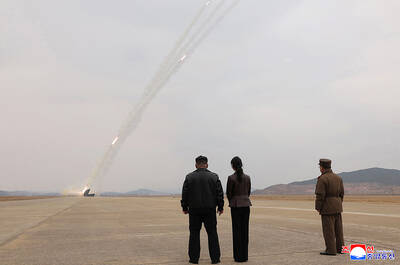
North Korea tested nuclear-capable rocket launchers, state media reported yesterday, a day after Seoul detected the launch of about 10 ballistic missiles. The test comes after South Korean and US forces launched their springtime military drills, due to run until Thursday. North Korean leader Kim Jong-un on Saturday oversaw the testing of the multiple rocket launcher system (MRLS), the Korean Central News Agency (KCNA) said. The test involved 12 600mm-caliber ultra-precision multiple rocket launchers and two artillery companies, it said. Kim said the drill gave Pyongyang’s enemies, within the 420km striking range, a sense of “uneasiness” and “a deep understanding
UPGRADED MISSILE: The Chungshan Institute of Science and Technology is reportedly to conduct a live-fire test of the Hsiung Feng III anti-ship missile on Thursday next week The US Army is planning to build new facilities to boost explosives production and strengthen its supply chain, a move aimed at addressing munitions shortages and supporting obligations to partners including Taiwan, Ukraine and Israel, Defense News reported. The army has issued a sources sought notice for a proposed Center of Excellence at the Blue Grass Army Depot in Kentucky, the report said. The facility would serve as a hub within the US industrial base for the production of key military explosives, including research department explosives (RDX) and high melting explosives (HMX), while also supporting research and development of next-generation materials. The proposed


 RSS
RSS