


The Food and Drug Administration (FDA) said yesterday that it would entrust the Ministry of Foreign Affairs and the Bureau of Foreign Trade with verifying the authenticity of product reports submitted by Namchow Chemical Industrial Co (南僑化學工業) to ascertain whether the company had imported industrial cooking oil for use at its food manufacturing factory.
FDA Interim Director-General Chiang Yu-mei (姜郁美) made the remarks on the sidelines of a legislative meeting yesterday afternoon, hours after demanding that Namchow Chemical — the flagship unit of the Namchow Group (南僑集團) — present official documents proving that 30 batches of oil it imported in recent years were for human consumption, as opposed to industry use, as stated in the customs clearance permits for the batches of oil.
“Taipei and Taoyuan’s health bureaus received the requested documents from Namchow Chemical before noon, including a certificate issued by the Australian Office Taipei for the company’s imported beef tallow, and 25 issued by the Philippine Department of Agriculture for the coconut and palm kernel oil it procured,” Chiang said.
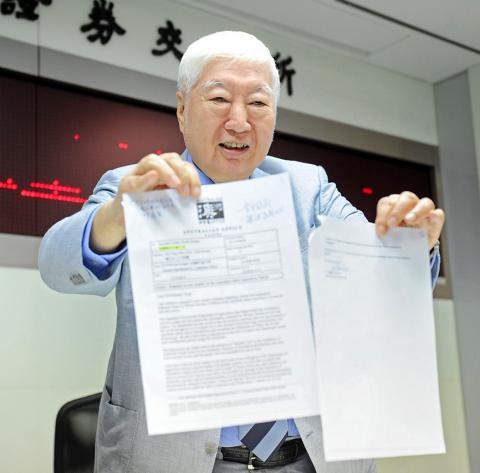
Photo: CNA
However, Chiang said even if the documents — all of which classify the oil in question as fit for human use after being refined — are proven authentic, “it is still rather reprehensible for a listed large-scale company to attempt to dodge cargo examinations at the border, which violates Article 30 of the Act Governing Food Safety and Sanitation (食品安全衛生管理法) and is punishable by a fine ranging from NT$30,000 (US$986) to NT$3 million.”
Earlier yesterday, Chiang told an impromptu press conference that Namchow Chemical had allegedly mixed oil for industry use in its edible oil products, further escalating an already widespread cooking oil scandal.
“Namchow Chemical’s food factory imported a total of 12 batches of beef tallow from Australia last year and this year, but five of the batches were listed as for industry use and thus entered the country without being examined,” Chiang said.
In addition, he said 22 of the 34 batches of coconut oil and three batches of palm kernel oil the company procured from the Philippines in the same period were also categorized as for industrial use on their customs documents.
When asked about the possibility of the 30 batches of oil being used to manufacture soaps, given that Namchow Chemical is most famous for its “Crystal Skin Care Laundry Soap” (水晶肥皂), Chiang dismissed the possibility and said all the import records were pulled from Namchow Chemical’s food factories.
Chiang dropped another bombshell on the local food industry when she said that apart from Namchow Chemical, Cheng I Food Co (正義股份) and Ting Hsin Oil and Fat Industrial Co (頂新製油實業), another company on the list of 27 oil and fat producers with NT$30 million or more in capital is being inspected by the FDA and which could have engaged in similar irregularities.
She declined to give the company’s name, as the investigation is still ongoing.
Cheng I and Ting Hsin Oil — both of which are Ting Hsin International Group (頂新集團) subsidiaries — have been accused of knowingly adulterating dozens of their cooking oil products with animal feed oil either imported from Vietnam or made locally.
The discovery prompted Taoyuan County, where one of Namchow Chemical’s cooking oil manufacturing factories is based, to launch a preventive recall of 123 of the company’s cooking oil products made from beef tallow, coconut oil or palm kernel oil yesterday afternoon.
“These products will not be allowed back on store shelves until the company presents documents proving the oils are safe for human use,” Taoyuan County Deputy Commissioner Huang Hung-pin (黃宏斌) told a press conference.
Later yesterday, Namchow Group chairman Alfred Chen (陳飛龍) held a press conference and said that its questionable butter fat, coconut and palm oil products are totally safe for cooking and eating, attributing the problem to paperwork mistakes at the group.
Chen said the group has already received identification documents for its butter fat products from the Department of Agriculture in Australia — their country of origin — and submitted them to Taiwan’s Food and Drug Administration in time as was requested, which may shield products made from these oil products from a precautionary recall,.
Identification documents from the Philippines, which exported coconut and palm oil products to Namchow, have also gradually been sent to the group, Chen added.
“We are sorry that we have made mistakes in the customs declaration paperwork which resulted in unease among the public,” Chen told a press conference.
However, the contents of the questionable butter fat and oil products are totally edible, he added.
Chen said the group has no motive to use industrial butter fat products to make edible oils, as the import tariff rate of the two kinds of products are both zero, with the cost of industrial butter fat products only 10 percent to 15 percent cheaper than edible products.
However, Namchow did import a certain amount of non-edible butter fat products for the purpose of manufacturing soap products — another business of the group — Chen added.
If anyone finds what he said was incorrect, Chen said the group would immediately shut down its plants and close its cooking oil-related business, and compensate the public appropriately by disposing of the group’s assets.
Namchow Chemical’s alleged oil adulteration practices seem particularly ironic, in the light of recent remarks made by Chen.
“I think the third son of the Wei family [former Ting Hsin Oil chairman Wei Ying-chun (魏應充)] had only been careless [in running his conglomerate] and did not mean to cause any harm [to the public],” Chen said on Sunday, adding that there was no guarantee that the large food companies that escaped the latest food scare would not be engulfed in the next.
Chen adopted a tougher tone the following day, saying that the recent oil scandals involving Wei’s companies indicated that his way of thinking had “gone wrong.”
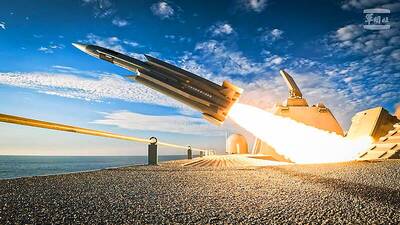
DETERRENCE: With 1,000 indigenous Hsiung Feng II and III missiles and 400 Harpoon missiles, the nation would boast the highest anti-ship missile density in the world With Taiwan wrapping up mass production of Hsiung Feng II and III missiles by December and an influx of Harpoon missiles from the US, Taiwan would have the highest density of anti-ship missiles in the world, a source said yesterday. Taiwan is to wrap up mass production of the indigenous anti-ship missiles by the end of year, as the Chungshan Institute of Science and Technology has been meeting production targets ahead of schedule, a defense official with knowledge of the matter said. Combined with the 400 Harpoon anti-ship missiles Taiwan expects to receive from the US by 2028, the nation would have
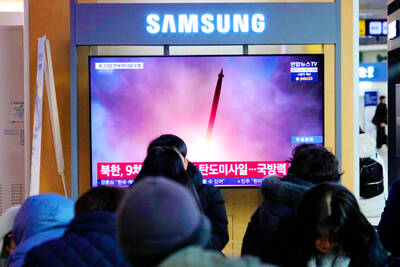
North Korea yesterday fired about 10 ballistic missiles to the sea toward Japan, the South Korean Joint Chiefs of Staff (JCS) said, days after Pyongyang warned of “terrible consequences” over ongoing South Korea-US military drills. Pyongyang recently dashed hopes of a diplomatic thaw with Seoul, Washington’s security ally, describing its latest peace efforts as a “clumsy, deceptive farce.” Seoul’s military detected “around 10 ballistic missiles launched from the Sunan area in North Korea toward the East Sea [Sea of Japan] at around 1:20pm,” JCS said in a statement, referring to South Korea’s name for the body of water. The missiles

‘UNWAVERING FRIENDSHIP’: A representative of a Japanese group that co-organized a memorial, said he hopes Japanese never forget Taiwan’s kindness President William Lai (賴清德) yesterday marked the 15th anniversary of the Tohoku earthquake and tsunami, urging continued cooperation between Taiwan and Japan on disaster prevention and humanitarian assistance. Lai wrote on social media that Taiwan and Japan have always helped each other in the aftermath of major disasters. The magnitude 9 earthquake struck northeastern Japan on March 11, 2011, triggering a massive tsunami that claimed more than 19,000 lives, according to data from Japanese authorities. Following the disaster, Taiwan donated more than US$240 million in aid, making it one of the largest contributors of financial assistance to Japan. In addition to cash donations and
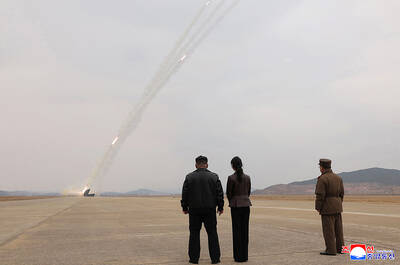
North Korea tested nuclear-capable rocket launchers, state media reported yesterday, a day after Seoul detected the launch of about 10 ballistic missiles. The test comes after South Korean and US forces launched their springtime military drills, due to run until Thursday. North Korean leader Kim Jong-un on Saturday oversaw the testing of the multiple rocket launcher system (MRLS), the Korean Central News Agency (KCNA) said. The test involved 12 600mm-caliber ultra-precision multiple rocket launchers and two artillery companies, it said. Kim said the drill gave Pyongyang’s enemies, within the 420km striking range, a sense of “uneasiness” and “a deep understanding


 RSS
RSS