


A top executive of Ting Hsin Oil and Fat Industrial Co (頂新製油實業) and two from Cheng I Food Co (正義股份) were detained yesterday in connection with the ongoing cooking oil scandals.
Ting Hsin Oil & Fat acting chairman and former general manager Chen Mao-chia (陳茂嘉) was detained after more than 10 hours of questioning by prosecutors in Changhua County overnight, following a search of the company headquarters.
In Greater Kaohsiung, Cheng I president Ho Yu-jen (何育仁) and deputy chief procurement officer Hu Chin-min (胡金忞) were also detained.
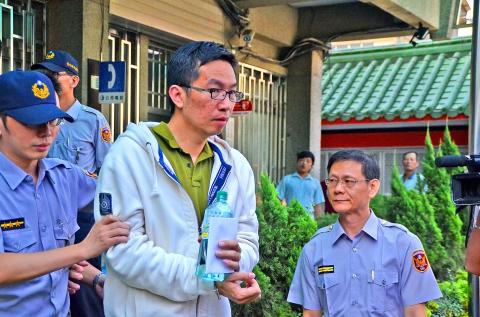
Photo: Yen Hung-chun, Taipei Times
The two companies, both units of food conglomerate Ting Hsin International Group (頂新集團), are accused of using lard meant for animal feed in their cooking oil products.
The incident — the third oil-related scandal to hit the conglomerate within a year — has sparked widespread outrage among consumers in Taiwan, leading to a campaign to boycott the group’s products and brands.
Former Cheng I and Ting Hsin Oil & Fat chairman Wei Ying-chun (魏應充) held a news conference on Saturday to apologize to the public.
He also announced that the two subsidiaries would suspend their operations until their procedures were improved.
He is now under investigation by the Taipei District Prosecutors’ Office.
The Taiwan High Prosecutors’ Office said a meeting is to be held today among prosecutors from 13 local prosecutors’ offices who currently have food-related cases on hand.
The meeting aims to integrate information and communications among the local prosecutors in a bid to enhance the efficiency of the investigations.
The Taiwan High Prosecutors’ Office said a total of 48 food-related cases have been undertaken by prosecutors in Keelung, Taipei, New Taipei City, Taoyuan, Greater Taichung, Chuanghua County, Yunlin County, Chiayi, Greater Tainan, Greater Kaohsiung, Pingtung County, Yilan County and Penghu.
Althought the 48 cases may not all be of major food security concerns, particiants at the meeting today are to nonetheless discuss the cases and decide whether any warrant an expansion in terms of its probes, the office said.
Meanwhile, according to the Pingtung District Prosecutors’ Office, Ting Hsin Oil & Fat Industrial had been indicted well before the latest revelations surfaced.
The indictment against Ting Hsin Oil & Fat Industrial and three of its executives was handed down on Aug. 21 and covered charges of fraud, faking product labels and violating food safety regulations, charges dating back to an oil scandal that emerged late last year, the office said.
Prosecutors said Ting Hsin Oil & Fat purchased low-cost oils from Chang Chi Foodstuff Factory Co (大統長基) that contained artificial coloring and cottonseed oil, but were marketed as more expensive products.
It then processed those oils and also sold them as high-priced pure olive oil or grapeseed oil, making illicit gains, prosecutors said.
Chang Chi Foodstuff’s scheme to pawn cheaper oils off as more expensive ones was not publicly exposed until October last year, when the Ting Hsin Group’s flagship Wei Chuan Foods Corp (味全食品工業) brand was also found to have sold the adulterated oil products for several years.
After an investigation, prosecutors determined that Ting Hsin Oil & Fat was selling its adulterated oils to Wei Chuan on a contract basis.
In the indictment, prosecutors alleged that the three of its executives knew the oils the company bought from Chang Chi were adulterated, yet continued to purchase and ship them to the Pingtung factory to be processed and packaged for Wei Chuan.
Prosecutors recommended that the company be fined NT$51.08 million (US$1.68 million) and have also asked the court to give them the maximum possible sentences because they “showed no remorse for the offenses.”
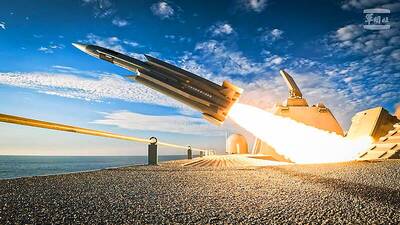
DETERRENCE: With 1,000 indigenous Hsiung Feng II and III missiles and 400 Harpoon missiles, the nation would boast the highest anti-ship missile density in the world With Taiwan wrapping up mass production of Hsiung Feng II and III missiles by December and an influx of Harpoon missiles from the US, Taiwan would have the highest density of anti-ship missiles in the world, a source said yesterday. Taiwan is to wrap up mass production of the indigenous anti-ship missiles by the end of year, as the Chungshan Institute of Science and Technology has been meeting production targets ahead of schedule, a defense official with knowledge of the matter said. Combined with the 400 Harpoon anti-ship missiles Taiwan expects to receive from the US by 2028, the nation would have

North Korea yesterday fired about 10 ballistic missiles to the sea toward Japan, the South Korean Joint Chiefs of Staff (JCS) said, days after Pyongyang warned of “terrible consequences” over ongoing South Korea-US military drills. Pyongyang recently dashed hopes of a diplomatic thaw with Seoul, Washington’s security ally, describing its latest peace efforts as a “clumsy, deceptive farce.” Seoul’s military detected “around 10 ballistic missiles launched from the Sunan area in North Korea toward the East Sea [Sea of Japan] at around 1:20pm,” JCS said in a statement, referring to South Korea’s name for the body of water. The missiles

‘UNWAVERING FRIENDSHIP’: A representative of a Japanese group that co-organized a memorial, said he hopes Japanese never forget Taiwan’s kindness President William Lai (賴清德) yesterday marked the 15th anniversary of the Tohoku earthquake and tsunami, urging continued cooperation between Taiwan and Japan on disaster prevention and humanitarian assistance. Lai wrote on social media that Taiwan and Japan have always helped each other in the aftermath of major disasters. The magnitude 9 earthquake struck northeastern Japan on March 11, 2011, triggering a massive tsunami that claimed more than 19,000 lives, according to data from Japanese authorities. Following the disaster, Taiwan donated more than US$240 million in aid, making it one of the largest contributors of financial assistance to Japan. In addition to cash donations and
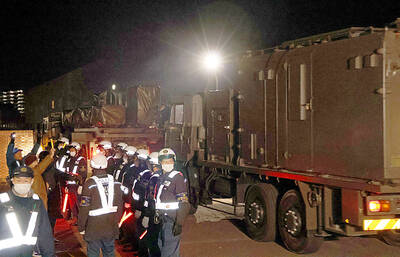
CLOSER TO CHINA: The upgraded Type-12 missile has a range of about 1,000km, compared with the original model’s range of 200km, and can reach mainland China Japan is preparing to deploy its first batch of domestically developed long-range missiles, with their launchers arriving at an army camp yesterday, as the country accelerates its offensive capability in response to rising challenges in the region. The upgraded Type-12 land-to-ship missiles are to be deployed at Camp Kengun in Japan’s southwestern prefecture of Kumamoto by the end of this month, completing the process of deployment, Japanese Chief Cabinet Secretary Minoru Kihara said without giving details. Army vehicles carrying the launchers and other equipment arrived past midnight in a highly secretive mission criticized by residents. Dozens of people stood outside of the


 RSS
RSS