


An investigation has begun to determine why the Ocean Researcher V — the nation’s largest maritime research vessel — sank on Friday night near Penghu, leaving two people dead and 24 injured.
The 2,700-tonne vessel set sail from Greater Tainan at 9am on Thursday for an eight-day mission conducted by the Environmental Protection Administration (EPA) and National Taiwan Ocean University aimed at studying atmospheric pollution.
However, the two-year-old ship was completely submerged in stormy waters off Penghu’s Longmen District (龍門) by 8:11pm on Friday, less than three hours after it first issued a distress call, officials said.
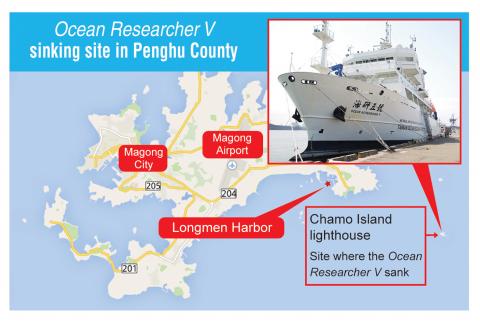
Sea and air rescue efforts continued for several hours after that, ending with all 45 people on board — 27 researchers and an 18-member crew — all accounted for.
Academia Sinica research fellow and team leader Hsu Shih-chieh (許世傑) and Lin Yi-chun (林怡君), an assistant engineer at Taiwan Ocean Research Institute, died in the incident, with prosecutors saying that the two drowned during rescue efforts.
The 24 injured were sent to hospitals in Penghu and Chiayi and none of their injuries were said to be life-threatening.
Weng Ying-ming (翁英明), a division head at the EPA’s Environmental Analysis Laboratory, who had been in a cerebral hemorrhage-induced coma since being hospitalized, had regained consciousness yesterday morning and emerged from his critical condition, EPA Minister Wei Kuo-yen (魏國彥) said.
Minister of Science and Technology Simon Chang (張善政) told a press conference yesterday that the vessel set out from Tainan’s Anping Harbor (安平港) on Thursday morning after an assessment of sea conditions found it was safe to undertake the mission. However, at noon on Friday, the crew decided to return to port after an update from the Central Weather Bureau said that weather conditions had deteriorated and that the mission could be jeopardized.
Experts suspect that the ship hit a coral reef near Penghu before sinking, possibly after drifting from its planned route due to high waves and strong currents triggered by Typhoon Vongfong.
Survivors said they heard a banging sound before water began to flow into the vessel around 5pm.
According to 33-year-old researcher Hsu Chia-kuan (許家綸), the ship’s crew was gathering for dinner at about 5pm when the captain said over the intercom that the stern of the ship was leaking.
Hsu Chia-kuan quoted the captain as saying that he had sealed off the compartment, but asked that everyone put on their life vests. Hsu Chia-kuan added that the captain later ordered everyone to prepare to abandon ship.
Hsu Chia-kuan said he saw Hsu Shih-chieh directing people during the evacuation process, adding that it was sad that Hsu had not made it out with the others.
A video released by the Coast Guard Administration documenting the rescue mission showed the ship slanting, with the bow pointing up, before sliding into the sea, as passengers either jumped or were swept into the water.
Eight rescue helicopters, two C-130 transport planes, four navy frigates and five patrol boats were dispatched for the rescue mission, according to the Ministry of National Defense (MND) and coast guard yesterday.
Ministry spokesperson Major General David Lo (羅紹和) said calls came in from National Rescue Command Center at about 5:45pm on Friday requesting the rescue. Helicopters of the air force’s Air Rescue Group, based at central Taiwan’s Chiayi Air Base, went into action immediately at about 6pm.
According to a coast guard officer, the rescue ships got about 50m from the floundering vessel, but rough waves posed great difficulties.
“It was blowing strong northeasterly winds with high waves pounding at the ships. Although we got close to the research vessel, it was hard to maneuver and stay put [so] we just kept getting pushed backward,” the officer said. “The people waiting for rescue were crowded on the deck of the tilting vessel. Then after several big waves, that vessel began to list and began to sink quickly. We saw the people on deck being thrown into the sea and fortunately they all had life jackets on.”
The coast guard officer said some coast guard crews risked danger by taking off on small rafts to pick up survivors tossing about in the churning waves, while others were plucked out from the sea surface by rescue helicopter lifts.
National Applied Research Laboratories Vice President Chyi Jen-inn (綦振瀛), meanwhile, dismissed rumors that there had been Chinese crew members on board.
While local media outlets have raised questions about the competence of the crew, which is contracted out and rotated on a three-month basis — suggesting a possible lack of experience with the vessel — Chang dismissed rumors that research vessel Captain Huang Yu-fa (黃余發) lacked experience, saying Huang had been a freighter captain at Evergreen Marine Corp (長榮海運) before being enlisted by the ministry in March and has since piloted the ship several times.
Chang said Huang gained his status as a captain in 2003 and has at least 10 years of sailing experience, including experience with maneuvering vessels weighing more than 10,000 tonnes. However, after Evergreen Marine Corp later yesterday issued a statement denying that Huang had worked for the freight company, the ministry apologized for giving misleading information at the press conference.
Chang said the research ship cost NT$1.46 billion (US$47.95 million) to build and was insured for NT$1.5 billion. Chang added that details regarding compensation are being worked out and, for family members of the deceased, could amount to NT$10 million each.
While the Ministry of Transportation and Communications, the Ministry of Science and Technology and related agencies have been instructed by Premier Jiang Yi-huah (江宜樺) to participate in investigations and provide assistance to those in need, the Ministry of Transportation and Communications said its Marine and Port Bureau maritime assessment committee would conclude an investigation into the causes for the sinking within 15 days.
Marine and Port Bureau Director-General Chi Wen-jong (祁文中) said the vessel was carrying between 100 to 120 kiloliters, or about 100,000 to 120,000 liters of diesel fuel when it went down. The EPA has been instructed by the premier to continue monitoring for possible leaks and to have containment booms prepared.
Additional reporting by Huang Li-hsiang, Alison Hsiao and CNA

‘NO SECURITY RISK’: The Railway Bureau reassured the public that the technicians’ activities were limited to technical guidance and did not involve sensitive systems The Railway Bureau yesterday said it had invited eight Chinese technicians to assist with an airport MRT construction project. The bureau issued the confirmation after an Internet user said Chinese nationals had entered the construction zone of Taiwan Taoyuan International Airport’s Terminal 3 project. They asked why “individuals from an enemy state” were allowed access to such a major national infrastructure project, which raised serious concerns over Taiwan’s industrial safety, sensitive systems and information security. The bureau’s Northern Region Engineering Branch Office said subcontractor Taiwan Handle Industrial Co (台灣手把工業) of the Taoyuan airport MRT’s “Contract No. CU05 Project A14 Station Civil, MEP &

A US uncrewed surface vessel (USV) encountered multiple Chinese warships during an autonomous transit of the Taiwan Strait, US defense company Seasats said in a statement on Wednesday. Seasats announced that a Lightfish USV had completed the first autonomous transit of the Taiwan Strait. Over five days, the USV traversed the entire length of the Strait while constantly monitoring surface vessel traffic, the company said. The Lightfish encountered multiple Chinese warships, one of which was a Chinese People’s Liberation Army Navy (PLAN) Type 056 corvette, it said. The Chinese vessels were operating “well within Taiwan’s exclusive economic zone without transmitting their identity via the
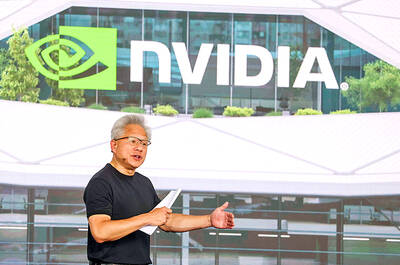
‘BOOMING’: ’ The number of partners we have here is incredible. You can see from their stock prices. They’re doing so well, they’re so happy,’ Jensen Huang said Nvidia Corp’s spending in Taiwan has ballooned to about US$150 billion a year, 10 times the US$10 billion to US$15 billion the company spent five years ago, Nvidia chief executive officer Jensen Huang (黃仁勳) said yesterday, suggesting Taiwan’s strategic importance in the global artificial intelligence (AI) supply chain. “Taiwan is the epicenter of the AI revolution. This is where the chips come, packaging comes. This is where the systems are made. This is where AI supercomputers were created,” Huang said at a meeting for the company’s employees in Beitou-Shilin Technology Park (北投士林科技園區) in Taipei, the planned site of Nvidia’s Taipei headquarters. “Taiwan
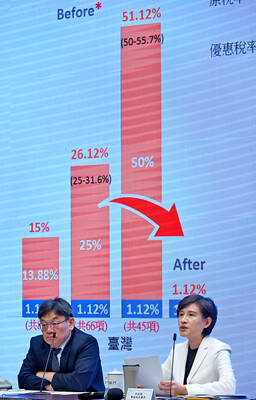
GREATER REACH? Auto parts and wood products would face tariffs of up to 15%, matching those targeting the EU, Japan and South Korea, Vice Premier said The US has announced that preferential tariff treatment for Taiwan’s non-semiconductor Section 232 goods would take effect retroactively from May 1, the Executive Yuan said yesterday. The US government yesterday posted a notice on the Federal Register’s public inspection Web site previewing tariff concessions for Taiwan under a memorandum of understanding (MOU) on Taiwan-US investment after two months of negotiations. The MOU signed on Jan. 15 stipulated three major preferential tariff arrangements: a 15 percent “reciprocal” tariff rate for Taiwan without stacking most-favored nation (MFN) rates; preferential Section 232 treatment for semiconductors and related products; and preferential Section 232 treatment for non-semiconductor


 RSS
RSS