


Minister of Health and Welfare Chiu Wen-ta (邱文達) resigned late yesterday to take political responsibility for the tainted lard oil scandal that has hit the local food industry and tarnished Taiwan’s international image as a “food paradise.”
“I express my sincere apology for the unease the oil scare has caused the public,” Chiu told a press conference at the ministry building in Taipei at 8pm.
“I also want to show my gratitude for the devotion to service the ministry has shown during my tenure, such as implementing the second-generation National Health Insurance program, promoting medical diplomacy and playing an active role in the World Health Assembly,” he said.
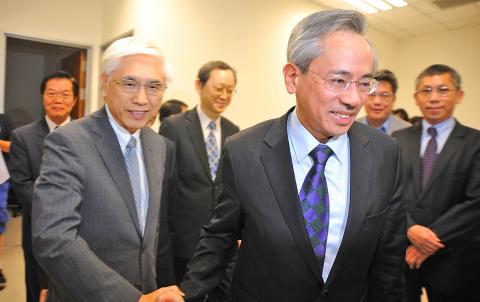
Photo: Liu Hsin-de, Taipei Times
Chiu said there are no longer any substandard lard oil products on store shelves and that the Pingtung District Prosecutors’ Office’s indictment of all responsible parties yesterday has at last put an end to the scandal.
“Hence, today I deliver on my promise to not cling to my post after ensuring that the oil scare was properly handled,” Chiu said, adding that he has plans to return to his former profession as a neuroscience researcher and medical instructor.
The 64-year-old physician-turned-politician served as Taipei Medical University president and professor for many years, and was best known to the public for promoting legislation on bicycle helmets, aimed at decreasing the number of brain injuries and accidental deaths.
During his tenure as minister since September 2011, the country suffered three other major food scares: a plasticizer food scare that year, a starch scandal and an adulterated cooking oil scare last year.
Meanwhile, Food and Drug Administration (FDA) Director-General Yeh Ming-kung (葉明功) has been transferred from his position due to the lard oil incident, the Executive Yuan said.
Yeh’s position would be temporarily taken over by FDA Deputy Director-General Chiang Yu-mei (姜郁美), the Executive Yuan said.
Earlier yesterday, eight people, who are operators and company executives involved in the scandal, were indicted by the Pingtung District Prosecutors’ Office on fraud charges and food safety violations.
Among the eight, Yeh Wen-hsiang (葉文祥), chairman of cooking oil maker Chang Guann Co (強冠企業) in Greater Kaohsiung; the company’s deputy general manager Tai Chi-chuan (戴啟川); Kuo Lieh-cheng (郭烈成), who ran an unlicensed cooking oil recycling operation in Pingtung County that was an upstream supplier of tainted oil to Chang Guann; and Kuo’s assistant, Shih Min-yu (施閔毓), were indicted on 235 counts of fraud in terms of the Act Governing Food Safety and Sanitation (食品安全衛生管理法), the prosecutors’ office said.
Head prosecutor Yang Wan-li (楊婉莉) said the four men played the main roles in the scandal, as they had supplied tainted oil to 235 downstream companies.

DRONE CENTRAL: Taiwan aims to become Asia’s democratic hub for drones, with most exports focused on high-quality military-grade models, an official said Taiwan’s drone industry is expected to expand significantly by 2030, producing 100,000 units per month and exporting half of them, the Ministry of Economic Affairs said yesterday. Current drone production capacity is about 15,000 units per month, but the industry can quickly scale up as demand increases, Industrial Development Administration Director-General Chiou Chyou-huey (邱求慧) told a news conference in Taipei. Taiwan’s drone output grew 2.5-fold last year to NT$12.9 billion (US$408.3 million) under a government program to develop the uncrewed vehicle sector, he said. The Executive Yuan in October last year approved plans to invest NT$44.2 billion into domestic production of uncrewed aerial

A signaling system malfunction disrupted high-speed rail (HSR) services beginning at 8am today, with trains temporarily reduced to three northbound and three southbound trains per hour as authorities conduct inspections. The malfunction occurred on a section of track in Miaoli County during pre-operation checks early this morning, forcing northbound and southbound trains to use a single track, the HSR operator said. The regular schedule has been replaced with three hourly trains offering only nonreserved seating in each direction, stopping at every station, it said, adding that business class cars would still have reserved seating. Departures from terminal stations are scheduled at the top

VERBOSE VESSELS: A CGA cutter and a China Coast Guard exchanged verbal barbs for more than a day in Taiwanese-controlled waters before the Chinese vessel left The Taiwanese and Chinese coast guards had a standoff near the strategically located Pratas Islands (Dongsha Islands, 東沙群島) in the north of the South China Sea, the Coast Guard Administration (CGA) said yesterday. The two sides engaged in intense radio exchanges over sovereignty claims during the 33-hour standoff. China Coast Guard vessel 3501 eventually left the restricted waters, 26.6 nautical miles (49.2km) west of the Pratas Islands, at 5pm yesterday, the CGA said. Lying approximately between southern Taiwan and Hong Kong, the Taiwan-controlled Pratas are seen by some security experts as vulnerable to Chinese attack due to their distance — more than
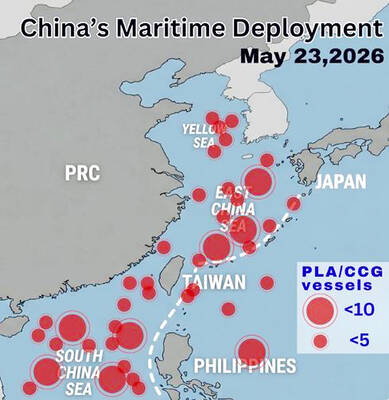
WARNING: China should stop engaging in actions that undermine regional peace and stability, as it would only build resentment among people across the Strait, the CGA said China has deployed more than 100 navy, coast guard and other vessels in waters from the Yellow Sea to the South China Sea and the western Pacific since US President Donald Trump and Chinese President Xi Jinping (習近平) met in Beijing, National Security Council Secretary-General Joseph Wu (吳釗燮) said yesterday. “In this part of the world, #China is the one & only PROBLEM wrecking the #StatusQuo & threatening regional peace & stability,” Wu wrote on X. In a separate post, he said Beijing was coercing Taiwan’s maritime domain, calling it illegal and provocative, after the Coast Guard Administration (CGA) expelled a


 RSS
RSS