


Taiwan’s Hsu Shu-ching won gold and set a new combined world mark of 233kg in the 53kg category at the Asian Games yesterday, while Kazakhistan weightlifter Zulfiya Chinshanlo broke her own clean-and-jerk world record.
Hsu, who won silver behind Chinshanlo at the London Olympics in 2012, turned the tables on her by beating the combined mark of 230kg, set at the Guangzhou Asian Games in 2010 by China’s Li Ping.
Chinshanlo was beaten for the title owing to her Taiwanese rival’s superior lift in the snatch.
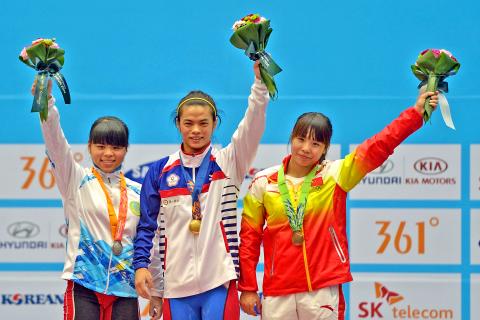
Photo: AFP
Chinshanlo had set the clean-and-jerk world record by lifting 131kg in London and bettered her mark by 1kg in Incheon.
Hsu lifted 101kg in the snatch and 132kg in the clean and jerk.
The drama wasn’t over as Chinshanlo, with one lift remaining, raised the weight to the improbable 137kg that would have given her the gold.
Photo: Reuters
However, she buckled under the huge load and had to settle for silver with a total of 228kg.
“I fought for this and I knew we were on the same level. But never in my dreams did I think I would have to break the world record to win gold,” a delighted Hsu told reporters afterward.
She added that it had all come as a shock and she had exceeded even her own expectations.
“I never lifted that much, not even in training,” Hsu said. “My next goal is to win an Olympic gold. I am so happy.”
Hsu’s and Chinshanlo’s efforts were not the only world records to be set in a dramatic evening at Incheon’s Moonlight Festival arena.
China’s 20-year-old Zhang Wanqiong set two new junior world records on her way to a bronze, her country’s first medal of the weightlifting competition.
Zhang was as surprised as anyone at what she had seen unfold at the end of the clean and jerk.
“I didn’t expect Hsu to do this well,” Zhang admitted. “I will just have to work harder from now.”
Chinshanlo was clearly upset after losing an event for which she had been a hot favourite and left without talking to waiting reporters.
“She is an Olympic champion. Second place is OK. She will work harder for two more years for the Rio Olympics,” said Alexy Ni, Chinshanlo’s coach.
The Games run until Oct. 4, with about 13,000 athletes competing for 439 gold medals. Taiwan is hoping to improve upon the 67 medals they won in 2010.
CYCLING
AFP, INCHEON, South Korea
Hong Kong’s Olympic medal-winning track cyclist Sarah Lee Wai-sze took gold in the women’s keirin.
Lee, 27, punched the air after she crossed the line, with Malaysia’s Fatehah Binti Mustapa taking silver and China’s Zhong Tianshi winning bronze.
Chinese riders Zhong and Lin Junhong made their move in the penultimate lap, but Mustapa and Lee battled back, leaving Zhong out of the medals. Lee, who is also tipped for gold in the individual sprint, became a star in Hong Kong when she won keirin bronze at the 2012 Olympics — the territory’s first cycling medal at a Summer Games, and only its third overall.
It is not her first Asian Games gold — she took the 500m time trial in Guangzhou, before becoming world champion in that event last year.
However, her form had been in question after she came in sixth when she defended her world title earlier this year.
SWIMMING
AFP, INCHEON, South Korea
Japan’s Kosuke Hagino stunned heavyweights Sun Yang and Park Tae-hwan to snatch gold in an electrifying men’s 200m freestyle final.
Hagino, 20, trailed the China and South Korea stars going into the final lap, but roared back in the last 50m to touch in 1 minute, 45.23 seconds, just 0.05 ahead of Sun.
Local hero Park, who had been greeted by deafening cheers at the Incheon aquatics arena named after him, clocked 1 minute, 45.85 seconds in a dramatic finish.
Sun, the reigning 400m and 1,500m world and Olympic champion, had looked sharpest in the morning’s heats, while Park, who won gold in the 400m at the 2008 Beijing Games, had struggled with his stroke.
Medley specialist Hagino, whose coach had given him “zero chance” of winning the gold, producing a sensational late burst to steal their thunder.
Hagino won two golds at last month’s Pan Pacific championships in Australia, including a stunning upset over US legend Michael Phelps to win the 200m individual medley and beating another US star Tyler Clary in the 400m medley.
China, top team at the past nine Asian Games, were second behind South Korea on the medals table according to the Asian Games Web site last night. Both nations had 12 gold, but South Korea’s 10 silvers to China’s nine gave them the lead.
South Korea unearthed an unlikely hero in Seoul schoolboy Kim Cheong-yong, 17, who upset the Olympic and world champion Jin Jong-oh to win the 10m air pistol title.
The shy Kim also helped South Korea bag the team title and said winning gold was like a “dream come true.”
“It was some luck and the blessings of all Koreans that saw me through,” Kim told his first ever press conference.
At the Asian Games, about 9,500 athletes from 45 countries are competing in 36 sports, including the full Olympic schedule.
While China, South Korea, Japan and other top teams have an army of Olympic and world champions taking part, Aishath Sajina of the Maldives reminded that it is also a Games for minnows.
The Maldives team got one of the biggest cheers of the swimming contest after finishing the women’s 4x100m freestyle relay heats in 5 minutes, 11.81 seconds — more than 90 seconds behind China.
Sajina splashed almost the whole two lengths of her anchor leg alone as the other teams toweled off. When Sajina touched it triggered a huge roar in the stadium, matched only by that given to local hero Park.
Additional reporting by staff writer
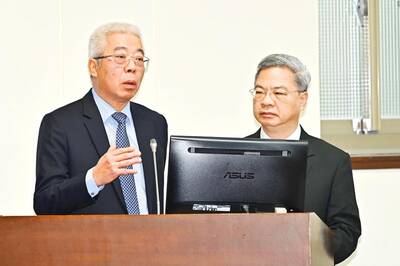
Taiwan has arranged for about 8 million barrels of crude oil, or about one-third of its monthly needs, to be shipped from the Red Sea this month to bypass the Strait of Hormuz and ease domestic supply pressures, CPC Corp, Taiwan (CPC, 台灣中油) said yesterday. The state-run oil company has worked with Middle Eastern suppliers to secure routes other than the Strait of Hormuz, through which about 20 percent of the world’s oil and liquefied natural gas typically passes, CPC chairman Fang Jeng-zen (方振仁) said at a meeting of the legislature’s Economics Committee in Taipei. Suppliers in Saudi Arabia have indicated they
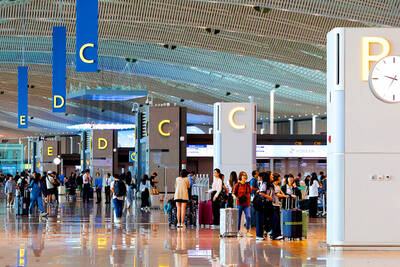
South Korea has adjusted its electronic arrival card system to no longer list Taiwan as a part of China, a move that the Ministry of Foreign Affairs said would help facilitate exchanges between the two sides. South Korea previously listed “Taiwan” as “Taiwan (China)” in the drop-down menus of its online arrival card system, where people had to fill out where they came from and their next destination. The ministry had requested South Korea make a revision and said it would change South Korea’s name on Taiwan’s online immigration system from “Republic of Korea” to “Korea (South),” should the issue not be
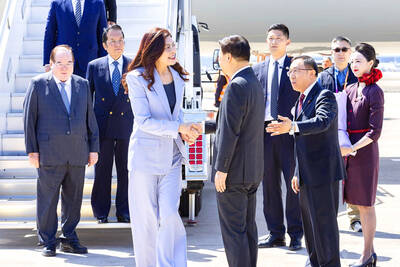
CCP ‘PAWN’? Beijing could use the KMT chairwoman’s visit to signal to the world that many people in Taiwan support the ‘one China’ principle, an academic said Chinese Nationalist Party (KMT) Chairwoman Cheng Li-wun (鄭麗文) yesterday arrived in China for a “peace” mission and potential meeting with Chinese President Xi Jinping (習近平), while a Taiwanese minister detailed the number of Chinese warships currently deployed around the nation. Cheng is visiting at a time of increased Chinese military pressure on Taiwan, as the opposition-dominated Legislative Yuan stalls a government plan for US$40 billion in extra defense spending. Speaking to reporters before going to the airport, Cheng said she was going on a “historic journey for peace,” but added that some people felt uneasy about her trip. “If you truly love Taiwan,
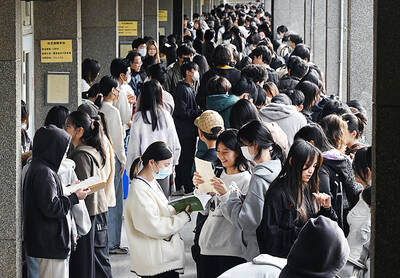
A global survey showed that 60 percent of Taiwanese had attained higher education, second only to Canada, the Ministry of the Interior said. Taiwan easily surpassed the global average of 43 percent and ranked ahead of major economies, including Japan, South Korea and the US, data from the Organisation for Economic Co-operation and Development (OECD) for 2024 showed. Taiwan has a high literacy rate, data released by the ministry showed. As of the end of last year, Taiwan had 20.617 million people aged 15 or older, accounting for 88.5 percent of the total population, with a literacy rate of 99.4 percent, the data


 RSS
RSS