


Scots rejected independence yesterday in a referendum that left the centuries-old UK intact, but headed for a major shake-up that is to give more autonomy to both Scotland and England.
Despite a surge in nationalist support in the final fortnight of the campaign, the “no” camp secured 55.30 percent of the vote, against 44.70 percent for the pro-independence “yes” camp.
After a campaign that fired up separatist movements around the world and stoked political passions across the country, turnout was 84.6 percent — the highest ever for an election in the UK.
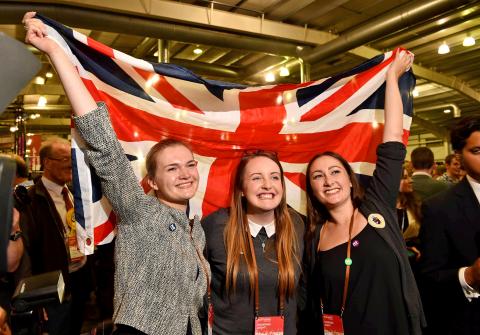
Photo: AFP
“No” campaigners across Scotland cheered, hugged and danced as the results came in the early morning and British Prime Minister David Cameron said he was “delighted.”
“It would have broken my heart to see our United Kingdom come to an end,” he said outside his Downing Street offices in London, looking visibly relieved after averting a humiliating defeat that could well have cost him his job.
Many “yes” activists watched dejected and in tears in the streets of the Scottish capital, Edinburgh, although Scottish First Minister Alex Salmond urged them to take heart from the huge numbers — 1.6 million — who backed independence.

Photo: EPA
The result reassured investors worried about the economic risks of a break-up and the British pound reached a two-year high against the euro, while European stock markets rallied.
A “yes” vote would have brought to an abrupt end a union between Scotland and England stretching back to 1707, and was being closely watched by separatist movements who are also now clamoring for a referendum, like the Catalans in Spain.
However, while the UK survived, it could soon look very different.
The British government must now deliver on promises made in the heat of the campaign to give more powers over tax, spending and welfare to the devolved government in Edinburgh.
In his televised address, Cameron said he would offer all parts of the UK greater local control — heading off growing demands from right-wing Conservatives and the UK Independence Party for England to be given more powers.
“Just as Scotland will vote separately in the Scottish parliament on their issues of tax, spending and welfare, so too England, as well as Wales and Northern Ireland, should be able to vote on these issues,” he said.
In what would be a radical shake-up of the constitutional order, he said these new powers would be delivered “at the same pace as the settlement for Scotland,” suggesting legislation would be drawn up as soon as January next year.

The subsidiary of Taiwan Semiconductor Manufacturing Co (TSMC, 台積電) in Kumamoto, Japan, turned a profit in the first quarter of this year, marking the first time the first fab of the unit has become profitable since mass production started at the end of 2024. According to the contract chipmaker’s financial statement released on Friday, Japan Advanced Semiconductor Manufacturing Inc (JASM), a joint venture running the fab in Kumamoto, posted NT$951 million (US$30.19 million) in profit in the January-to-March period, compared with a loss of NT$1.39 billion in the previous quarter, and a loss of NT$3.25 billion in the first quarter of

DRONE CENTRAL: Taiwan aims to become Asia’s democratic hub for drones, with most exports focused on high-quality military-grade models, an official said Taiwan’s drone industry is expected to expand significantly by 2030, producing 100,000 units per month and exporting half of them, the Ministry of Economic Affairs said yesterday. Current drone production capacity is about 15,000 units per month, but the industry can quickly scale up as demand increases, Industrial Development Administration Director-General Chiou Chyou-huey (邱求慧) told a news conference in Taipei. Taiwan’s drone output grew 2.5-fold last year to NT$12.9 billion (US$408.3 million) under a government program to develop the uncrewed vehicle sector, he said. The Executive Yuan in October last year approved plans to invest NT$44.2 billion into domestic production of uncrewed aerial
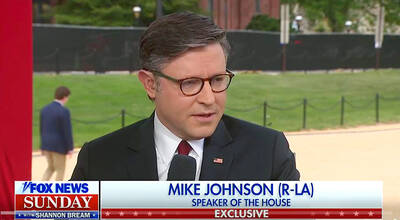
RESOLUTE BACKING: Two Republican senators are planning to introduce legislation that would impose immediate sanctions on China if it attempts to invade Taiwan US House of Representatives Speaker Mike Johnson on Sunday reaffirmed US congressional support for Taiwan, saying the US and “all freedom-loving people” have a stake in preventing China from seizing Taiwan by force. Johnson made the remarks in an interview with Fox News Sunday on US President Donald Trump’s summit with Chinese President Xi Jinping (習近平) last week. In an interview that aired on Friday on Fox News, just as Trump wrapped up a high-stakes visit to China, he said he has yet to green-light a new US$14 billion arms package to Taiwan and that it “depends on China.” “It’s a very good
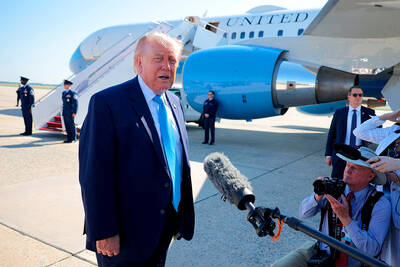
US President Donald Trump yesterday said he would speak to President William Lai (賴清德) as his administration considers whether to move ahead with a US$14 billion weapons sale to Taiwan — a potential arms deal that has drawn criticism from China. “Well, I’ll speak to him. I speak to everybody,” Trump told reporters yesterday when asked if he had any plans to call his counterpart, although he did not offer a time frame for when such a conversation could take place. Trump previously said he would speak to the person “that’s running Taiwan,” without specifying who he meant. “We have that situation very


 RSS
RSS