

The Greater Kaohsiung Government Department of Health yesterday fined edible oil manufacturer Chang Guann Co (強冠企業) NT$50 million (US$1.67 million) over its peddling of lard oil tainted with recycled waste oil.
The fine is the highest that can be imposed on violators of Article 15-1 of the Act Governing Food Safety and Sanitation (食品安全衛生管理法), which prohibits the manufacturing, processing and selling of foods or food additives that have deteriorated or gone rotten.
The department has also referred company chairman Yeh Wen-hsiang (葉文祥), to the Kaohsiung District Prosecutors’ Office for investigation.
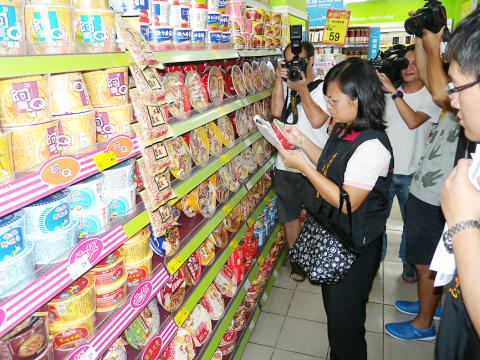
As of 2pm yesterday, the Food and Drug Administration (FDA) had identified 1,256 companies that bought a total of 782 tonnes of “Fragrant Lard Oil” manufactured by Chang Guann between March 1 and last month made with recycled waste oil provided by the owner of a Pingtung-based unlicensed factory, Kuo Lieh-cheng (郭烈成).
Kuo allegedly obtained waste oil recycled from restaurant fryers from waste recycler Hu Hsin-te (胡信德), whose factory, named Shun Te Enterprise (順德企業行), in Greater Kaohsiung’s Daliao District (大寮) was shut down yesterday by the local government’s Economic Development Bureau after it was found to be unregistered.
Fourteen more food products were drawn into the oil scandal yesterday, bringing the number of types of products contaminated with the tainted lard to 222.
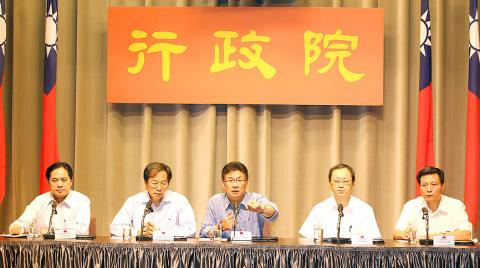
Photo: CNA
Among them, eight were from Greater Kaohsiung-based Ching Hsin Fresh Food Factory (晉欣鮮食廠), which provides foodstuffs to the 450 southern branches of Taiwan FamilyMart Co (全家便利商店), Taiwan’s second-largest convenience store chain.
FDA Northern Center for Regional Administration Director Feng Jun-lan (馮潤蘭) said nearly 99 percent of the 222 types of tainted food products have been pulled off the shelves and sealed, weighing 228 tonnes in total.
“They are to be destroyed by health departments nationwide in the near future,” Feng said, adding that her agency was still tracing the whereabouts of about 79 of the 782 tonnes of tainted lard oil.
Separately yesterday, Vice Premier Mao Chi-kuo (毛治國) described Chang Guann’s selling of substandard lard oil as a “vile criminal act” and demanded the severest penalties for the perpetrators.
Mao was quoted by Executive Yuan spokesperson Sun Lih-chyun (孫立群) after the first meeting of an inter-ministerial task force established on Friday last week to deal with the tainted lard scandal.
At a press conference after the meeting, Sun said the fact that the tainted lard oil had been mixed with something not meant for human consumption was enough to make it an illegal product, regardless of whether it met legal standards, as recent FDA test results found.
Health and Welfare Vice Minister Hsu Ming-neng (許銘能) said the FDA only tested samples of the questionable oil for substances for which the government has set a maximum permissible level, such as heavy metals.
“The ministry is to discuss with experts in the area other kinds of substances that should also be tested for in the future,” Hsu said.
Mao also quoted representatives from the Ministry of Justice as saying at the meeting that investigators were checking into the bank accounts belonging to the companies and individuals involved in the case to ensure that all their illegal gains were confiscated.
As for other ministries’ handling of the oil scandal, Mao said that the Council of Agriculture on Friday instructed the Pingtung County Department of Agriculture to seal and run tests on the oil produced by animal feed manufacturer Ching Wei Co (進威), which was allegedly made with waste oil procured from Kuo.
“The Ministry of National Defense has removed all food products that could have been contaminated with the lard oil from military stores, while the Ministry of Education has demanded that schools keep records of the edible oil they use and conduct regular spot checks on their meal providers,” Mao said.

PATROL PARTNERS: The ‘Chiayi’ and the ‘Penghu’ departed for a two-day joint patrol of Palau’s exclusive economic zone, the CGA’s second diplomatic visit to the country The Coast Guard Administration (CGA) set a record for its southernmost deployment of a coast guard vessel as the vessels Chiayi and the Penghu reached Palau’s Pulo Anna Island on Saturday in a cooperative exercise between the two countries. The island, about 217 nautical miles (401km) southwest of Koror in the Palauan state of Sonsorol and 1,220 nautical miles from Taiwan’s southernmost point, Oluanpi (鵝鑾鼻), is the furthest south a CGA vessel has sailed. The two vessels are in Palau for the coast guard’s second diplomatic visit to the country. They docked at Malakal Harbor on Tuesday last week. The coast guard
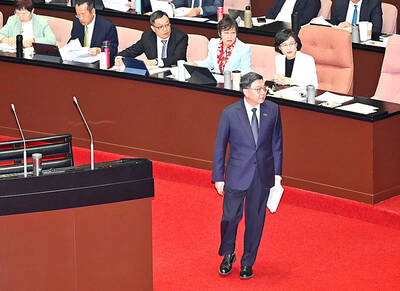
The government is monitoring online rumors that a pneumonic plague outbreak has spread from Russia into China, and it might enhance quarantine measures, Premier Cho Jung-tai (卓榮泰) said yesterday. During a legislative meeting, Democratic Progressive Party Legislator Wang Ting-yu (王定宇) said that rumors had circulated that the disease had spread across several Chinese provinces. He asked Cho whether the government was prepared to prevent the disease spreading to Taiwan, given the volume of traffic between the two sides, and how concerned the government was about the alleged outbreak. The Ministry of Health and Welfare had implemented border quarantine measures after briefing the Executive
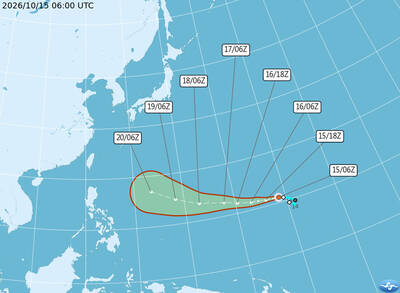
EAST OF GUAM: Tropical Storm Champi is forecast to strengthen into a typhoon, but its effect on Taiwan is uncertain due to the presence of a high-pressure system Tropical Storm Champi formed yesterday and has the potential to increase in strength, the Central Weather Administration (CWA) said yesterday. Forecasters are closely monitoring a Pacific high-pressure system that would dictate whether the storm turns north or moves toward Taiwan next week, the CWA said. The most likely scenario is that it turns northward after passing the Ryukyu Islands, CWA forecaster Cheng Chieh-jen (鄭傑仁) said. As of 8pm yesterday, Champi was east of Guam moving west-northwest at 20kph, CWA data showed. It had maximum sustained winds near the center of 72kph and gusts of up to 101kph, the data showed. If the Pacific high-pressure system
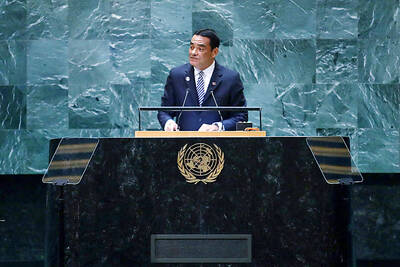
RIGHT TO DIPLOMACY: Under the UN Charter, every state has the right to conduct foreign policy free from external pressure, Belize said in a statement Belize and Paraguay on Monday condemned Beijing sanctions over their countries’ ties with Taiwan, saying China’s actions create unnecessary tensions. Earlier on Monday, Beijing announced sanctions against Paraguayan Minister of Information and Communication Technologies Gustavo Villate and Belizean Minister of Foreign Affairs Francis Fonseca. The Paraguayan Ministry of Foreign Affairs said it rejected the sanctions, writing on X that they created unnecessary friction. It added that it reaffirmed its support for Taiwan and its commitment to democratic values and principles. Villate told the Spanish-language Paraguayan daily ABC Color the sanctions were “predictable” and linked them to several cooperation projects between Taiwan and Paraguay. The projects


 RSS
RSS