


US National Security Adviser Susan Rice yesterday began talks in Beijing with top Chinese military and diplomatic officials on bilateral challenges, such as a recent close encounter between their air force planes over the South China Sea.
Rice met with Chinese State Councilor Yang Jiechi (楊潔篪) on a trip to pave the way for a visit by US President Barack Obama to Beijing in November.
Rice said that among all the other issues facing the US, Obama still considered China to be a priority and that her primary reason for coming to Beijing was to hammer out the agenda for the November meeting between Obama and Chinese President Xi Jinping (習近平).
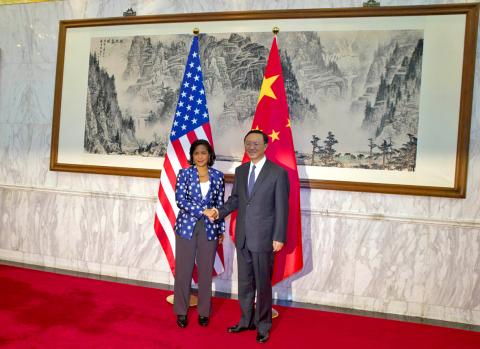
Photo: AFP
At the sprawling Diaoyutai State Guesthouse in western Beijing, Yang told Rice that the countries needed to “truly respect each other’s core interests and major concerns and constructively manage our differences and sensitive issues.”
He said they would discuss military relations, counterterrorism, the Middle East, North Korea, South Sudan, Iran and other topics of mutual concern.
Rice is scheduled to meet today with China’s national defense and foreign affairs ministers before departing tomorrow.
The countries’ relationship has been tested by US allegations of Chinese military cyberspying and Obama’s stated pivot to Asia, which China sees as an effort to contain its rising power.
On Aug. 19, a Chinese jet made several close passes near a US Navy P-8 Poseidon plane, coming within 9m of it at one point. The incident took place about 220km from Hainan Island, which is home to naval airfields and a highly sensitive submarine base.
China rejected US accusations that its pilot acted recklessly and unprofessionally, and says it will continue responding to US surveillance flights off its coast.
An editorial last week from Xinhua news agency referred to the encounter as an example of Washington’s resorting to “provocations out of fear for Beijing’s growing economic prowess and regional clout.”
“What is also worrying is that the US leadership has apparently followed a bad tradition of taking China as scapegoat for its own messy domestic and foreign policies, while overlooking the big picture of China-US relations,” the editorial said.
Rice also drew Chinese ire with her harsh criticisms of Beijing’s approach to the crisis in Syria while serving as US ambassador to the UN, although the Xinhua editorial said she has since matured in her approach to China.
“Thus, Rice’s first China trip in her current position comes at a particularly critical time when it is of great urgency for the United States to reaffirm its commitment and sincerity to Beijing by treating it as a true partner,” Xinhua said.
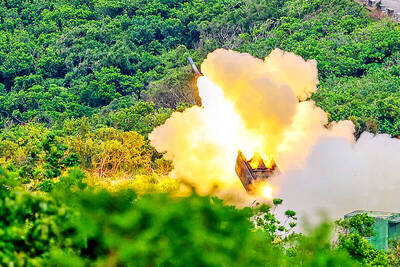
PRECISION STRIKES: The most significant reason to deploy HIMARS to outlying islands is to establish a ‘dead zone’ that the PLA would not dare enter, a source said A High Mobility Artillery Rocket System (HIMARS) would be deployed to Penghu County and Dongyin Island (東引) in Lienchiang County (Matsu) to force the Chinese military to retreat at least 100km from the coastline, a military source said yesterday. Taiwan has been procuring HIMARS and Army Tactical Missile Systems (ATACMS) from the US in batches. Once all batches have been delivered, Taiwan would possess 111 HIMARS units and 504 ATACMS, which have a range of 300km. Considering that “offense is the best defense,” the military plans to forward-deploy the systems to outlying islands such as Penghu and Dongyin so that
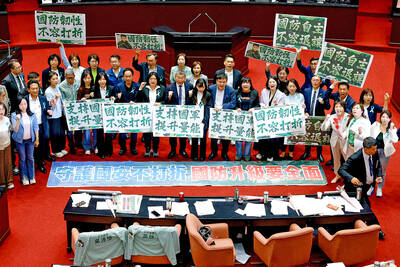
WHAT WAS ALL THAT FOR? Jaw Shaw-kong said that Cheng Li-wen had pushed for more drastic cuts and attacked him, just for the outcome to be nearly identical to his bill The legislature yesterday passed a supplementary budget bill to fund the purchase of separate packages of US military equipment, with the combined amount of spending capped at NT$780 billion (US$24.8 billion). The Chinese Nationalist Party (KMT) and Taiwan People’s Party (TPP) used their legislative majority to pass the bill, which runs until 2033 and has two main funding provisions. One was for NT$300 billion of arms sales already approved by the US for Taiwan on Dec. 17 last year, the other was for NT$480 billion for another arms package expected to be announced by Washington. The bill, which fell short of the NT$1.25

A former television news host and six military personnel — active and retired — have been indicted on espionage charges, Kaohsiung prosecutors said yesterday. Lin Chen-you (林宸佑), a former CTi News host and YouTuber, last year allegedly made videos at the direction of a Chinese agent criticizing the Democratic Progressive Party’s recall campaign, the Ciaotou District Prosecutors’ Office told a news conference in Kaohsiung. He allegedly received 4,325 tether coins for the videos from an unidentified person surnamed Huang (黃), believed to be an agent of a hostile foreign power, they said. Lin, also known as Ma Te (馬德), has a show named

‘CRITICAL MOMENT’: Any delay in the passage of the remaining funds would weaken Taiwan’s security and play into the hands of the Chinese Communist Party, the AIT said While welcoming the Legislative Yuan’s approval of a supplementary defense budget, the US Department of State said that further delays to Taiwan military spending are a “concession” to China. The remarks came after the legislature on Friday passed the budget bill to fund the purchase of separate packages of military equipment from the US, with total spending capped at NT$780 billion (US$24.82 billion). One package allocates NT$300 billion for arms sales approved by the US for Taiwan on Dec. 17 last year, while the other sets aside NT$480 billion for an arms package expected to be announced by Washington. The


 RSS
RSS