


Taiwanese civil rights organizations yesterday rallied behind the people of Hong Kong in their pursuit of universal suffrage in 2017, as China sets limits on the vote for the election of the territory’s leader.
Local groups initiated a signature drive to show their support for pro-democracy activists who on Sunday vowed “an era of civil disobedience” in protest against Beijing’s decision to reject open nominations for candidates in the territory’s first direct leadership election in 2017.
What has been happening in Hong Kong is its “democratic groups are aligning against the anti-democratic force spearheaded by the Chinese Communist Party” (CCP), Wang Dan (王丹), an exiled Chinese democracy activist who serves as chairman of the New School for Democracy, told a press conference in Taipei
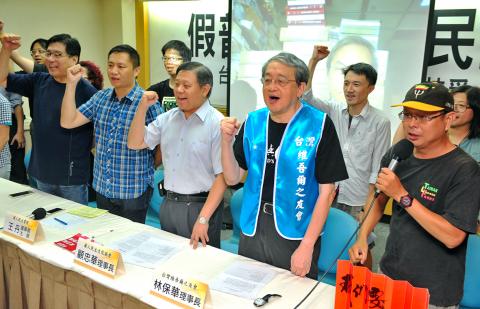
Photo: Chien Jung-fong, Taipei Times
When the CCP, which does not permit democracy, tries to expand its influence in the world by fostering an anti-democratic force, not just in Hong Kong, but also in other places, “it is everyone’s business” to stop this attempt to take human civilization backward, Wang said.
If China succeeds in controlling Hong Kong, Taiwan — “which is already teetering on the edge” of falling into China’s hands — would face imminent danger, because Beijing would then concentrate its efforts on resolving the Taiwan issue, he said.
Taiwan Friends of Uighurs chairman Paul Lin (林保華) said President Ma Ying-jeou (馬英九) was responsible for what is happening in Hong Kong today.
“China used to govern Hong Kong under the principle of ‘one country, two systems’ because it wanted to establish a model for settling the ‘Taiwan issue.’ With Ma in power, Taiwan is already under its control, and thus it no longer respects the formula of ‘one country, two systems,’” Lin said.
Lin said that Taiwanese who voted for Ma have to stand up for Hong Kong to make up for their mistake.
The activists said they were concerned that China might launch a bloody crackdown on the pro-
democracy movement in Hong Kong as it did during the Tiananmen Square protests in 1989.
“We do not want to see that happen, but if it does, we hope to get help from at least 100 university professors and 20 academics at Academia Sinica in Taiwan to nominate Occupy Central activists for the Nobel Peace Prize,” Wang said.
Wang said the idea was floated in a discussion on Sunday night among exiled Chinese dissidents who participated in the 1989 movement.
Lin said that any attempt by China to put down pro-democracy activists would only drive Hong Kong to seek independence.
“We will stand with Hong Kong people in fighting for their rights to self-determination as they have called for,” he added.
Speaking via a video conference, Alliance for True Democracy convener Joseph Cheng (鄭宇碩) said he wanted to tell people in Taiwan: “Please continue to lend us your support. We will never give up.”
“We often hear the phrase ‘Today’s Hong Kong, tomorrow’s Taiwan.’ This is not what we want. We hope that what Hong Kong will look like tomorrow is what Taiwan has today: democracy,” Cheng said.
Hong Kong Federation of Students chairman Alex Chow Yong Kang (周永康) said that people in Hong Kong would never believe that the territory is governed by Hong Kongers or that Hong Kongers would enjoy a high degree of autonomy under the “one country, two systems” principle as Beijing has promised.
Chow said that civil society in Taiwan, China and Macau should work together to resist the common threat that they face from China.
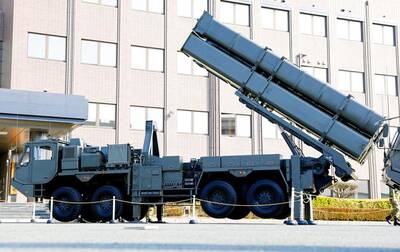
Japan has deployed long-range missiles in a southwestern region near China, the Japanese defense minister said yesterday, at a time when ties with Beijing are at their lowest in recent years. The missiles were installed in Kumamoto in the southern region of Kyushu, as Japan is attempting to shore up its military capacity as China steps up naval activity in the East China Sea. “Standoff defense capabilities enable us to counter the threat of enemy forces attempting to invade our country ... while ensuring the safety of our personnel,” Japanese Minister of Defense Shinjiro Koizumi said. “This is an extremely important initiative for
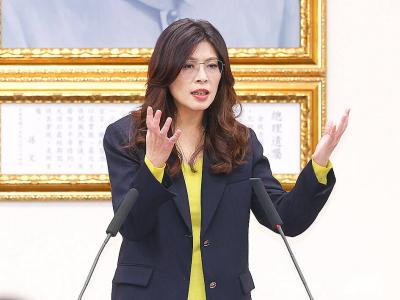
Chinese Nationalist Party (KMT) Chairwoman Cheng Li-wun (鄭麗文) today accepted an invitation from Chinese President Xi Jinping (習近平) to lead a delegation to China next month, saying she hopes to promote the peaceful development of cross-strait relations and bring stability to the Taiwan Strait. “I am grateful and happy to accept this invitation,” Cheng said in a statement from the KMT chairperson’s office. Cheng said she hopes both sides can work together to promote the peaceful development of cross-strait relations, enhance exchange and cooperation, bring stability to the Taiwan Strait and improve people’s livelihoods. At today's news conference, Cheng said any efforts to
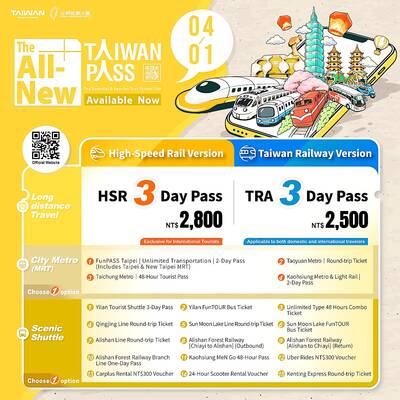
MORE POPULAR: Taiwan Pass sales increased by 59 percent during the first quarter compared with the same period last year, the Tourism Administration said The Tourism Administration yesterday said that it has streamlined the Taiwan Pass, with two versions available for purchase beginning today. The tourism agency has made the pass available to international tourists since 2024, allowing them to access the high-speed rail, Taiwan Railway Corp services, four MRT systems and four Taiwan Tourist Shuttles. Previously, five types of Taiwan Pass were available, but some tourists have said that the offerings were too complicated. The agency said only two types of Taiwan Pass would be available, starting from a three-day pass with the high-speed rail and a three-day pass with Taiwan Railway Corp. The former costs NT$2,800

The nation’s fastest supercomputer, Nano 4 (晶創26), is scheduled to be launched in the third quarter, and would be used to train large language models in finance and national defense sectors, the National Center for High-Performance Computing (NCHC) said. The supercomputer, which would operate at about 86.05 petaflops, is being tested at a new cloud computing center in the Southern Taiwan Science Park in Tainan. The exterior of the server cabinet features chip circuitry patterns overlaid with a map of Taiwan, highlighting the nation’s central position in the semiconductor industry. The center also houses Taiwania 2, Taiwania 3, Forerunner 1 and


 RSS
RSS