


President Ma Ying-jeou (馬英九) yesterday downplayed the potential impact of alleged information leaks to China by former Mainland Affairs Council (MAC) deputy minister Chang Hsien-yao (張顯耀), calling it a “ripple in the strong wave of cross-strait developments.”
The remark follows his comment the day before comparing Chang to a “pest” in cross-strait ties that has to be eliminated — the first time Ma responded to the weeks-long scandal.
The president said the suspected leak was just a “ripple” that would not affect cross-strait developments, adding that Taipei and Beijing currently enjoy the “most stable period in cross-strait relations over the past 65 years.”
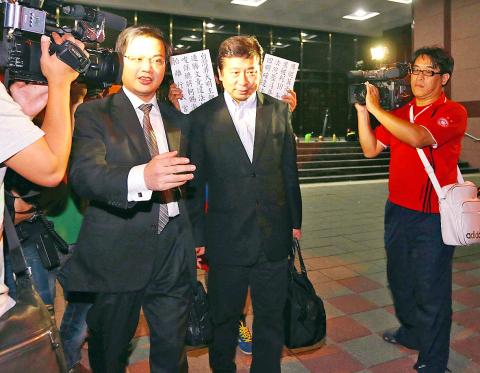
Photo: CNA
Speaking at a ceremony to mark Armed Forces Day, the president said the government would continue its efforts to promote cross-strait relations, but it has to be predicated on mutual respect and legitimacy for it to be in the interests of Taiwan and its people.
Separately yesterday, the Taiwan Solidarity Union (TSU) caucus called on Ma to report to the Legislative Yuan on the state of the nation after the legislature’s plenary session commences on Sept. 12, saying that since the president had likened Chang to a “pest,” he should explain who had nurtured the “pest” and allowed it to grow.
TSU caucus whip Lai Chen-chang (賴振昌) said that since Ma is the head of the state and, according to the Constitution, the highest person in charge of the national security system, and Chang was officially appointed by the president to take charge of cross-strait negotiations, Ma has to report to the nation since he was the decisionmaker and an interested party in the case involving national security.
TSU Legislator Chou Ni-an (周倪安) said that Chang, Mainland Affairs Council Minister Wang Yu-chi (王郁琦) and the Presidential Office have changed their stories several times since the dispute broke out, and the whole brouhaha has already caused damage to national security, cross-strait developments and diplomatic affairs.
Chou said Ma has been unapologetic and has acted as if nothing has happened, when he should be held accountable.
The Chinese-language United Daily News yesterday also ran a headline story claiming that Chang’s trusted assistants might have released at least 30 confidential documents to a Taiwanese businessman, who handed them over to officials at China’s Taiwan Affairs Office.
The report said the Investigation Bureau found Chang’s secretary faxing from the Mainland Affairs Council office classified documents to a Taiwanese businessman who acted as the middleman between Chang and Chinese officials.
Another assistant of Chang might have also verbally disclosed classified information to Chinese officials, the report quoted the bureau as saying.
The Taipei District Prosecutors’ Office rebutted the report and denied earlier reports saying that Chang had been wiretapped.
Chang was released earlier yesterday at about 2am after being questioned for 12 hours.
Chang’s aide, Chen Hung-yi (陳宏義), and two others who were called in for questioning have also been released.
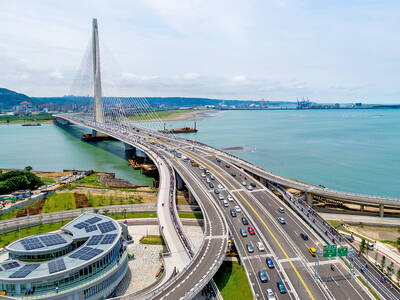
The Ministry of Transportation and Communications yesterday inaugurated the Danjiang Bridge across the Tamsui River in New Taipei City, saying that the structure would be an architectural icon and traffic artery for Taiwan. Feted as a major engineering achievement, the Danjiang Bridge is 920m long, 211m tall at the top of its pylon, and is the longest single-pylon asymmetric cable-stayed bridge in the world, the government’s Web site for the structure said. It was designed by late Iraqi-British architect Zaha Hadid. The structure, with a maximum deck of 70m, accommodates road and light rail traffic, and affords a 200m navigation channel for boats,
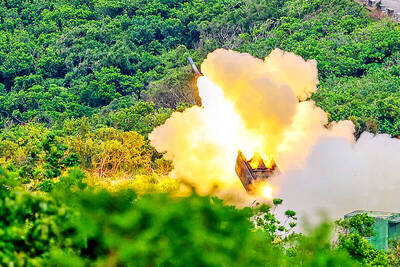
PRECISION STRIKES: The most significant reason to deploy HIMARS to outlying islands is to establish a ‘dead zone’ that the PLA would not dare enter, a source said A High Mobility Artillery Rocket System (HIMARS) would be deployed to Penghu County and Dongyin Island (東引) in Lienchiang County (Matsu) to force the Chinese military to retreat at least 100km from the coastline, a military source said yesterday. Taiwan has been procuring HIMARS and Army Tactical Missile Systems (ATACMS) from the US in batches. Once all batches have been delivered, Taiwan would possess 111 HIMARS units and 504 ATACMS, which have a range of 300km. Considering that “offense is the best defense,” the military plans to forward-deploy the systems to outlying islands such as Penghu and Dongyin so that
Taiwan Semiconductor Manufacturing Co (TSMC, 台積電), the world’s largest foundry service provider, yesterday said that global semiconductor revenue is projected to hit US$1.5 trillion in 2030, after the figure exceeds US$1 trillion this year, as artificial intelligence (AI) demand boosts consumption of token and compute power. “We are still at the beginning of the AI revolution, but we already see a significant impact across the whole semiconductor ecosystem,” TSMC deputy cochief operating officer Kevin Zhang (張曉強) said at the company’s annual technology symposium in Hsinchu City. “It is fair to say that in the past decade, smartphones and other mobile devices were
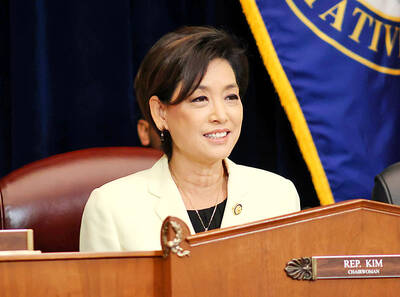
‘CLEAR MESSAGE’: The bill would set up an interagency ‘tiger team’ to review sanctions tools and other economic options to help deter any Chinese aggression toward Taiwan US Representative Young Kim has introduced a bill to deter Chinese aggression against Taiwan, calling for an interagency “tiger team” to preplan coordinated sanctions and economic measures in response to possible Chinese military or political action against Taiwan. “[Chinese President] Xi Jinping [習近平] has directed the People’s Liberation Army to be ready to invade Taiwan by 2027. China has a plan. America should have one too,” Kim said in a news release on Thursday last week. She introduced the “Deter PRC [People’s Republic of China] aggression against Taiwan act” to “ensure the US has a coordinated sanctions strategy ready should


 RSS
RSS