


China’s state-run media yesterday warned Washington that Beijing could treat its surveillance flights as an “act of hostility,” after US accusations that a Chinese fighter jet flew dangerously close to a US military aircraft.
US Rear Admiral John Kirby on Friday said the armed Chinese warplane came close to the US P-8 Poseidon surveillance aircraft on three occasions, at times less than 9m away, in what he called a “very dangerous” intercept.
Chinese Ministry of National Defense spokesman Yang Yujun (楊宇軍) called the allegations “totally groundless” in a statement cited by Xinhua news agency.
The incident took place 220km off China’s Hainan Island, over an area the US insists is international waters, but Beijing regards as part of its territory.
The incident has echoes of a major incident in April 2001, when a Chinese fighter jet collided with a US Navy EP-3 spy plane about 110km off Hainan.
The Global Times — which is owned by Chinese Communist Party mouthpiece the People’s Daily, and often takes a nationalist tone — lashed out in an editorial at US surveillance “in the coastal waters and airspace of China.”
“Such reconnaissance is posing a threat to China’s core security interests, which could be treated as an act of hostility,” it said.
“It would be a life and death fight between China and the US if the collisions in the South China Sea became confrontations concerning both sides’ core interests,” it warned.
The official China Daily newspaper accused the US of undermining mutual trust, saying that Washington’s concerns over China’s rise were a “psychological need to create an enemy to make up for its sense of loss after the end of the Cold War.”
US naval and airborne reconnaissance missions “do nothing to convince the Chinese authorities and the Chinese people that the US is sincere in claiming it wants to build mutual trust with China,” the newspaper said in an editorial.
Washington and Beijing have long disagreed over aviation and maritime rights in the strategic South China Sea, the site of key shipping routes, and which Beijing claims almost in its entirety.
In the 2001 collision, a Chinese pilot was killed and the US aircraft was forced to make an emergency landing on Hainan.
Chinese authorities detained its 24-member crew for more than a week until both governments worked out a face-saving deal for their release.
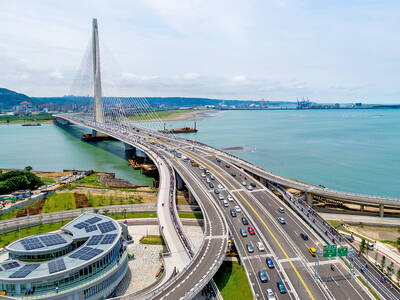
The Ministry of Transportation and Communications yesterday inaugurated the Danjiang Bridge across the Tamsui River in New Taipei City, saying that the structure would be an architectural icon and traffic artery for Taiwan. Feted as a major engineering achievement, the Danjiang Bridge is 920m long, 211m tall at the top of its pylon, and is the longest single-pylon asymmetric cable-stayed bridge in the world, the government’s Web site for the structure said. It was designed by late Iraqi-British architect Zaha Hadid. The structure, with a maximum deck of 70m, accommodates road and light rail traffic, and affords a 200m navigation channel for boats,
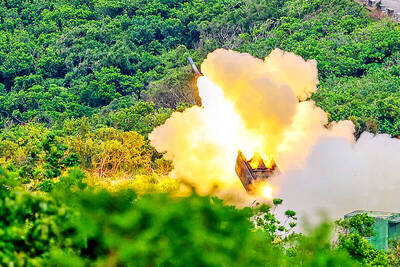
PRECISION STRIKES: The most significant reason to deploy HIMARS to outlying islands is to establish a ‘dead zone’ that the PLA would not dare enter, a source said A High Mobility Artillery Rocket System (HIMARS) would be deployed to Penghu County and Dongyin Island (東引) in Lienchiang County (Matsu) to force the Chinese military to retreat at least 100km from the coastline, a military source said yesterday. Taiwan has been procuring HIMARS and Army Tactical Missile Systems (ATACMS) from the US in batches. Once all batches have been delivered, Taiwan would possess 111 HIMARS units and 504 ATACMS, which have a range of 300km. Considering that “offense is the best defense,” the military plans to forward-deploy the systems to outlying islands such as Penghu and Dongyin so that

WHAT WAS ALL THAT FOR? Jaw Shaw-kong said that Cheng Li-wen had pushed for more drastic cuts and attacked him, just for the outcome to be nearly identical to his bill The legislature yesterday passed a supplementary budget bill to fund the purchase of separate packages of US military equipment, with the combined amount of spending capped at NT$780 billion (US$24.8 billion). The Chinese Nationalist Party (KMT) and Taiwan People’s Party (TPP) used their legislative majority to pass the bill, which runs until 2033 and has two main funding provisions. One was for NT$300 billion of arms sales already approved by the US for Taiwan on Dec. 17 last year, the other was for NT$480 billion for another arms package expected to be announced by Washington. The bill, which fell short of the NT$1.25

‘CLEAR MESSAGE’: The bill would set up an interagency ‘tiger team’ to review sanctions tools and other economic options to help deter any Chinese aggression toward Taiwan US Representative Young Kim has introduced a bill to deter Chinese aggression against Taiwan, calling for an interagency “tiger team” to preplan coordinated sanctions and economic measures in response to possible Chinese military or political action against Taiwan. “[Chinese President] Xi Jinping [習近平] has directed the People’s Liberation Army to be ready to invade Taiwan by 2027. China has a plan. America should have one too,” Kim said in a news release on Thursday last week. She introduced the “Deter PRC [People’s Republic of China] aggression against Taiwan act” to “ensure the US has a coordinated sanctions strategy ready should


 RSS
RSS