


The Executive Yuan’s Referendum Review Committee yesterday unanimously rejected a referendum proposal on the Fourth Nuclear Power Plant in New Taipei City’s Gongliao District (貢寮), saying that the proposal failed to meet requirements as stipulated in the Referendum Act (公民投票法).
“All 13 Referendum Review Committee members who attended the meeting believe that the question asked in the proposal, and the stated reason for the proposal, are contradictory and may confuse voters, obstructing them from understanding the question asked by the proposer,” Referendum Review Committee Chairperson Chu Hsin-min (朱新民) told reporters immediately after the 2.5-hour meeting. “Therefore, all 13 of them voted to reject the proposal.”
Chu said that while the question asks voters “Do you agree to allow Taiwan Power Co (Taipower, 台電) to insert fuel rods into [the reactors] of the Fourth Nuclear Power Plant in New Taipei City, and start test operations,” the written reason for the referendum only expresses opposition to nuclear power.
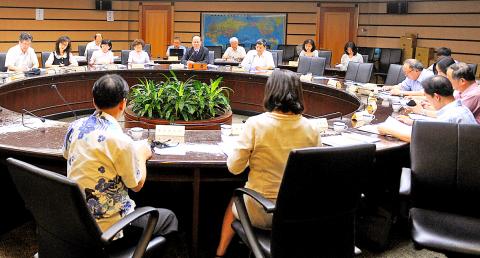
Photo: Chu Pei-hsiung, Taipei Times
“Asking whether voters agree to allow [Taipower] to insert fuel rods while expressing opposition to nuclear energy is contradictory and may confuse voters, and is therefore in violation of Article 14 of the Referendum Act, which prohibits such contradiction,” Chu said.
He added that some committee members also questioned whether “inserting fuel rods” and “starting test operations” would be considered “major national policies” that can be decided through a referendum, while others said that normal procedure is to conduct test operations before inserting fuel rods, and thus the question itself is confusing.
“Moreover, since the government has already announced that the Fourth Nuclear Power Plant would be immediately sealed upon completion of the construction and would not start operations, the referendum fails to meet the legal requirement that a referendum should aim to overturn a major national policy,” Chu said.
The above reasons led to the committee’s rejection of the referendum proposal, he said.
The committee comprises 21 members, of which 14 took part in yesterday’s review. The chairman of the committee was excluded from the vote.
Environmentalists and legislators were outraged at the decision, which would block a second-phase signature drive for the referendum, unless they win an appeal against the decision.
Taiwan Environmental Protection Union (TEPU) chairman Liu Chun-hsiu (劉俊秀) was furious at the result because the committee has “turned a deaf ear to public opinion.”
“The first stage of the petition collected more than 120,000 signatures and took us two years to complete. Two years of hard work and the hope of 120,000 people were dismissed by 13 people in less than two hours. To say that the committee is as useless as an appendix is an understatement — it is a cancer that needs to be removed so that the nation can practice real democracy,” he said.
Democratic Progressive Party Legislator Tien Chiu-chin (田秋堇) accused the committee of “playing tricks” and questioned the means by which its members were selected. She also raised doubts about the legitimacy of the unquestionable power the committee wields over referendum-related issues.
Saying that there is no real difference between the rejected referendum question and the proposed revision by the committee, which asks voters whether they “object to” Taiwan Power conducting a trial run on the plant involving fuel rods, she said that the committee is attempting to take advantage of the Referendum Act, which states that if the plebiscite’s question is not answered by at least 50 percent of the people allowed to vote in a presidential election, the answer to the question shall be deemed a denial by default.
TEPU member and signature convener Kao cheng-yan (高成炎) said that the union would ask the committee to return its proposal and submit a revised question for the plebiscite on Monday.
Kao added that the TEPU would file an appeal with the Executive Yuan’s Appeal Committee to revoke the decision, he said.
Confident that public opinion would make the more sensible judgement, he suggested that news outlets and political parties conduct public opinion polls, whose results he said would greatly increase the chance for an appeal to be upheld.
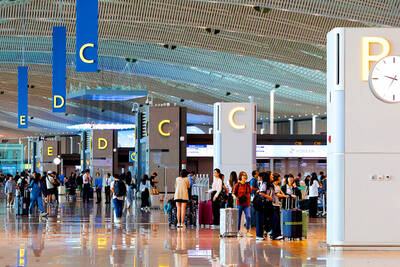
South Korea has adjusted its electronic arrival card system to no longer list Taiwan as a part of China, a move that the Ministry of Foreign Affairs said would help facilitate exchanges between the two sides. South Korea previously listed “Taiwan” as “Taiwan (China)” in the drop-down menus of its online arrival card system, where people had to fill out where they came from and their next destination. The ministry had requested South Korea make a revision and said it would change South Korea’s name on Taiwan’s online immigration system from “Republic of Korea” to “Korea (South),” should the issue not be

The Legislative Yuan’s Finance Committee yesterday approved proposed amendments to the Amusement Tax Act (娛樂稅法) that would abolish taxes on films, cultural activities and competitive sporting events, retaining the fee only for dance halls and golf courses. The proposed changes would set the maximum tax rate for dance halls and golf courses at 50 and 20 percent respectively, with local governments authorized to suspend the levies. Article 2 of the act says that “amusement tax shall be levied on tickets sold or fees charged by amusement places, facilities or activities” in six categories: “Cinema; professional singing, story-telling, dancing, circus, magic show, acrobatics

Tainan, Taipei and New Taipei City recorded the highest fines nationwide for illegal accommodations in the first quarter of this year, with fines issued in the three cities each exceeding NT$7 million (US$220,639), Tourism Administration data showed. Among them, Taipei had the highest number of illegal short-term rental units, with 410. There were 3,280 legally registered hotels nationwide in the first quarter, down by 14 properties, or 0.43 percent, from a year earlier, likely indicating operators exiting the market, the agency said. However, the number of unregistered properties rose to 1,174, including 314 illegal hotels and 860 illegal short-term rental
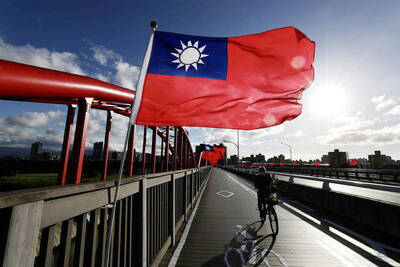
INFLATION UP? The IMF said CPI would increase to 1.5 percent this year, while the DGBAS projected it would rise to 1.68 percent, with GDP per capita of US$44,181 The IMF projected Taiwan’s real GDP would grow 5.2 percent this year, up from its 2.1 percent outlook in January, despite fears of global economic disruptions sparked by the US-Iran conflict. Taiwan’s consumer price index (CPI) is projected to increase to 1.5 percent, while unemployment would be 3.4 percent, roughly in line with estimates for Asia as a whole, the international body wrote in its Global Economic Outlook Report published in the US on Monday. The figures are comparatively better than the IMF outlook for the rest of the world, which pegged real GDP growth at 3.1 percent, down from 3.3 percent


 RSS
RSS