


Former Mainland Affairs Council (MAC) deputy minister Chang Hsien-yao (張顯耀) yesterday called on President Ma Ying-jeou (馬英九) to “take care of himself” because Ma has been “hijacked” by a handful of people and deceived into believing allegations against him fabricated by those people.
Chang held a news conference in Taipei yesterday, his first since he reportedly tendered his resignation from the council on Thursday last week, a move the Executive Yuan said on Saturday was due to “family reasons.”
He told reporters that “a small group of people” have been “spreading allegations and arbitrarily accusing him [of being a spy] without proper investigation and trial.”
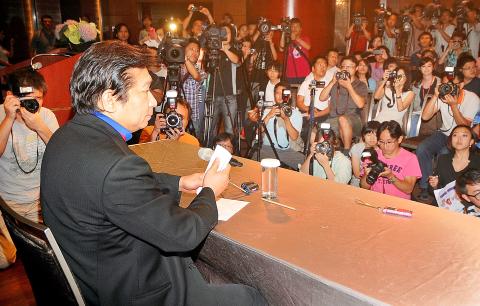
Photo: Liao Chen-huei, Taipei Times
Since Tuesday, there have been a number of media reports claiming that Chang was under suspicion of leaking information to China before undertaking cross-strait negotiations. The Chinese-language United Daily News alone ran four stories yesterday, all quoting anonymous officials or “sources” as saying or implicating that Chang had leaked national secrets.
One story’s headline said the Ministry of Justice’s Investigation Bureau “suspects that Chang has been recruited as a Chinese Communist Party [CCP] spy.”
“The task force revealed that the information Chang had leaked was related to concerns about national security, and the leaks had gone on for a long time with a plan in mind, a crime that could be seen as intentional,” the story said.
Another United Daily News story cited “an informed source” as saying Chang’s case might have to do with “disclosing our baseline too early [to China], which led to a collapse of negotiations for a meeting between Ma and Chinese President Xi Jinping (習近平) at APEC.”
“After reading the newspaper this morning, I felt that [the accusations of being a spy for the CCP] amounts to a White Terror era in the 21st century, since during the White Terror in this country in the past century, those who had different opinions were persecuted and labeled as political enemies and red spies,” Chang said at the news conference.
All cross-strait negotiations, in public or in private, that he had taken part in had followed the instructions of the president, the former and the current secretary-general of the National Security Council (NSC) and the Mainland Affairs Council minister, he said.
“All I did was follow orders,” he said. “If I am to be put under investigation, then I should not be the only one subjected to such a move.”
The Straits Exchange Foundation and the Mainland Affairs Council staff “must be agitated now with these charges and cross-strait relations likely to return to a freezing point,” he said.
“How can cross-strait negotiations proceed if the appointed representative is colluding with [China]? Cross-strait mutual trust will be lost and the negotiation mechanism has been damaged,” he said.
Chang then said that Ma should “take care of himself, [because] he has been deceived and hijacked.”
He reiterated a comment made earlier in the week — that he plans to disclose the full truth, “for self-protection,” but cannot do so now.
“I cannot expose it now as it would constitute a leak of information, but I will go to the prosecutors to clarify the issue,” he said.
Chang said he believes that Taiwan is a democratic country with rule of law, where it is impossible for “a small group of people” to spoil the institution.
“They might have suppressed the Investigation Bureau into submission, but they cannot deceive the prosecutors, the courts and the public,” he said.
When asked whether the “small group of people” he referred to included NSC Secretary-General King Pu-tsung (金溥聰), Chang only reiterated his distress about the allegations.
Asked whether he had been contacted by the Investigation Bureau or prosecutors before his resignation, Chang said no.
He nodded his head when asked if Mainland Affairs Council Minister Wang Yu-chi (王郁琦) had lied when he said he had told Chang on Thursday last week about the suspicion over information leaks.
Quizzed by reporters later in the day about Chang’s remarks, Wang said that he felt regretful and puzzled by his comments.
As of press time last night, the council had not formally commented on Chang’s press conference.
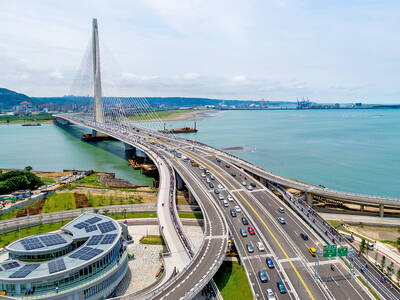
The Ministry of Transportation and Communications yesterday inaugurated the Danjiang Bridge across the Tamsui River in New Taipei City, saying that the structure would be an architectural icon and traffic artery for Taiwan. Feted as a major engineering achievement, the Danjiang Bridge is 920m long, 211m tall at the top of its pylon, and is the longest single-pylon asymmetric cable-stayed bridge in the world, the government’s Web site for the structure said. It was designed by late Iraqi-British architect Zaha Hadid. The structure, with a maximum deck of 70m, accommodates road and light rail traffic, and affords a 200m navigation channel for boats,
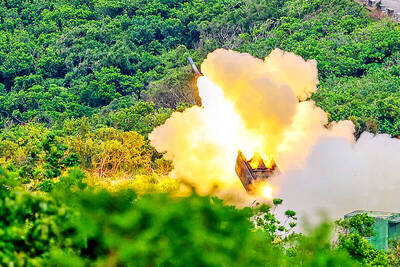
PRECISION STRIKES: The most significant reason to deploy HIMARS to outlying islands is to establish a ‘dead zone’ that the PLA would not dare enter, a source said A High Mobility Artillery Rocket System (HIMARS) would be deployed to Penghu County and Dongyin Island (東引) in Lienchiang County (Matsu) to force the Chinese military to retreat at least 100km from the coastline, a military source said yesterday. Taiwan has been procuring HIMARS and Army Tactical Missile Systems (ATACMS) from the US in batches. Once all batches have been delivered, Taiwan would possess 111 HIMARS units and 504 ATACMS, which have a range of 300km. Considering that “offense is the best defense,” the military plans to forward-deploy the systems to outlying islands such as Penghu and Dongyin so that
Taiwan Semiconductor Manufacturing Co (TSMC, 台積電), the world’s largest foundry service provider, yesterday said that global semiconductor revenue is projected to hit US$1.5 trillion in 2030, after the figure exceeds US$1 trillion this year, as artificial intelligence (AI) demand boosts consumption of token and compute power. “We are still at the beginning of the AI revolution, but we already see a significant impact across the whole semiconductor ecosystem,” TSMC deputy cochief operating officer Kevin Zhang (張曉強) said at the company’s annual technology symposium in Hsinchu City. “It is fair to say that in the past decade, smartphones and other mobile devices were
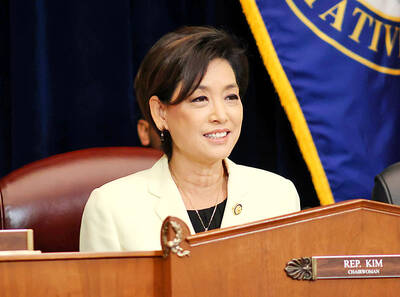
‘CLEAR MESSAGE’: The bill would set up an interagency ‘tiger team’ to review sanctions tools and other economic options to help deter any Chinese aggression toward Taiwan US Representative Young Kim has introduced a bill to deter Chinese aggression against Taiwan, calling for an interagency “tiger team” to preplan coordinated sanctions and economic measures in response to possible Chinese military or political action against Taiwan. “[Chinese President] Xi Jinping [習近平] has directed the People’s Liberation Army to be ready to invade Taiwan by 2027. China has a plan. America should have one too,” Kim said in a news release on Thursday last week. She introduced the “Deter PRC [People’s Republic of China] aggression against Taiwan act” to “ensure the US has a coordinated sanctions strategy ready should


 RSS
RSS