


When a national disaster strikes, the central government should team up with the relevant local government to provide relief to those affected, instead of wasting time on political point-scoring, the Democratic Progressive Party (DPP) said yesterday following a press conference held by President Ma Ying-jeou (馬英九).
Whether it is dealing with a disaster such as the gas pipeline explosions in Greater Kaohsiung or drawing up contingency plans for flood prevention, close cooperation between the central and local governments is needed to get funds and personnel on site as quickly as possible, DPP spokesperson Hsu Chia-ching (徐佳青) said.
“This is not the time for recrimination. The nation needs a rapid response plan to protect Greater Kaohsiung residents, as well as the petrochemical industry,” Hsu said.
Separately, Academia Sinica researcher Huang Kuo-chang (黃國昌) criticized Ma’s press conference saying the president had not only not said anything new, but tried to shift the blame away from himself.
It is common sense that after a disaster, issues of relief, culpability and prevention must be discussed, Huang said, adding that Ma’s press conference bypassed the disaster to focus on other matters.
Criticizing what he called the Ma administration’s attempts to shift blame to the Greater Kaohsiung Government for not taking preventive measures, as well as Ma’s doling out slogans instead of help to those affected by the blasts, Huang said “such an attitude is not one becoming of the head of state.”
Huang also said the president was “too removed from the real world” to claim that the student-led Sunflower movement had stalled the draft cross-strait oversight act.
“If it were not for the movement, there would be no draft act,” he said. “Ma is the one who should be blamed for delaying the oversight act’s passage by trying to skirt democratic procedures with the cross-strait services trade pact.”
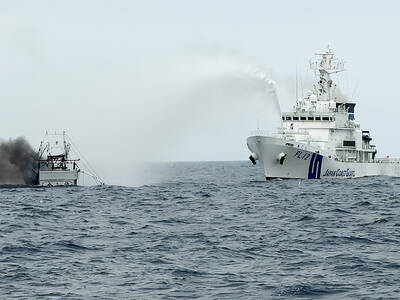
CREDIT-GRABBER: China said its coast guard rescued the crew of a fishing vessel that caught fire, who were actually rescued by a nearby Taiwanese boat and the CGA Maritime search and rescue operations do not have borders, and China should not use a shipwreck to infringe upon Taiwanese sovereignty, the Coast Guard Administration (CGA) said yesterday. The coast guard made the statement in response to the China Coast Guard (CCG) saying it saved a Taiwanese fishing boat. The Chuan Yu No. 6 (全漁6號), a fishing vessel registered in Keelung, on Thursday caught fire and sank in waters northeast of Diaoyutai Islands (釣魚台). The vessel left Keelung’s Badouzih Fishing Harbor (八斗子漁港) at 3:35pm on Sunday last week, with seven people on board — a 62-year-old Taiwanese captain surnamed Chang (張) and six
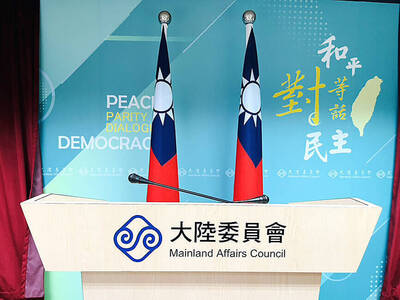
RISKY BUSINESS: The ‘incentives’ include initiatives that get suspended for no reason, creating uncertainty and resulting in considerable losses for Taiwanese, the MAC said China’s “incentives” failed to sway sentiment in Taiwan, as willingness to work in China hit a record low of 1.6 percent, a Ministry of Labor survey showed. The Directorate-General of Budget, Accounting and Statistics (DGBAS) also reported that the number of Taiwanese workers in China has nearly halved from a peak of 430,000 in 2012 to an estimated 231,000 in 2024. That marked a new low in the proportion of Taiwanese going abroad to work. The ministry’s annual survey on “Labor Life and Employment Status” includes questions respondents’ willingness to seek employment overseas. Willingness to work in China has steadily declined from

LEVERAGE: China did not ‘need to fire a shot’ to deny Taiwan airspace over Africa when it owns ‘half the continent’s debt,’ a US official said, calling it economic warfare The EU has raised concerns about overflight rights following the delay of President William Lai’s (賴清德) planned state visit to the Kingdom of Eswatini after three African nations denied overflight clearance for his charter at the last minute. Taiwanese allies Paraguay and Saint Kitts and Nevis, as well as several US lawmakers and the Inter-Parliamentary Alliance on China (IPAC) condemned China for allegedly pressuring the countries. Lai was scheduled to fly directly to Taiwan’s only African ally from yesterday to Sunday to celebrate the 40th anniversary of King Mswati III’s accession and his 58th birthday, but Seychelles, Mauritius and Madagascar suddenly revoked
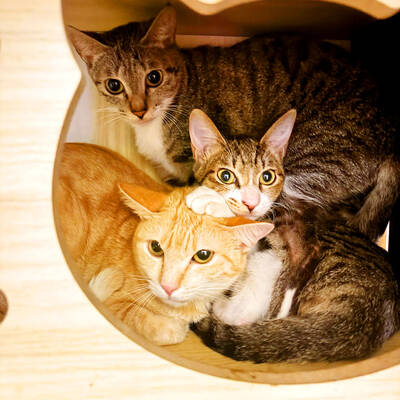
The number of pet cats in Taiwan surpassed that of pet dogs for the first time last year, reaching 1,742,033, a 32.8 percent increase from 2023, the Ministry of Agriculture said yesterday, citing a survey. By contrast, the number of pet dogs declined slightly by 1.2 percent over the same period to 1,462,528, the ministry said. Despite the shift, households with dogs still slightly outnumber those with cats by 1.2 percent. However, while the number of households with multiple dogs has remained relatively stable, households keeping more than two cats have increased, contributing to the overall rise in the feline population. The trend


 RSS
RSS