


With Greater Kaohsiung residents still recovering from the damage caused by the gas pipeline explosions last week, another gas leak was reported in Cianjhen District (前鎮) yesterday morning, stirring widespread panic among residents as authorities tried to pin down the source of the escaping gas.
The Kaohsiung City Environmental Protection Bureau said the leak involved methane.
The leak was reported shortly before 7:50am, at which time the bureau dispatched personnel to the intersection of Yisin and Kaisyuan roads after receiving word of “the smell of gas pervading the air.”
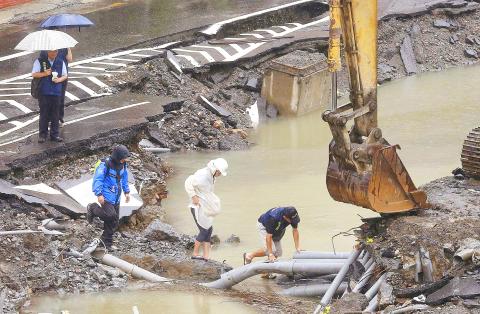
Photo: CNA
Residents living within a 150m radius of Kaisyuan Third Road were evacuated by the city’s police department to Kaohsiung Municipal Guanghua Junior High School and Le Chyuan Elementary School.
The incident has once again raised grave concern among residents over their safety.
“A week has passed since the explosions. When will we be safe?” a motorist asked.
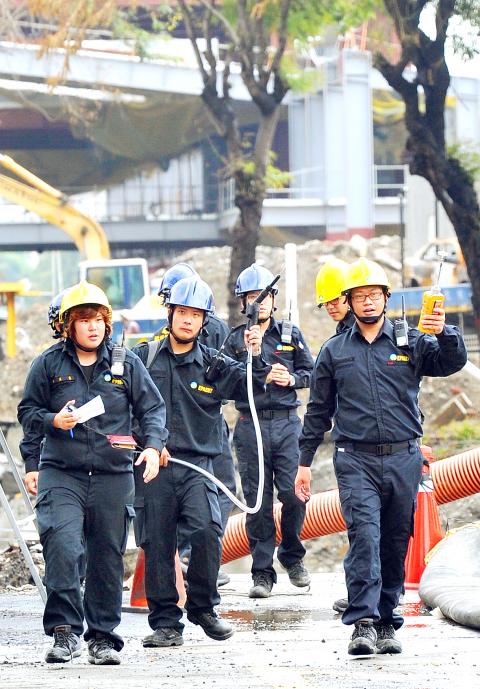
Photo: Huang Chi-yuan, Taipei Times
Kaohsiung City Environmental Protection Bureau Director-General Derek Chen (陳金德) said that gas concentration levels measured at 7:50am were 100 parts per million (ppm), indicating that a gas leak had taken place.
The leak might be due to a purging of pipelines that LCY Chemical Corp (李長榮化工) commenced at 6am yesterday to drive out any remaining propene, the gas that caused the pipeline explosions last week, Chen said.
“By about 8:20am, readings had shot up to 3,000ppm and the bureau ordered LCY Chemical to immediately halt the purging,” he added.
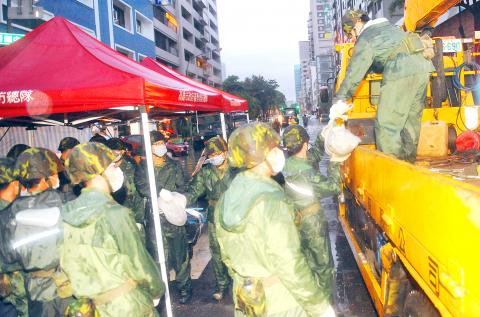
Photo: Chang Chung-yi, Taipei Times
“However, bubbles kept emerging from the rainwater-flooded trenches [left by the blasts] and the concentration level kept rising. At about 11am the readings had reached 5,000ppm. The situation was very critical,” Chen said.
“The situation persisted into the afternoon and at about 2:30pm, the concentration level finally dropped to below 10ppm,” he said, adding that the crisis had been defused.
Citing an analysis of sampled gases, Chen said the gas that leaked yesterday morning was predominantly methane.
Early measurements taken by the bureau showed that at least four gases were leaked, including methane, propene, ethylene and butane.
The bureau last night issued an announcement that it would continue to monitor gas concentration levels at the site to ensure residents’ safety.

PROVOCATIVE: Chinese Deputy Ambassador to the UN Sun Lei accused Japan of sending military vessels to deliberately provoke tensions in the Taiwan Strait China denounced remarks by Japan and the EU about the South China Sea at a UN Security Council meeting on Monday, and accused Tokyo of provocative behavior in the Taiwan Strait and planning military expansion. Ayano Kunimitsu, a Japanese vice foreign minister, told the Council meeting on maritime security that Tokyo was seriously concerned about the situation in the East China and South China seas, and reiterated Japan’s opposition to any attempt to change the “status quo” by force, and obstruction of freedom of navigation and overflight. Stavros Lambrinidis, head of the EU delegation to the UN, also highlighted South China Sea

SILENCING CRITICS: In addition to blocking Taiwan, China aimed to prevent rights activists from speaking out against authoritarian states, a Cabinet department said The Ministry of Foreign Affairs (MOFA) yesterday condemned transnational repression by Beijing after RightsCon, a major digital human rights conference scheduled to be held in Zambia this week, was abruptly canceled due to Chinese pressure over Taiwanese participation. This year’s RightsCon, the world’s largest conference discussing issues “at the intersection of human rights and technology,” was scheduled to take place from tomorrow to Friday in Lusaka, and expected to draw 2,600 in-person attendees from 150 countries, along with 1,100 online participants. However, organizers were forced to cancel the event due to behind-the-scenes pressure from China, the ministry said, expressing its “strongest condemnation”
Taiwan Semiconductor Manufacturing Co (TSMC, 台積電), the world’s largest contract chipmaker, said it expects its 2-nanometer (2nm) chip capacity to grow at a compound annual rate of 70 percent from this year to 2028. The projection comes as five fabs begin volume production of 2-nanometer chips this year — two in Hsinchu and three in Kaohsiung — TSMC senior vice president and deputy cochief operating officer Cliff Hou (侯永清) said at the company’s annual technology symposium in Silicon Valley, California, last week. Output in the first year of 2-nanometer production, which began in the fourth quarter of last year, is expected to
Taiwan’s economy grew far faster than expected in the first quarter, as booming demand for artificial intelligence (AI) applications drove a surge in exports, spilling over into investment and consumption, the Directorate-General of Budget, Accounting and Statistics (DGBAS) said yesterday. GDP growth was 13.69 percent year-on-year during the January-to-March period, beating the DGBAS’ February forecast by 2.23 percentage points and marking the most robust growth in nearly four decades, DGBAS senior official Chiang Hsin-yi (江心怡) told a news conference in Taipei. The result was powered by exports, which remain the backbone of Taiwan’s economy, Chiang said. Outbound shipments jumped 51.12 percent year-on-year to


 RSS
RSS