


A series of suspected gas explosions that shook Greater Kaohsiung from late Thursday night to early yesterday morning claimed at least 26 lives and injured 269 people.
The blasts tore through the city’s roads and dug a 100m trench up to 1.8m deep. At least 1.5km of roadways were damaged.
Cars and fire trucks were trapped and overturned in the rubble. Vehicles were hurled through the air, landing on the roofs of houses. Flames erupted from manholes after their covers were blasted off, with gouts of fire reaching 15 stories high.
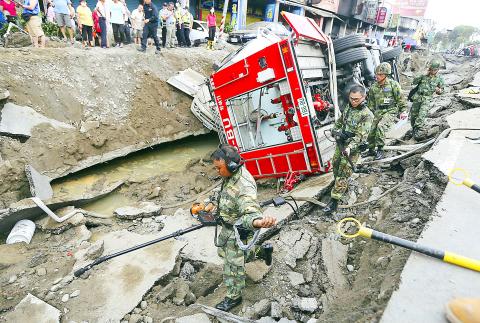
Photo: Toby Chang, Reuters
According to the Greater Kaohsiung Government, at 8:46pm on Thursday it received reports of manholes spewing white smoke and the suspected smell of gas near Kaisyuan 3rd Road and Ersheng 1st Road in Cianjhen District (前鎮). A few hours after the first report, a series of explosions took place on Yisin Road, Ersheng Road, Sanduo Road and Guanghua Road in the same district, and in neighboring Lingya District (苓雅).
At press time, city government information showed that the incident had claimed 26 lives and injured 269. Among the 26 confirmed dead were three firefighters and one volunteer who rushed to the scene after residents smelled gas. Rescuers were also searching for two others who went missing.
At 8:30pm yesterday, two people were reportedly discovered alive under debris, and rescue workers were trying to free them using excavators, shovels and their bare hands. It has not been confirmed whether the two men are the two firefighters who were reported missing.
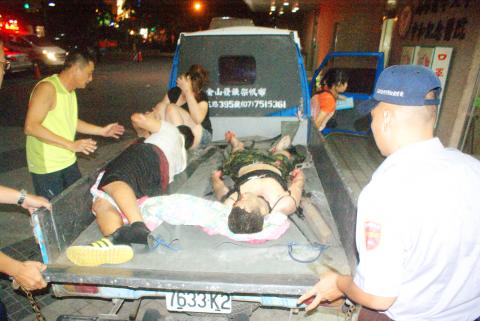
Photo: Huang Chia-lin, Taipei Times
Some of the fatalities were homeowners checking out their properties after being informed about the first blasts.
Two injured people rescued from a fourth-floor balcony said that they had been propelled to the rooftop by the blasts.
The Chinese-language Apple Daily newspaper’s reporter Wei Bin (魏斌) was injured by the explosions, receiving second and third-degree burns over about 50 percent of his body, the paper reported.
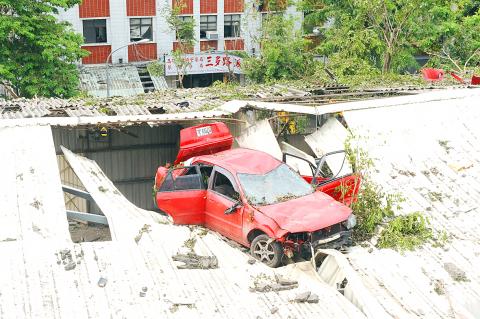
Photo: Chang Chung-yi, Taipei Times
Schools and work were called off in Cianjhen and Lingya districts yesterday.
Hundreds of troops and firefighters from neighboring Greater Tainan, Chiayi City, Taitung County and Pingtung County were deployed to support the rescue effort.
Yesterday morning, fires still burned on the streets, but the local government said that they were left burning to avoid further explosions, adding that the firefighting crew was on the scene to keep the fire from consuming nearby buildings.
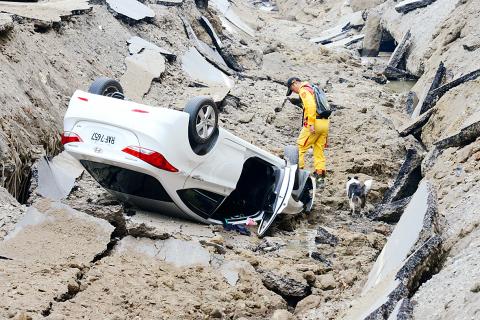
Photo: AFP/Sam Yeh
The cause of the explosions had not been determined, with authorities now focusing on the volatile chemical propene — which is carried in pipelines that run alongside the city’s underground sewage system in the area — as the suspected cause.
Chemical companies such as CPC Corp, Taiwan (台灣中油), China Petrochemical Development Corp (中石化), China General Terminal and Distribution Corp (CGTD, 華運), LCY Chemical Corp (李長榮化學) and Hsin Kao Gas Co Ltd (欣高), which have pipelines in the area, were called in by the city government’s emergency response center amid the inquiry into the cause of the fatal blasts.
Minister of Economic Affairs Chang Chia-juch (張家祝) said yesterday morning that natural gas has been excluded from the list of possible causes, adding that gas check valves in the area have been closed.
The Greater Kaohsiung Government said a 4-inch pipeline carrying propene was found to have encountered a pressure anomaly between 8:40pm and 9pm on Thursday night.
Greater Kaohsiung Deputy Mayor Lee Yung-te (李永得) said CGTD Corp was attempting to transfer propene, a compressed fuel gas, from the seaport to LCY Chemical Corp, and the correspondence between the workers of the two companies showed that the effort failed. It was suspected that the gas had leaked during the transfer process, causing the explosions.
Greater Kaohsiung Mayor Chen Chu (陳菊), at a meeting with Premier Jiang Yi-huah (江宜樺) at the city’s emergency response command center, said that Cianjhen District had seen another gas explosion that had caused serious damage in 1997 and called on the central government and the Industrial Development Bureau to examine and overhaul the city’s pipeline network.
Life detectors and rescue dogs have been employed in the rescue operation, as well as helicopters searching for signs of life within what is known as the “golden 72 hours,” during which most survivors are found.
Additional reporting by Huang Wen-huang and Wu Chun-feng

DRONE CENTRAL: Taiwan aims to become Asia’s democratic hub for drones, with most exports focused on high-quality military-grade models, an official said Taiwan’s drone industry is expected to expand significantly by 2030, producing 100,000 units per month and exporting half of them, the Ministry of Economic Affairs said yesterday. Current drone production capacity is about 15,000 units per month, but the industry can quickly scale up as demand increases, Industrial Development Administration Director-General Chiou Chyou-huey (邱求慧) told a news conference in Taipei. Taiwan’s drone output grew 2.5-fold last year to NT$12.9 billion (US$408.3 million) under a government program to develop the uncrewed vehicle sector, he said. The Executive Yuan in October last year approved plans to invest NT$44.2 billion into domestic production of uncrewed aerial

A signaling system malfunction disrupted high-speed rail (HSR) services beginning at 8am today, with trains temporarily reduced to three northbound and three southbound trains per hour as authorities conduct inspections. The malfunction occurred on a section of track in Miaoli County during pre-operation checks early this morning, forcing northbound and southbound trains to use a single track, the HSR operator said. The regular schedule has been replaced with three hourly trains offering only nonreserved seating in each direction, stopping at every station, it said, adding that business class cars would still have reserved seating. Departures from terminal stations are scheduled at the top
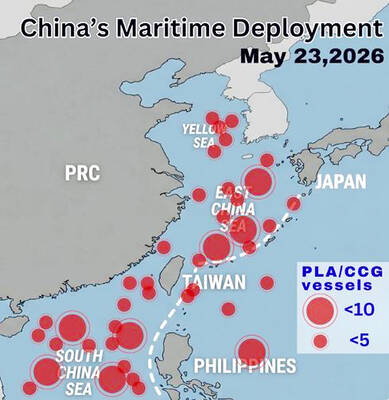
WARNING: China should stop engaging in actions that undermine regional peace and stability, as it would only build resentment among people across the Strait, the CGA said China has deployed more than 100 navy, coast guard and other vessels in waters from the Yellow Sea to the South China Sea and the western Pacific since US President Donald Trump and Chinese President Xi Jinping (習近平) met in Beijing, National Security Council Secretary-General Joseph Wu (吳釗燮) said yesterday. “In this part of the world, #China is the one & only PROBLEM wrecking the #StatusQuo & threatening regional peace & stability,” Wu wrote on X. In a separate post, he said Beijing was coercing Taiwan’s maritime domain, calling it illegal and provocative, after the Coast Guard Administration (CGA) expelled a

VERBOSE VESSELS: A CGA cutter and a China Coast Guard exchanged verbal barbs for more than a day in Taiwanese-controlled waters before the Chinese vessel left The Taiwanese and Chinese coast guards had a standoff near the strategically located Pratas Islands (Dongsha Islands, 東沙群島) in the north of the South China Sea, the Coast Guard Administration (CGA) said yesterday. The two sides engaged in intense radio exchanges over sovereignty claims during the 33-hour standoff. China Coast Guard vessel 3501 eventually left the restricted waters, 26.6 nautical miles (49.2km) west of the Pratas Islands, at 5pm yesterday, the CGA said. Lying approximately between southern Taiwan and Hong Kong, the Taiwan-controlled Pratas are seen by some security experts as vulnerable to Chinese attack due to their distance — more than


 RSS
RSS