


Under a heavy police presence and with more than 100 demonstrators calling on him to resign, Premier Jiang Yi-huah (江宜樺) yesterday afternoon appeared in court to face charges of attempted murder filed against him and high-ranking police officers in a private prosecution over the violent crackdown on protesters who briefly took over the Executive Yuan in March.
“Mastermind behind the violence. Abuser of democracy. Face the trial. Jiang Yi-huah, step down,” more than 100 demonstrators affiliated with several civic groups, including Taiwan March and the Black Island Youth Front, shouted as Jiang, as well as National Police Agency Director-General Wang Cho-chiun (王卓鈞), Taipei City Police Department Commissioner Huang Sheng-yung (黃昇勇) and Zhongzheng First Police Precinct Chief Fang Yang-ning (方仰寧), arrived at the Taipei District Court as defendants.
More than 300 officers were deployed to maintain security, and the street in front of the courthouse was closed off since the morning, even though the court appearances did not start until 2:30pm.
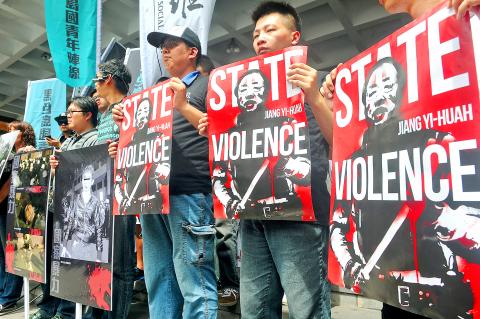
Photo: Liao Chen-huei, Taipei Times
A total of 23 demonstrators who took part in the occupation of the Executive Yuan compound from the evening of March 23 to the early hours of the morning on March 24 and were injured during a crackdown by the police filed charges against the officials.
The occupation of the executive compound took place while the legislative floor was also occupied.
Under orders from the premier to clear the executive compound and the streets around it before the morning rush hour, police used water cannons and truncheons against demonstrators, who were mostly engaged in peaceful sit-ins, resulting in bloodshed.
“I understand that the judge must be under tremendous pressure as he or she decided to summon government officials to appear in court,” said Chen Wei-ting (陳為廷), one of the Sunflower movement’s student leaders. “I would like to call on Jiang to be a man and shoulder his responsibilities. He should tell nothing but the truth in court, and shoulder any political and legal responsibilities that he may have.”
“I would also like to call on the judge to review the case from a constitutional point of view. This court meeting is only the first step; our ultimate goal is to have Jiang step down,” he added.
Unlike a public prosecution, in which prosecutors lay charges, in a private prosecution, the court hears cases directly filed by the accusers.
The hearing held yesterday was part of preliminary proceedings in which the judges are questioning the officials about their decisionmaking process and handling of the Sunflower movement protests. In line with the Code of Criminal Procedure (刑事訴訟法), preliminary hearings are held behind closed doors. Only if judges decide that the evidence is sufficient to warrant a trial would subsequent legal proceeding continue and the court be open.
Jiang was questioned for about two hours.
Facing questions from the media, Jiang refused to comment, both when he arrived and when he left the court.
Wang said in response to media queries that he would “respect the judiciary.”
Meanwhile, Fang again drew fire because he was serving as the commander of the police maintaining security at the scene even though he was appearing in court as a defendant.
“How can a defendant in a manslaughter lawsuit serve as commander of 300 police officers outside the courthouse while he is in court at the same time?” asked attorney Cheng Wen-lung (鄭文龍), who was among the protesters. “This is an abuse of power.”
However, Fang said that he had transferred authority to his deputy chief when he was in the court.
Additional reporting by staff writer

LEVERAGE: China did not ‘need to fire a shot’ to deny Taiwan airspace over Africa when it owns ‘half the continent’s debt,’ a US official said, calling it economic warfare The EU has raised concerns about overflight rights following the delay of President William Lai’s (賴清德) planned state visit to the Kingdom of Eswatini after three African nations denied overflight clearance for his charter at the last minute. Taiwanese allies Paraguay and Saint Kitts and Nevis, as well as several US lawmakers and the Inter-Parliamentary Alliance on China (IPAC) condemned China for allegedly pressuring the countries. Lai was scheduled to fly directly to Taiwan’s only African ally from yesterday to Sunday to celebrate the 40th anniversary of King Mswati III’s accession and his 58th birthday, but Seychelles, Mauritius and Madagascar suddenly revoked
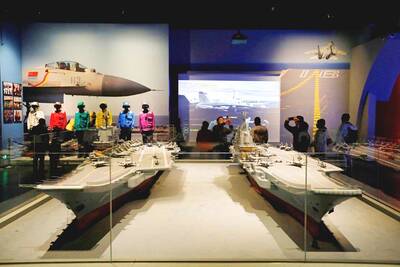
China on Wednesday teased in a video an aircraft carrier that could be its fourth, and the first using nuclear power, while making an allusion to Taiwan and vowing to further build up its islands, as it looks to boost maritime power, secure resources and bolster territorial claims. The video, issued on the eve of the 77th founding anniversary of the Chinese People’s Liberation Army Navy, featured fictional officers with names that are homophones of three commissioned aircraft carriers, the Liaoning (遼寧), Shandong (山東) and Fujian (福建). Titled Into the Deep, it showed a 19-year-old named “Hejian” (何劍) joining the group, sparking
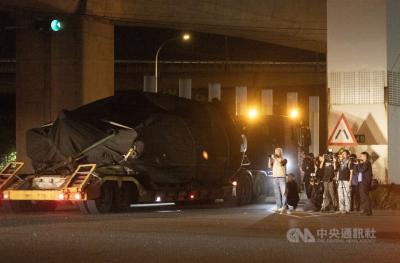
The final batch of 28 M1A2T Abrams tanks purchased from the US arrived at Taipei Port last night and were transported to the Armor Training Command in Hsinchu County’s Hukou Township (湖口), completing the military’s multi-year procurement of 108 of the tanks. Starting at 12:10am today, reporters observed more than a dozen civilian flatbed trailers departing from Taipei Port, each carrying an M1A2T tank covered with black waterproof tarps. Escorted by military vehicles, the convoy traveled via the West Coast Expressway to the Armor Training Command, with police implementing traffic control. The army operates about 1,000 tanks, including CM-11 Brave Tiger
BIG YEAR: The company said it would also release its A12 chip the same year to keep a ‘reliable stream of new silicon technologies’ flowing to its customers Taiwan Semiconductor Manufacturing Co (TSMC, 台積電) yesterday said its newest A13 chip is to enter volume production in 2029 as the chipmaker seeks to hold onto its tech leadership and demand for next-generation chips used in artificial intelligence (AI), high-performance-computing (HPC) and mobile applications. TSMC, the world’s biggest contract chipmaker, also unveiled its A12 chip at its annual technology symposium in Santa Clara, California. The A12 chip, which features TSMC’s super-power-rail technology to provide backside power delivery for AI and HPC applications, is also to enter volume production in 2029, a year after the scheduled release of the A14 chip. The technology moves


 RSS
RSS