

The Chiang Ching-kuo Foundation for International Scholarly Exchange has demanded an explanation from the European Association for Chinese Studies (EACS) over a page about the foundation being ripped from brochures at a recent event promoting Chinese study in Portugal, an executive said yesterday.
Founded in 1975, the Paris-based EACS is an international association representing European academics specializing in Chinese studies. It has more than 700 members.
A foundation official who wished to remain anonymous told the Taipei Times by telephone that the foundation sent a letter to the EACS yesterday to register its “unhappiness” over the incident that took place on Tuesday last week at the opening ceremony of the 20th conference of the EACS.
She said the foundation had not been aware of the incident until it was reported by the Chinese-language Liberty Times (the Taipei Times’ sister newspaper) yesterday.
According to the Liberty Times, at the request of Xu Lin (許琳), director-general of the Hanban, the common name of the Chinese National Office for Teaching Chinese as a Foreign Language at China’s Ministry of Education, page 59 of all brochures that gave information about the foundation was ripped out.
Xu has also served on China’s State Council.
All the brochures handed out to participants had the torn-out remnants of a page between page 58 and 61, with page 59 and 60 missing, the Liberty Times reported.
“We didn’t know about this until we saw the reports in the news because we did not send anyone to the conference,” the foundation official said.
She said it was the first time it had happened to the foundation during the many years it has worked with overseas institutions such as the EACS and the US-based Association of Asian Studies to promote Chinese studies as a sponsor.
This year, the foundation donated NT$650,000 to the event, she said.
“The EACS owes us an explanation. It not only hurt our foundation, but also the nation as a whole,” the foundation’s executive said.
The conference this year, titled “From the origins of Sinology to current interdisciplinary research approaches: Bridging the past and future of Chinese Studies,” was a biennial event hosted by the EACS from Tuesday to Saturday last week at Universidade do Minho and Universidade de Coimbra, Portugal.
On the sidelines of the event was an exhibition on Chinese academic studies that included more than 501 works in 561 volumes provided by the Center for Chinese Studies at the National Central Library and the foundation. The works were donated to Universidade do Minho on Friday.
Ministry of Foreign Affairs spokesperson Anna Kao (高安) yesterday responded to reports by the Liberty Times that questioned the ministry’s inaction over the matter.
Representative to Portugal Her Jian-gueng (何建功) was not aware of the incident when it happened, but he lodged a protest with the EACS and the universities immediately after he learned about it, Kao said.
In a press release, the Mainland Affairs Council said it felt “deep regret about and disappointed” at the incident, adding that what China has done at the EACS conference has had a harmful effect on cross-strait relations.
The council urged China to show respect and take a pragmatic view of Taiwan’s participation in activities in the international community.
National Central Library director-general Tseng Shu-hsien (曾淑賢) yesterday said that EACS president Roger Greatrex had come to the exhibition site to apologize to the foundation after the incident.
After Chinese officials showed their displeasure at the page about the foundation in the brochure, staff from the Universidade do Minho tore it from all the brochures without taking the matter to the EACS first, Tseng said.
At the opening ceremony, several EACS officials had spoken out against the Chinese Hanban and the Universidade do Minho, Tseng said.
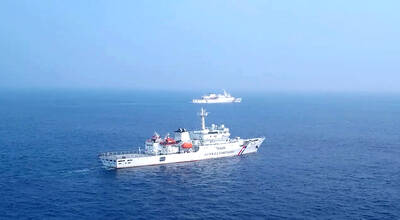
PATROL PARTNERS: The ‘Chiayi’ and the ‘Penghu’ departed for a two-day joint patrol of Palau’s exclusive economic zone, the CGA’s second diplomatic visit to the country The Coast Guard Administration (CGA) set a record for its southernmost deployment of a coast guard vessel as the vessels Chiayi and the Penghu reached Palau’s Pulo Anna Island on Saturday in a cooperative exercise between the two countries. The island, about 217 nautical miles (401km) southwest of Koror in the Palauan state of Sonsorol and 1,220 nautical miles from Taiwan’s southernmost point, Oluanpi (鵝鑾鼻), is the furthest south a CGA vessel has sailed. The two vessels are in Palau for the coast guard’s second diplomatic visit to the country. They docked at Malakal Harbor on Tuesday last week. The coast guard
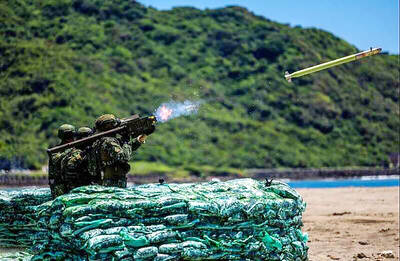
BATCH 1: The military has plans to assign the weapons to the army to defend Taiwan proper, as well as outlying islands and the navy for the Marine Corps, the official said Taiwan is to receive 500 Stinger missiles and 178 launchers from the US by the end of the year, the first batch under a planned two-stage acquisition totaling 2,621 missiles and 763 launchers, a defense official said yesterday on condition of anonymity. The portable missiles would play a vital role in the nation’s air defense capabilities, the source said. The army plans to deploy 2,235 missiles and 657 launchers to defend Taiwan proper and outlying islands, they said, citing military documents. The navy is allotted 295 missiles and 85 launchers to arm the Marine Corps and some surface vessels that lack air defense
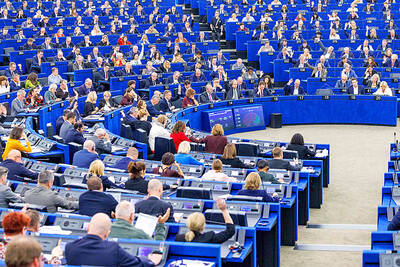
The European Parliament on Wednesday adopted a recommendation on EU-China political relations that rejected China’s efforts to restrict Taiwan’s participation in international organizations and exchanges. The recommendation, addressed to the European Council, the European Commission and EU High Representative for Foreign Affairs and Security Policy Kaja Kallas, includes several references to EU-Taiwan relations and expresses support for closer ties, saying they would bring positive benefits and have strategic importance. Describing Taiwan as a valuable partner in trade and technology, the European Parliament said it “rejects China’s attempts to coerce international organizations, third countries and other actors into restricting Taiwan’s international participation and
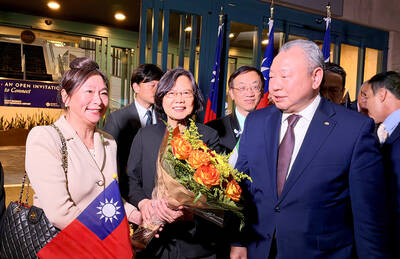
Former president Tsai Ing-wen (蔡英文) on Monday arrived in San Francisco, receiving a warm welcome from hundreds of overseas Taiwanese as she launched a week-long visit. Accompanied by Representative to the US Alexander Yui (俞大?), and head of Taiwan’s San Francisco office Wu Chih-hsiang (伍志翔), Tsai arrived at her hotel, waving, smiling and giving high-fives to Taiwanese compatriots amid cheers of “Taiwan’s democracy involves you and me” to welcome her to the San Francisco Bay Area. It is Tsai’s first visit to the US since she left office in May 2024 after serving two four-year terms as president. Tsai is today to deliver


 RSS
RSS