


Hamas yesterday agreed to observe a 24-hour humanitarian truce after initially rejecting such an offer by Israel, as fighting resumed and the two sides wrangled over the terms of a lull that the international community hopes can be expanded into a more sustainable truce.
Between the rival announcements Palestinian militants fired rockets deep into Israel, prompting it to resume an offensive aimed at destroying rocket launchers and cross-border attack tunnels used by Hamas.
Hours later Hamas said it would be willing to abide by a new 24-hour humanitarian truce ahead of the Eid al-Fitr holiday marking the end of the Muslim fasting month of Ramadan.
Hamas spokesman Sami Abu Zuhri said the truce would go into effect at 2pm yesterday. The three-day Eid al-Fitr holiday is expected to begin today or tomorrow, depending on the sighting of the new moon.
Israel had offered a 24-hour truce late on Saturday, but Hamas — which has demanded the lifting of the Israeli and Egyptian blockade on Gaza, as well as the release of Palestinian prisoners — rejected it.
Israeli Army spokesman Lieutenant Colonel Peter Lerner did not say if Israel would hold its fire during the time requested by Hamas, but said troops would continue demolishing militant tunnels.
The 20-day war has killed more than 1,050 Palestinians, mainly civilians, according to Palestinian health officials. Israel has lost 43 soldiers. Two civilians and a Thai worker in Israel were killed by rocket and mortar attacks from Gaza.
The military had earlier said about a dozen rockets were fired toward Israel since midnight — without causing casualties or damage — and that as a result it would “resume its aerial, naval and ground activity in the Gaza Strip.”
The Israeli military released a video showing a rocket being fired from what it said was a Gaza school.
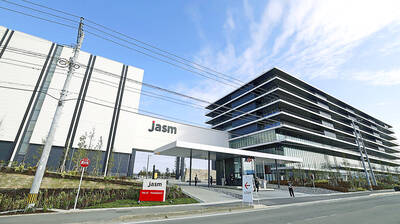
The subsidiary of Taiwan Semiconductor Manufacturing Co (TSMC, 台積電) in Kumamoto, Japan, turned a profit in the first quarter of this year, marking the first time the first fab of the unit has become profitable since mass production started at the end of 2024. According to the contract chipmaker’s financial statement released on Friday, Japan Advanced Semiconductor Manufacturing Inc (JASM), a joint venture running the fab in Kumamoto, posted NT$951 million (US$30.19 million) in profit in the January-to-March period, compared with a loss of NT$1.39 billion in the previous quarter, and a loss of NT$3.25 billion in the first quarter of
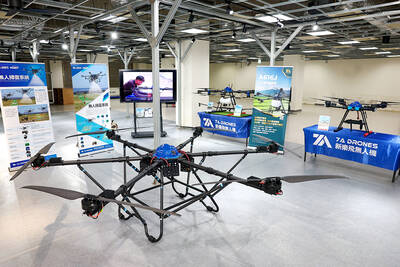
DRONE CENTRAL: Taiwan aims to become Asia’s democratic hub for drones, with most exports focused on high-quality military-grade models, an official said Taiwan’s drone industry is expected to expand significantly by 2030, producing 100,000 units per month and exporting half of them, the Ministry of Economic Affairs said yesterday. Current drone production capacity is about 15,000 units per month, but the industry can quickly scale up as demand increases, Industrial Development Administration Director-General Chiou Chyou-huey (邱求慧) told a news conference in Taipei. Taiwan’s drone output grew 2.5-fold last year to NT$12.9 billion (US$408.3 million) under a government program to develop the uncrewed vehicle sector, he said. The Executive Yuan in October last year approved plans to invest NT$44.2 billion into domestic production of uncrewed aerial
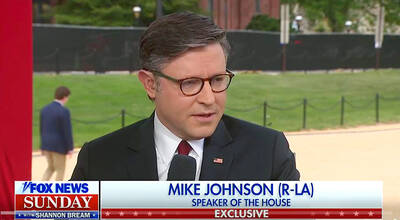
RESOLUTE BACKING: Two Republican senators are planning to introduce legislation that would impose immediate sanctions on China if it attempts to invade Taiwan US House of Representatives Speaker Mike Johnson on Sunday reaffirmed US congressional support for Taiwan, saying the US and “all freedom-loving people” have a stake in preventing China from seizing Taiwan by force. Johnson made the remarks in an interview with Fox News Sunday on US President Donald Trump’s summit with Chinese President Xi Jinping (習近平) last week. In an interview that aired on Friday on Fox News, just as Trump wrapped up a high-stakes visit to China, he said he has yet to green-light a new US$14 billion arms package to Taiwan and that it “depends on China.” “It’s a very good
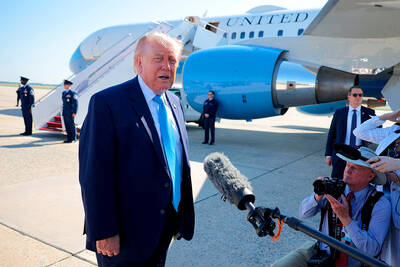
US President Donald Trump yesterday said he would speak to President William Lai (賴清德) as his administration considers whether to move ahead with a US$14 billion weapons sale to Taiwan — a potential arms deal that has drawn criticism from China. “Well, I’ll speak to him. I speak to everybody,” Trump told reporters yesterday when asked if he had any plans to call his counterpart, although he did not offer a time frame for when such a conversation could take place. Trump previously said he would speak to the person “that’s running Taiwan,” without specifying who he meant. “We have that situation very


 RSS
RSS