


Writers and prominent literary figures accused Minister of Culture Lung Ying-tai (龍應台) of making political appointments as executives to head the National Museum of Taiwan Literature (NMTL), after the museum’s new deputy director took up the position on Wednesday.
Lung appointed the museum’s director and deputy director, but neither of them has a related academic background, nor authentic connections to Taiwanese literature studies, they said.
The move led prominent figures in the nation’s literary circles to charge that the museum’s mission statement has been abandoned to become a haven for political appointees and the museum has been turned into Lung’s “personal fiefdom.”
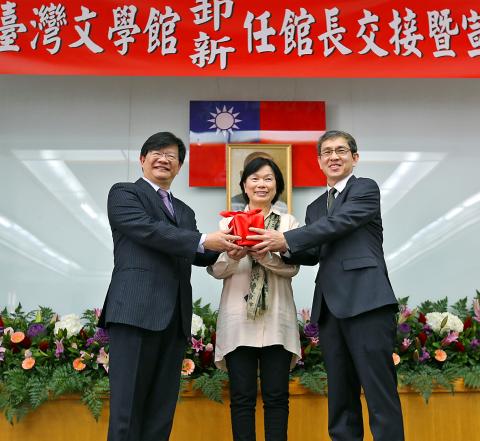
Photo: CNA
National Museum of Taiwan Literature deputy director Hsiao Shu-chen (蕭淑貞) assumed his position this week, while the museum’s director, Weng Chih-tsung (翁誌聰), took up his position in January.
Weng has a doctorate in Chinese literature from the Chu Hai College of Higher Education in Hong Kong and was a senior executive officer of the ministry’s Bureau of Audiovisual and Music Industry Development.
Hsiao, with an academic background in library information studies, was Weng’s subordinate at the bureau, responsible for the popular music division.
Yang Tsui (楊翠), a prominent Taiwanese literature academic, said the appointment of Weng and Hsiao is a slap in the face of the literary community and shows that the museum has lost its direction.
“It shows that this government looks down on Taiwanese literature. There are many people in the literary community with years of administrative experience, but Lung does not want them in charge of the NMTL,” said Yang, whose grandfather is Yang Kui (楊逵), a leading Taiwanese writer best known for two of his books, The Newspaper Boy (送報伕) and The Indomitable Rose (壓不扁的玫瑰花).
When Weng took up his post earlier this year, it stirred up a storm of protest from the literary community. A petition campaign was started at the time to rebuke Lung and critics said that Weng is a stranger to the field of Taiwanese literature, and his appointment was totally inappropriate.
In response, Weng said on Friday that he had to find a new assistant because the museum’s former deputy director had reached retirement age.
“Hsiao was chosen because we worked well together at the Bureau of Audiovisual and Music Industry of Development,” he said.
“When I started in the director’s post I already thought she would be suitable as deputy director. The decision was made after long and serious considerations,” Weng added.
Laiho Culture Foundation chief executive officer Chou Fu-i (周馥儀) said Hsiao’s appointment is extremely questionable because she has no connection to Taiwanese literature.
“We also want to ask Weng, who has now been the museum’s director for half a year, what work programs he has undertaken and what results he has achieved,” she said.
Yang Tsui said one of the two top posts at the museum had always been filled by someone from the Taiwanese literary community, but even if the occupants of these positions are not from the literary community, they should provide evidence of their professional work to convince people that they are suitable for the jobs.
“However, since becoming the director, Weng’s policies and programs still cannot persuade people as to his professionalism and expertise on Taiwanese literature,” she said.
“The National Museum of Taiwan Literature is an important representation and symbol of Taiwanese culture and literature. However, it has now veered far away from Taiwanese literature,” Yang Tsui added.

LEVERAGE: China did not ‘need to fire a shot’ to deny Taiwan airspace over Africa when it owns ‘half the continent’s debt,’ a US official said, calling it economic warfare The EU has raised concerns about overflight rights following the delay of President William Lai’s (賴清德) planned state visit to the Kingdom of Eswatini after three African nations denied overflight clearance for his charter at the last minute. Taiwanese allies Paraguay and Saint Kitts and Nevis, as well as several US lawmakers and the Inter-Parliamentary Alliance on China (IPAC) condemned China for allegedly pressuring the countries. Lai was scheduled to fly directly to Taiwan’s only African ally from yesterday to Sunday to celebrate the 40th anniversary of King Mswati III’s accession and his 58th birthday, but Seychelles, Mauritius and Madagascar suddenly revoked
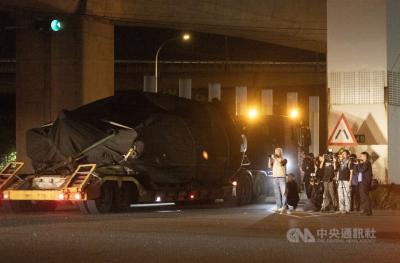
The final batch of 28 M1A2T Abrams tanks purchased from the US arrived at Taipei Port last night and were transported to the Armor Training Command in Hsinchu County’s Hukou Township (湖口), completing the military’s multi-year procurement of 108 of the tanks. Starting at 12:10am today, reporters observed more than a dozen civilian flatbed trailers departing from Taipei Port, each carrying an M1A2T tank covered with black waterproof tarps. Escorted by military vehicles, the convoy traveled via the West Coast Expressway to the Armor Training Command, with police implementing traffic control. The army operates about 1,000 tanks, including CM-11 Brave Tiger
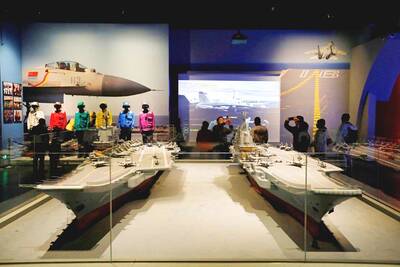
China on Wednesday teased in a video an aircraft carrier that could be its fourth, and the first using nuclear power, while making an allusion to Taiwan and vowing to further build up its islands, as it looks to boost maritime power, secure resources and bolster territorial claims. The video, issued on the eve of the 77th founding anniversary of the Chinese People’s Liberation Army Navy, featured fictional officers with names that are homophones of three commissioned aircraft carriers, the Liaoning (遼寧), Shandong (山東) and Fujian (福建). Titled Into the Deep, it showed a 19-year-old named “Hejian” (何劍) joining the group, sparking
BIG YEAR: The company said it would also release its A12 chip the same year to keep a ‘reliable stream of new silicon technologies’ flowing to its customers Taiwan Semiconductor Manufacturing Co (TSMC, 台積電) yesterday said its newest A13 chip is to enter volume production in 2029 as the chipmaker seeks to hold onto its tech leadership and demand for next-generation chips used in artificial intelligence (AI), high-performance-computing (HPC) and mobile applications. TSMC, the world’s biggest contract chipmaker, also unveiled its A12 chip at its annual technology symposium in Santa Clara, California. The A12 chip, which features TSMC’s super-power-rail technology to provide backside power delivery for AI and HPC applications, is also to enter volume production in 2029, a year after the scheduled release of the A14 chip. The technology moves


 RSS
RSS