


Two unnamed Taiwanese tourists gained instant notoriety yesterday after photographs of a Japanese hot spring hotel room that they are suspected of wrecking were circulated widely online.
The photos were reportedly posted on Facebook by a Taiwanese woman under the name Miki Juan. According to the page, the woman works at a hotel in Nasu District, Tochigi Prefecture, on Japan’s Honshu Island.
“Our hotel cares very much about the tourists from Taiwan and has been friendly to them. However, two Taiwanese tourists who stayed at the hotel last night chose to repay the kindness this way [referring to a photo of the room,” she wrote. “Four sliding doors and two windows in the Japanese-style room were completely destroyed. The hotel owner’s wife, who is also Taiwanese, was so angry that she was in tears.”
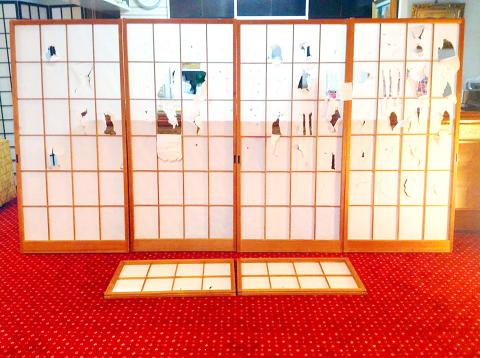
Photo: CNA
The photographs and messages were subsequently shared by more than 5,000 netizens, many of whom also responded to her posts, condemning the “acts of vandalism.”
“Do they think that they are still in a Taiwanese night market, playing some kind of ‘poke-and-win’ game?” one commenter said. “The compensation will probably mean nothing to these brats, whose parents will pay for the damage.”
Though Juan said the hotel has asked the travel agency to seek compensation on its behalf, another netizen using the name Kevin Chung said the hotel was being too nice to the suspects and should disclose their names so that they would avoid repeating such shameful acts.
Juan said that the two Taiwanese tourists are minors who had not traveled with their parents, adding that she could not reveal their names because it would violate the Personal Information Protection Act (個人資料保護法).
She also said that her aim was not to publicly shame them.
“My purpose is not to find or punish them. Instead, I want to get Taiwanese thinking about how they should behave themselves when they travel overseas,” she said.
“I worked in a Taiwanese travel agency before and it was really embarrassing to hear complaints about our clients from our business partners in Japan. However, I was really furious this time. We have worked so hard to encourage Japanese to pay more attention to Taiwanese tourists and all these efforts could go down the drain because of the misbehaving few,” she said.
Juan said that the two tourists apologized and paid for the damage, urging people to refrain from trying to identify and locate them.
Travel Agent Association secretary-general Roget Hsu (許高慶) said that this was the first time that he heard of such an incident.
“This case shows that more needs to be done to enhance citizenship education in Taiwan,” he said.

‘NO SECURITY RISK’: The Railway Bureau reassured the public that the technicians’ activities were limited to technical guidance and did not involve sensitive systems The Railway Bureau yesterday said it had invited eight Chinese technicians to assist with an airport MRT construction project. The bureau issued the confirmation after an Internet user said Chinese nationals had entered the construction zone of Taiwan Taoyuan International Airport’s Terminal 3 project. They asked why “individuals from an enemy state” were allowed access to such a major national infrastructure project, which raised serious concerns over Taiwan’s industrial safety, sensitive systems and information security. The bureau’s Northern Region Engineering Branch Office said subcontractor Taiwan Handle Industrial Co (台灣手把工業) of the Taoyuan airport MRT’s “Contract No. CU05 Project A14 Station Civil, MEP &

A US uncrewed surface vessel (USV) encountered multiple Chinese warships during an autonomous transit of the Taiwan Strait, US defense company Seasats said in a statement on Wednesday. Seasats announced that a Lightfish USV had completed the first autonomous transit of the Taiwan Strait. Over five days, the USV traversed the entire length of the Strait while constantly monitoring surface vessel traffic, the company said. The Lightfish encountered multiple Chinese warships, one of which was a Chinese People’s Liberation Army Navy (PLAN) Type 056 corvette, it said. The Chinese vessels were operating “well within Taiwan’s exclusive economic zone without transmitting their identity via the

Taiwan is still in the process of assessing the possibility of recruiting workers from Eswatini, the Ministry of Foreign Affairs said yesterday, adding that its goal is to help Eswatini upgrade its vocational training centers. If there are plans to recruit workers from Eswatini, safeguarding national security, protecting public health and ensuring the employment rights of Taiwanese would be prerequisites, Department of West Asian and African Affairs Director-General Yen Chia-liang (顏嘉良) told a news conference. Key considerations would also include filling labor shortages in specific industries, and fostering bilateral professional and technical exchanges, he said. Yen was asked about the progress of labor

‘BOOMING’: ’ The number of partners we have here is incredible. You can see from their stock prices. They’re doing so well, they’re so happy,’ Jensen Huang said Nvidia Corp’s spending in Taiwan has ballooned to about US$150 billion a year, 10 times the US$10 billion to US$15 billion the company spent five years ago, Nvidia chief executive officer Jensen Huang (黃仁勳) said yesterday, suggesting Taiwan’s strategic importance in the global artificial intelligence (AI) supply chain. “Taiwan is the epicenter of the AI revolution. This is where the chips come, packaging comes. This is where the systems are made. This is where AI supercomputers were created,” Huang said at a meeting for the company’s employees in Beitou-Shilin Technology Park (北投士林科技園區) in Taipei, the planned site of Nvidia’s Taipei headquarters. “Taiwan


 RSS
RSS