


The media were shut out of yesterday’s meeting between China’s Taiwan Affairs Office (TAO) Minister Zhang Zhijun (張志軍) and New Taipei City Mayor Eric Chu (朱立倫), which had been scheduled to be held before cameras.
Instead, Zhang and Chu met for 40 minutes behind closed doors.
A city official, who was not authorized to speak for the city government, told the Taipei Times that the TAO demanded that the Zhang-Chu talk be held away from cameras to prevent a possible reccurrence of what it called the “[Greater Tainan Mayor] William Lai (賴清德) incident in Shanghai,” referring to Lai’s statement during a visit to Shanghai that the future of Taiwan is a matter to be determined by its 23 million people.
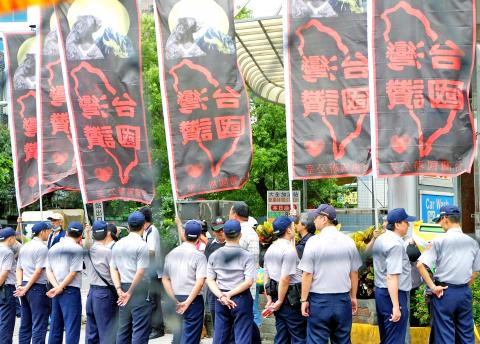
Photo: Sam Yet, AFP
Zhang made a few short remarks after the meeting without taking questions from reporters, as he has done since arriving on Wednesday.
He praised the facilities in Tucheng (土城) and Sijhih (汐止) districts that provide care services for elderly people and children that he visited earlier in the day.
Both sides of the Taiwan Strait should promote exchanges in the fields of care services for the elderly and children, Zhang said, adding that the focus of future cross-strait economic cooperation should be extended to small and medium-sized (SMEs) enterprises without overlooking the needs of big businesses.
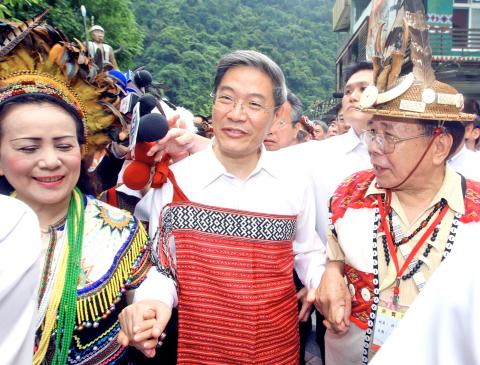
Photo: CNA
Zhang later visiting the Vigor Kobo bakery, where he sat down with several SME leaders, along with Mainland Affairs Council Deputy Minister Chang Hsien-yao (張顯耀) and Economic Development Director Yeh Hui-ching (葉惠青).
“I am here to listen to what SMEs [businesspeople] have to say, your ideas and suggestions, hoping that this would be helpful to promote cross-strait economic and trade exchanges and to benefit SME,” Zhang told the business leaders.
Zhang said the potential for SMEs on both sides of the strait was “unlimited,” as long as both sides take the right path of cooperation.
The discussions focused on difficulties that SME entrepreneurs said they have encountered when investing in China.
Zhang then headed to Wulai (烏來), where he met Aboriginal representatives and promised some elderly Atayals that China would do more to promote Aboriginal villages in Taiwan as tourism destinations for Chinese tourists.
Zhang’s engagements with elderly people, children, SMEs leaders and some Atayals were open to a small number of “lucky” journalists.
On several occasions, reporters squabbled with council officials and police officers they said were impeding them from doing their job.
At the nursing center in Tucheng, the council and the city government initially insisted that only six of the 26 reporters who arrived on a bus provided by the council for the media covering Zhang’s visit would be allowed inside the center when Zhang and the mayor chatted with residents over lunch.
The officials only backed off after the repeated arguments with reporters.
Zhang also held a closed-door discussion last night with about 11 academics, mostly well-known unification activists, including New Revolutionary Alliance (新同盟會) president Hsu Li-nong (許歷農), a retired general, and Shih Hsin University professor Wang Hsiao-po (王曉波).

SILENCING CRITICS: In addition to blocking Taiwan, China aimed to prevent rights activists from speaking out against authoritarian states, a Cabinet department said The Ministry of Foreign Affairs (MOFA) yesterday condemned transnational repression by Beijing after RightsCon, a major digital human rights conference scheduled to be held in Zambia this week, was abruptly canceled due to Chinese pressure over Taiwanese participation. This year’s RightsCon, the world’s largest conference discussing issues “at the intersection of human rights and technology,” was scheduled to take place from tomorrow to Friday in Lusaka, and expected to draw 2,600 in-person attendees from 150 countries, along with 1,100 online participants. However, organizers were forced to cancel the event due to behind-the-scenes pressure from China, the ministry said, expressing its “strongest condemnation”
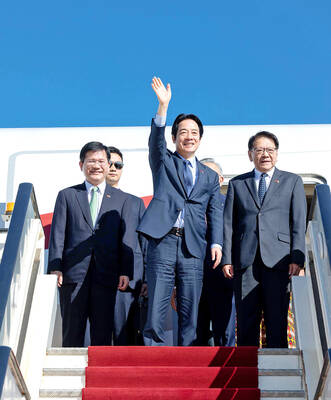
DELAYED BUT DETERMINED: The president’s visit highlights Taiwan’s right to international engagement amid regional pressure from China President Willaim Lai (賴清德) yesterday arrived in Eswatini, more than a week after his planned visit to Taiwan’s sole African ally was suspended because of revoked overflight permits. “The visit, originally scheduled for April 22, was postponed due to unforeseen external factors,” Lai wrote on social media. “After several days of careful arrangements by our diplomatic and national security teams, we successfully arrived today.” Lai said he looked forward to further deepening Taiwan-Eswatini relations through closer cooperation in the economy, agriculture, culture and education, as well as advancing the nation’s international partnerships. The president was initially scheduled to arrive in time to celebrate
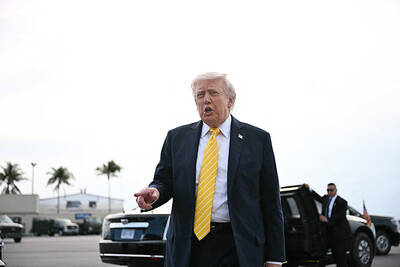
Iran’s Islamic Revolutionary Guard Corp (IRGC) yesterday said the US faced a choice between an “impossible” military operation or a “bad deal” with Tehran, after US President Donald Trump disparaged Iran’s latest peace proposal. Negotiations between the two countries have been deadlocked since a ceasefire came into effect on April 8, with only one round of direct peace talks held so far. Iran’s Tasnim and Fars news agencies reported that Tehran had submitted a 14-point proposal to mediator Pakistan, but Trump was quick to cast doubt on it. “I will soon be reviewing the plan that Iran has just sent to us, but

A group affiliated with indicted Chinese immigrant Xu Chunying (徐春鶯) is to be dissolved for monitoring Chinese immigrants in Taiwan, a source said yesterday. Xu, the secretary-general of the Cross-Strait Marriage and Family Service Alliance, was indicted on March 24 on charges of violating the Anti-Infiltration Act (反滲透法). The alliance “illegally monitored" Chinese immigrants living in Taiwan on behalf of the Chinese Communist Party (CCP) and the Ministry of the Interior is expected to dissolve the organization in the coming days under provisions of the Civil Associations Act (人民團體法), the source said. Xu, who married a Taiwanese in 1993 and became a Republic


 RSS
RSS