

Taliban militants disguised as security forces stormed Pakistan’s busiest airport on Sunday and at least 27 people were killed in a night-long battle at one of the country’s most high-profile targets.
The assault on Jinnah International Airport in Karachi, Pakistan’s sprawling commercial hub of 18 million people, all but destroys prospects for peace talks between the Pakistani Taliban and the government of Pakistani Prime Minister Nawaz Sharif.
It also deals a heavy blow to Sharif’s efforts to attract foreign investors to revive economic growth and raises questions about security at the country’s main installations.
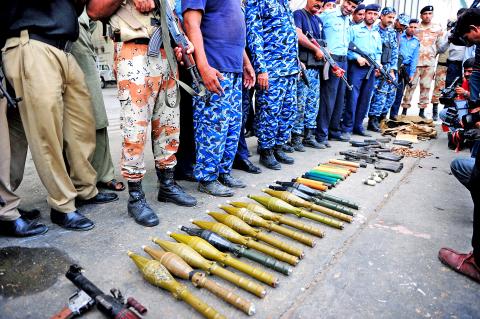
Photo: AFP
The attack began just before midnight, when 10 gunmen wearing military uniforms and armed with automatic rifles and rocket-propelled grenades shot their way into the airport’s old terminal, which is used mainly for charter and executive flights.
Gun battles raged through the night until security forces regained control of the airport at dawn. Passengers were evacuated and all flights were diverted.
The military’s media director-general Asim Bajwa said the airport had been cleared and would soon resume operations.
The government said security was being stepped up at all airports.
“We need to keep extremely vigilant,” Shujaat Azeem, special assistant to Sharif on aviation, said in a statement.
The Pakistani Taliban, an alliance of insurgent groups fighting to topple the government and set up a Shariah state, said they carried out the attack in response to air strikes on their strongholds near the Afghan border and suggested their mission was to hijack a passenger plane.
“It is a message to the Pakistan government that we are still alive to react over the killings of innocent people in bomb attacks on their villages,” Taliban spokesman Shahidullah Shahid said.
Pakistan’s paramilitary force said that the attackers were ethnic Uzbeks. Pakistani officials often blame foreign militants holed up in lawless areas on the Afghan border for staging attacks alongside the Pakistani Taliban around the country.
The death toll included airport security guards and workers with Pakistan International Airlines.
In a separate unrelated attack, at least 22 Shiite pilgrims were killed in a suicide attack near Pakistan’s border with Iran, a local official said.
A radical Sunni group claimed responsibility for the attack.
Karachi is Pakistan’s biggest city and commercial hub, home to a vibrant stock exchange, the central bank and the country’s main port.
However, it is also a violent and chaotic place where Taliban militants and criminal gangs operate freely underground.
At the airport, gunbattles went on for five hours and television pictures showed fire raging as ambulances ferried casualties away.
At least three loud explosions were heard as militants wearing suicide vests blew themselves up.
By dawn yesterday, the army said the airport had been secured, but heavy smoke rose above the building.
“Ten militants aged between 20 and 25 have been killed by security forces,” a spokesman for the Rangers said. “A large cache of arms and ammunition has been recovered from the militants.”
“A sweep operation is being carried out at the airport, which is expected to be completed by midday,” he added.

SOFT TENNIS: Yu Kai-wen and Huang Shih-yuan narrowly defeated their Japanese rivals to capture Taiwan’s first gold at the Asian Games in Nagoya Yu Kai-wen (余凱文) and Huang Shih-yuan (黃詩媛) won Taiwan’s first gold of this year’s Asian Games, defeating a Japanese duo in a nail-biter in the soft tennis mixed doubles final in Nagoya, Japan, while Johnny Sun (孫家閎) won silver in wushu and Shih Cheng-chung (石政中) won bronze in men’s kumite. Yu and Huang narrowly defeated Japan’s Toshiki Uematsu and Rena Temma 5-4 (2-4, 5-3, 4-2, 1-4, 1-4, 4-0, 1-4, 4-1, 7-5) to give Taiwan its first gold in soft tennis mixed doubles at an Asian Games since 2018. Sun secured Taiwan’s first wushu medal at this year’s game, with a combined score

CALL FOR CHANGE: They urged the UN to facilitate Taiwan’s involvement in the body, recognize its peace efforts and to work with members in preventing military conflict Representatives to the UN from five of Taiwan’s diplomatic allies sent a joint letter to UN Secretary-General Antonio Guterres on Friday, calling for the country’s inclusion in the body. Allies in the letter sent ahead of the 81st session of the UN General Assembly General Debate made three demands in support of Taiwan: inclusion, recognition and camaraderie. They implored the UN to seek an appropriate way to facilitate Taiwan’s meaningful involvement in the world governing body, saying that UN Resolution 2758, which accepted the People’s Republic of China (PRC) as a member of the UN, does not exclude Taiwan. Beijing claims that the
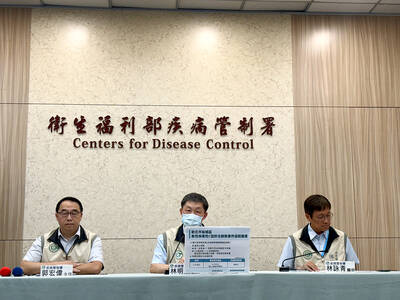
AT-RISK GROUPS: Of the accumulated 1,586 severe cases and 304 related deaths in this flu season, 65.8% were older people and 83.2% had chronic diseases, an official said The Centers for Disease Control (CDC) yesterday said that 165 severe flu cases and 30 flu-related deaths were reported last week, the highest weekly numbers in this flu season, and that cases might continue to increase, urging people to take precautions. Medical visits for flu-like illnesses increased by 1.4 percent to 141,374 last week, with 11.8 percent being emergency visits, showing that the seasonal flu is still in its epidemic period, CDC Epidemic Intelligence Center Director Guo Hung-wei (郭宏偉) said. From Tuesday last week to Monday, 165 severe flu cases and 30 flu-related deaths were confirmed, the highest weekly numbers
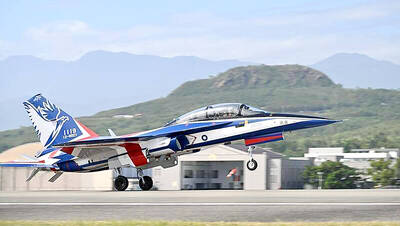
Aerospace Industrial Development Corp (AIDC, 漢翔航空工業) has finished production of the nation’s T-5 Brave Eagle (勇鷹) advanced jet trainers, with the final aircraft scheduled to be formally delivered at a ceremony on Thursday. The delivery of the trainer jets marks the end of the program, which dates back to 2017, with the first prototypes completed in 2019. Fifty-six of the 66 trainers had been delivered as of May. The Brave Eagle was developed and produced by AIDC and the National Chungshan Institute of Science and Technology. The program has provided a foundation for the development of a domestically produced next-generation primary trainer and


 RSS
RSS