


Greater Tainan Mayor William Lai (賴清德) yesterday caused jitters among an audience of Chinese politicians and academics with talk about Taiwanese independence and the politically sensitive Tiananmen Square student movement on the second day of his trip to China.
Lai, a member of the Democratic Progressive Party (DPP), made his remarks at a Fudan University discussion session in Shanghai.
Regarding cross-strait exchanges, Lai said that since the Taiwanese consciousness of independence preceded the establishment of the DPP, getting rid of the “Taiwan independence clause” in its party charter would not make the society’s call for independence disappear.
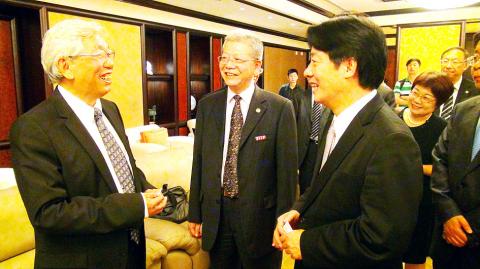
Photo: CNA
According to Greater Tainan Department of Information and International Relations Director and delegation member Chao Ching-hui (趙卿惠), Lai spoke in response to a Chinese professor’s comment on what the professor described as the stalled cross-strait relationship.
Fudan University professor Jiang Yihua (姜義華) reportedly blamed the DPP’s independence platform for the alleged stall, saying that despite cross-strait exchanges over the past years, this particular problem has been little recognized and should now be faced squarely.
Lai said that the DPP’s Taiwan independence clause and its Resolution on Taiwan’s Future are part of the trajectory of the development of Taiwan’s history.
“Taiwanese independence is a cause held by the DPP, which completely respects Taiwanese people’s self-determination in terms of procedure. It has enjoyed a clear consensus in Taiwan, as [former president] Chen Shui-bian (陳水扁) was elected as president on the party’s platform,” Lai said.
“It is important to understand whether the DPP made the cause of independence arise in society, or whether it was society’s call for independence that brought the DPP into existence. Removing the DPP’s Taiwanese independence party platform would not do away with Taiwan’s call for independence,” he said.
Lai said that no problem could be solved before China understands this historical trajectory and he called on the two sides to seek common ground, but also treasure their differences through understanding and reconciliation.
The mayor also mentioned the 1989 Tiananmen Square student movement.
“Fudan University students answered to the cause of the student movement that took place after the death of [reformist Chinese Communist Party] secretary-general Hu Yaobang (胡耀邦) in 1989. And there were more than 400 professors who signed the petition urging the government to recognize the student movement as a patriotic movement,” he said.
The issue of whether Beijing would change its no-contact policy toward the DPP has again come to the forefront amid Lai’s first visit to China on Friday.
Separately yesterday, Beijing reiterated its opposition to Taiwanese independence, but said that it welcomes exchanges with people from all quarters of Taiwan — provided they support advancing cross-strait ties.
The Chinese government maintains a “clear and consistent” policy toward the DPP and stands firmly against Taiwanese independence, China’s Taiwan Affairs Office spokesperson Fan Liqing (范麗青) said when asked about whether Beijing has begun to engage with the DPP.
“We welcome anyone as long as he or she favors, supports and participates in the peaceful development of cross-strait relations, no matter what he or she has advocated in the past,” she said.
Additional reporting by CNA
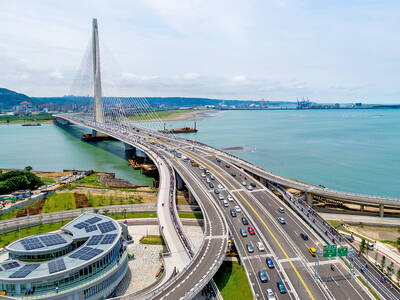
The Ministry of Transportation and Communications yesterday inaugurated the Danjiang Bridge across the Tamsui River in New Taipei City, saying that the structure would be an architectural icon and traffic artery for Taiwan. Feted as a major engineering achievement, the Danjiang Bridge is 920m long, 211m tall at the top of its pylon, and is the longest single-pylon asymmetric cable-stayed bridge in the world, the government’s Web site for the structure said. It was designed by late Iraqi-British architect Zaha Hadid. The structure, with a maximum deck of 70m, accommodates road and light rail traffic, and affords a 200m navigation channel for boats,
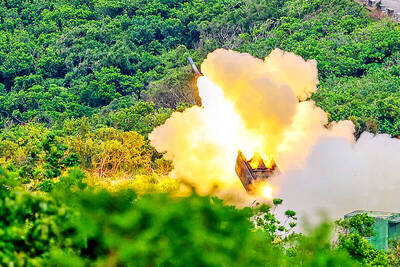
PRECISION STRIKES: The most significant reason to deploy HIMARS to outlying islands is to establish a ‘dead zone’ that the PLA would not dare enter, a source said A High Mobility Artillery Rocket System (HIMARS) would be deployed to Penghu County and Dongyin Island (東引) in Lienchiang County (Matsu) to force the Chinese military to retreat at least 100km from the coastline, a military source said yesterday. Taiwan has been procuring HIMARS and Army Tactical Missile Systems (ATACMS) from the US in batches. Once all batches have been delivered, Taiwan would possess 111 HIMARS units and 504 ATACMS, which have a range of 300km. Considering that “offense is the best defense,” the military plans to forward-deploy the systems to outlying islands such as Penghu and Dongyin so that
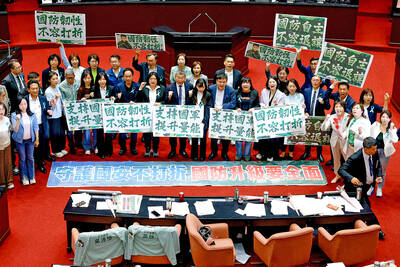
WHAT WAS ALL THAT FOR? Jaw Shaw-kong said that Cheng Li-wen had pushed for more drastic cuts and attacked him, just for the outcome to be nearly identical to his bill The legislature yesterday passed a supplementary budget bill to fund the purchase of separate packages of US military equipment, with the combined amount of spending capped at NT$780 billion (US$24.8 billion). The Chinese Nationalist Party (KMT) and Taiwan People’s Party (TPP) used their legislative majority to pass the bill, which runs until 2033 and has two main funding provisions. One was for NT$300 billion of arms sales already approved by the US for Taiwan on Dec. 17 last year, the other was for NT$480 billion for another arms package expected to be announced by Washington. The bill, which fell short of the NT$1.25
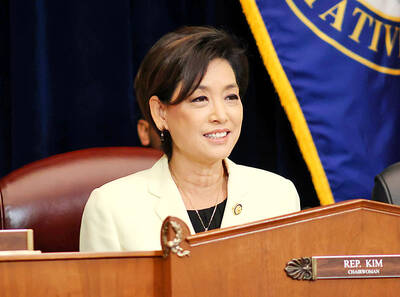
‘CLEAR MESSAGE’: The bill would set up an interagency ‘tiger team’ to review sanctions tools and other economic options to help deter any Chinese aggression toward Taiwan US Representative Young Kim has introduced a bill to deter Chinese aggression against Taiwan, calling for an interagency “tiger team” to preplan coordinated sanctions and economic measures in response to possible Chinese military or political action against Taiwan. “[Chinese President] Xi Jinping [習近平] has directed the People’s Liberation Army to be ready to invade Taiwan by 2027. China has a plan. America should have one too,” Kim said in a news release on Thursday last week. She introduced the “Deter PRC [People’s Republic of China] aggression against Taiwan act” to “ensure the US has a coordinated sanctions strategy ready should


 RSS
RSS