


Preparing for conflict with Taiwan — including deterring or defeating US intervention — remains the focus and “primary driver” of China’s military, a US Department of Defense annual report on China’s armed forces said.
The Chinese People’s Liberation Army (PLA) is also placing an emphasis on preparing for contingencies in the South and East China seas, the report released to the US Congress said on Thursday.
“As China’s interests, capabilities and international influences have grown, its military modernization program has also become increasingly focused on military investments for a range of missions beyond China’s coast, including sea lane security, counter-piracy, peacekeeping and humanitarian assistance,” the 100-page report said.
Although the dialogue between the US and China is improving, outstanding questions remain about the rate of growth in China’s military expenditures due to the lack of transparency regarding Beijing’s intentions.
Last year, China announced a 5.7 percent increase in its annual military budget to US$119.5 billion — continuing more than 20 years of sustained annual defense spending increases.
“As the US builds a stronger foundation for a military-to-military relationship with China, it also will continue to monitor China’s evolving military strategy, doctrine and force development and encourage China to be more transparent,” the report said.
“Dealing with a potential contingency in the Taiwan Strait remains the PLA’s primary mission despite an overall reduction of cross-strait tensions — a trend that continued following the re-election of Taiwan President Ma Ying-jeou [馬英九],” the report said.
Should conditions change, the PLA could be called upon to “compel” Taiwan to abandon possible moves toward independence or to “reunify” Taiwan with China by force of arms, it said.
Following Beijing’s leadership transition between 2012 and last year, China does not appear to have fundamentally altered its approach to Taiwan and despite “occasional signs of impatience” China appears content to respect Taiwan’s approach to cross-strait relations, the report said.
China is developing and testing several new classes and variants of offensive missiles, forming additional missile units, upgrading older missile systems and developing methods to counter ballistic missile defenses, it said.
China’s second artillery has deployed more than 1,000 short-range ballistic missiles to garrisons across from Taiwan and is fielding cruise missiles.
“Security in the Taiwan Strait is largely a function of dynamic interactions between and among mainland China, Taiwan and the US,” the report said.
China’s strategy toward Taiwan has been influenced by what it sees as positive developments in Taipei’s political situation and approach to engagement with Beijing, it said.
The report says that the two sides have made progress in expanding cross-strait trade, economic links, and people-to-people contacts, but that China’s overall strategy continues to “incorporate elements” of persuasion and coercion to deter or repress Taiwanese independence.
There are no signs that China’s “military disposition” toward Taiwan has changed, the report said.
“The PLA has continued to develop and deploy military capabilities to coerce Taiwan or to attempt an invasion, if necessary,” it said.
It says that China appears prepared to defer the use of force as long as it believes that unification over the long term remains possible and the costs of conflict outweigh the benefits.
“The PLA is capable of increasingly sophisticated military action against Taiwan,” the report said.
“It is possible China would first pursue a measured approach characterized by signaling its readiness to use force, followed by a deliberate buildup of force to optimize the speed of engagement over strategic deception,” it said.
The report said that another option would be for China to sacrifice overt, large-scale preparations in favor of surprise to force rapid military or political resolution before other countries could respond.
“China today probably could not enforce a full military blockade, but its ability to do so will improve significantly over the next five or 10 years,” the report said.
In a limited campaign against Taiwan, China might use a variety of disruptive, punitive or lethal military actions in conjunction with overt and clandestine economic and political activities.
A campaign could include computer networks or limited kinetic attacks against Taiwan’s political, military and economic infrastructure to induce fear and degrade confidence in the Taipei leadership.
Large-scale amphibious invasion, the report said, is one of the most complicated and difficult military operations and an attempt to invade Taiwan would “invite international intervention.”
This would be a significant political and military risk, it said.
Moreover, China does not appear to be building the conventional amphibious lift required to support such a campaign, it said.
The report says that the second artillery is prepared to conduct missile attacks and precision strikes against Taiwan’s air defense systems, air bases, radar sites, missiles, space assets and communications facilities in an attempt to degrade Taiwan’s defenses, neutralize the nation’s leadership or break the public’s will to fight.
Meanwhile, the PLA air force has stationed a large number of advanced aircraft within close range of Taiwan, providing a significant capability to conduct air superiority and ground attack operations.
The PLA navy is improving anti-air and anti-surface warfare capabilities, developing a credible at-sea nuclear deterrent and introducing new platforms that are positioned to strike Taiwan.
PLA ground forces are conducting joint training exercises that are to prepare them for a Taiwan invasion scenario.
The report said that Taiwan has historically relied upon multiple military variables to deter PLA aggression: the PLA’s inability to project sufficient power across the Taiwan Strait, the nation’s military’s technological superiority and the inherent geographic advantages of island defense.
Yet, the report said, China’s increasingly modern weapons and platforms of more than 1,200 ballistic missiles, an anti-ship ballistic missile program, ships, submarines and combat aircraft “have eroded or negated many of these factors.”
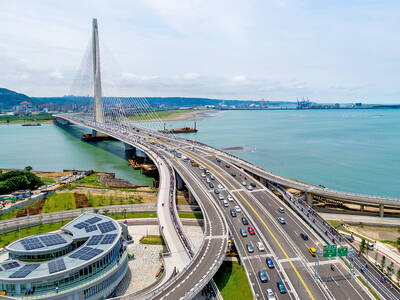
The Ministry of Transportation and Communications yesterday inaugurated the Danjiang Bridge across the Tamsui River in New Taipei City, saying that the structure would be an architectural icon and traffic artery for Taiwan. Feted as a major engineering achievement, the Danjiang Bridge is 920m long, 211m tall at the top of its pylon, and is the longest single-pylon asymmetric cable-stayed bridge in the world, the government’s Web site for the structure said. It was designed by late Iraqi-British architect Zaha Hadid. The structure, with a maximum deck of 70m, accommodates road and light rail traffic, and affords a 200m navigation channel for boats,
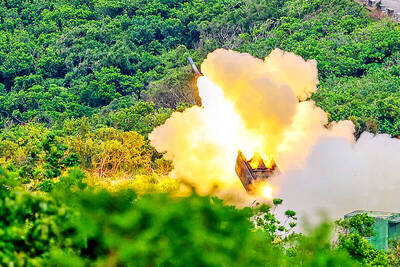
PRECISION STRIKES: The most significant reason to deploy HIMARS to outlying islands is to establish a ‘dead zone’ that the PLA would not dare enter, a source said A High Mobility Artillery Rocket System (HIMARS) would be deployed to Penghu County and Dongyin Island (東引) in Lienchiang County (Matsu) to force the Chinese military to retreat at least 100km from the coastline, a military source said yesterday. Taiwan has been procuring HIMARS and Army Tactical Missile Systems (ATACMS) from the US in batches. Once all batches have been delivered, Taiwan would possess 111 HIMARS units and 504 ATACMS, which have a range of 300km. Considering that “offense is the best defense,” the military plans to forward-deploy the systems to outlying islands such as Penghu and Dongyin so that

WHAT WAS ALL THAT FOR? Jaw Shaw-kong said that Cheng Li-wen had pushed for more drastic cuts and attacked him, just for the outcome to be nearly identical to his bill The legislature yesterday passed a supplementary budget bill to fund the purchase of separate packages of US military equipment, with the combined amount of spending capped at NT$780 billion (US$24.8 billion). The Chinese Nationalist Party (KMT) and Taiwan People’s Party (TPP) used their legislative majority to pass the bill, which runs until 2033 and has two main funding provisions. One was for NT$300 billion of arms sales already approved by the US for Taiwan on Dec. 17 last year, the other was for NT$480 billion for another arms package expected to be announced by Washington. The bill, which fell short of the NT$1.25

‘CLEAR MESSAGE’: The bill would set up an interagency ‘tiger team’ to review sanctions tools and other economic options to help deter any Chinese aggression toward Taiwan US Representative Young Kim has introduced a bill to deter Chinese aggression against Taiwan, calling for an interagency “tiger team” to preplan coordinated sanctions and economic measures in response to possible Chinese military or political action against Taiwan. “[Chinese President] Xi Jinping [習近平] has directed the People’s Liberation Army to be ready to invade Taiwan by 2027. China has a plan. America should have one too,” Kim said in a news release on Thursday last week. She introduced the “Deter PRC [People’s Republic of China] aggression against Taiwan act” to “ensure the US has a coordinated sanctions strategy ready should


 RSS
RSS