


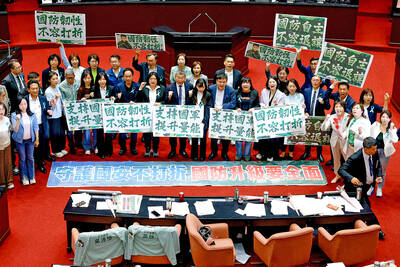
Lawyers, student leaders and a legislator yesterday accused law-enforcement agencies, including prosecutors and the police, of abusing their powers and intimidation for summoning and questioning hundreds of Sunflower movement participants since the movement’s protests ended on April 10.
More than 400 people have been questioned or investigated by the prosecutors and the police, who obtained the protesters’ personal and medical information — sometimes illegally — since the three-week-long occupation of the Legislative Yuan’s main chamber, they said.
“There are people who were simply sitting outside the Executive Yuan [during the storming] being investigated, and some students have been summoned for questioning just because they left their contact numbers when accompanying their friends to a hospital,” Democratic Front Against Cross-strait Trade in Services Agreement convener Lai Chung-chiang (賴中強) told a press conference at the Legislative Yuan.
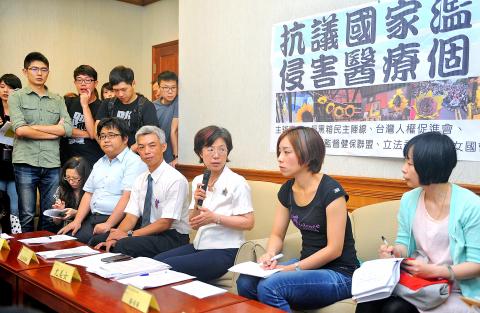
Photo: Liao Chen-huei, Taipei Times
Lee Chun-ta (李俊達), a representative from the student group Democracy Tautin, and Black Island Nation Youth Front spokesperson Huang Yu-Fen (黃郁芬) criticized Taipei hospitals for providing visit records to authorities. They accused the hospitals of flouting medical ethics and said that the hospitals had become the authorities’ stooges.
“Hospitals are supposed to be a place where lives are saved and injuries attended to, but now they have become the abettor of the authorities’ persecution as people are being hunted down by the state power for visiting a medical facility,” Huang said.
However, Lee Wui-chiang (李偉強), head of the Ministry of Health and Welfare’s Department of Medical Affairs, denied that hospitals had turned over personal information about patients to the police, adding that the ministry had confirmed and reconfirmed with hospital officials that such details had not been given out.
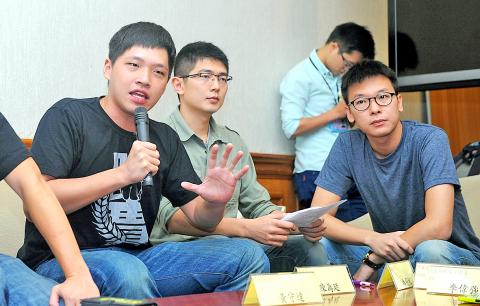
Photo: Liao Chen-huei, Taipei Times
Democratic Progressive Party Legislator Yu Mei-nu (尤美女) said she wanted to know why, “if the police could identify participants involved in the movement so easily, without help from the hospitals, those police officers who wielded batons against protesters have been so difficult to find?”
A National Fire Agency official said the Taipei City Fire Department did hand over information on 36 people, out of the 42 requests that it received from the Taipei City Police Department.
“They were all processed as confidential documents,” he said.
Attorney Liu Chi-wei (劉繼蔚) said the Emergency Medical Services Act (緊急救護法) prohibits the disclosure, without permission, of “information, known or held from performing … duties.”
“Officials have not been held politically accountable for the state violence committed, while people are now intimidated by the state power… The laws are simply tools and toys for the Chinese Nationalist Party [KMT] government to play with,” said Dennis Wei (魏揚), a key figure in the Sunflower movement.
Lin Fei-fan (林飛帆), another student leader, said prosecutors are going beyond the call of duty as part of the government’s intimidation measures against those who “dare to express their dissent against the establishment.”
Student leader Chen Wei-ting (陳為廷) questioned the need to interrogate hundreds of people when the main actors of the movement have already, on their own initiative, offered to help prosecutors and police clarify what occurred during the protests.
“President Ma Ying-jeou (馬英九) said on June 4, commemorating the Tiananmen Square Massacre, that he hopes ‘democracy and rule of law could one day become the common language of the two sides of the [Taiwan] Strait.’ Ma is truly working toward that goal, since now we are getting closer to China’s standard [of repression],” Chen said.
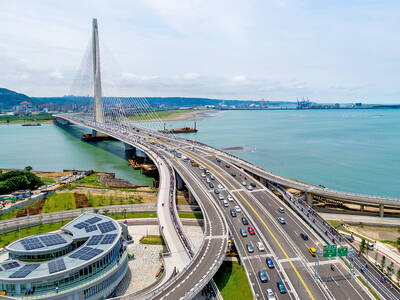
The Ministry of Transportation and Communications yesterday inaugurated the Danjiang Bridge across the Tamsui River in New Taipei City, saying that the structure would be an architectural icon and traffic artery for Taiwan. Feted as a major engineering achievement, the Danjiang Bridge is 920m long, 211m tall at the top of its pylon, and is the longest single-pylon asymmetric cable-stayed bridge in the world, the government’s Web site for the structure said. It was designed by late Iraqi-British architect Zaha Hadid. The structure, with a maximum deck of 70m, accommodates road and light rail traffic, and affords a 200m navigation channel for boats,
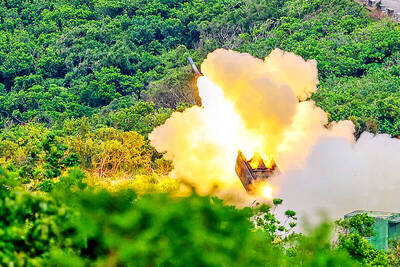
PRECISION STRIKES: The most significant reason to deploy HIMARS to outlying islands is to establish a ‘dead zone’ that the PLA would not dare enter, a source said A High Mobility Artillery Rocket System (HIMARS) would be deployed to Penghu County and Dongyin Island (東引) in Lienchiang County (Matsu) to force the Chinese military to retreat at least 100km from the coastline, a military source said yesterday. Taiwan has been procuring HIMARS and Army Tactical Missile Systems (ATACMS) from the US in batches. Once all batches have been delivered, Taiwan would possess 111 HIMARS units and 504 ATACMS, which have a range of 300km. Considering that “offense is the best defense,” the military plans to forward-deploy the systems to outlying islands such as Penghu and Dongyin so that
WHAT WAS ALL THAT FOR? Jaw Shaw-kong said that Cheng Li-wen had pushed for more drastic cuts and attacked him, just for the outcome to be nearly identical to his bill The legislature yesterday passed a supplementary budget bill to fund the purchase of separate packages of US military equipment, with the combined amount of spending capped at NT$780 billion (US$24.8 billion). The Chinese Nationalist Party (KMT) and Taiwan People’s Party (TPP) used their legislative majority to pass the bill, which runs until 2033 and has two main funding provisions. One was for NT$300 billion of arms sales already approved by the US for Taiwan on Dec. 17 last year, the other was for NT$480 billion for another arms package expected to be announced by Washington. The bill, which fell short of the NT$1.25
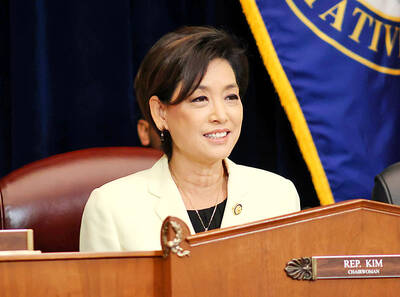
‘CLEAR MESSAGE’: The bill would set up an interagency ‘tiger team’ to review sanctions tools and other economic options to help deter any Chinese aggression toward Taiwan US Representative Young Kim has introduced a bill to deter Chinese aggression against Taiwan, calling for an interagency “tiger team” to preplan coordinated sanctions and economic measures in response to possible Chinese military or political action against Taiwan. “[Chinese President] Xi Jinping [習近平] has directed the People’s Liberation Army to be ready to invade Taiwan by 2027. China has a plan. America should have one too,” Kim said in a news release on Thursday last week. She introduced the “Deter PRC [People’s Republic of China] aggression against Taiwan act” to “ensure the US has a coordinated sanctions strategy ready should


 RSS
RSS